

A Practical Guide to Choosing the Right HVAC for Heat-Dome Summers
Why Heat-Dome Summers Are Changing the HVAC Systems Eatonville Homeowners Need How the transition from mild to heat-dome summers affects which HVAC system is right for your home is one of the most important questions Pac
Why Heat-Dome Summers Are Changing the HVAC Systems Eatonville Homeowners Need
How the transition from mild to heat-dome summers affects which HVAC system is right for your home is one of the most important questions Pacific Northwest homeowners are asking right now — and the answer has changed a lot in just a few years.
Here's a quick breakdown of what that transition means for your cooling system:
Not long ago, a mild Pacific Northwest summer meant most homes in and around Eatonville could get by with a basic cooling setup — or nothing at all. That's no longer the reality. Heat domes are trapping high-pressure air over Washington State for days at a time, pushing temperatures into dangerous territory and straining both home infrastructure and the regional energy grid. During a single heat event in Sacramento, SMUD recorded peak demand of 3,847 megawatts — roughly 40% above average summer demand. Similar stress is landing on utilities across the Pacific Northwest.
The system that kept your home comfortable five years ago may not be built for what summers look like in 2026. And choosing the wrong replacement can mean higher energy bills, uneven cooling, and a unit that burns out before its time.
My name is Matthew Percy, and as the owner of Eatonville Heating & Cooling, I've seen how how the transition from mild to heat-dome summers affects which HVAC system is right for your home has shifted the conversations I have with South Sound homeowners every single week. In this guide, I'll walk you through exactly what to look for — and what to avoid — when choosing a system built for today's summers.
How the transition from mild to heat-dome summers affects which HVAC system is right for your home
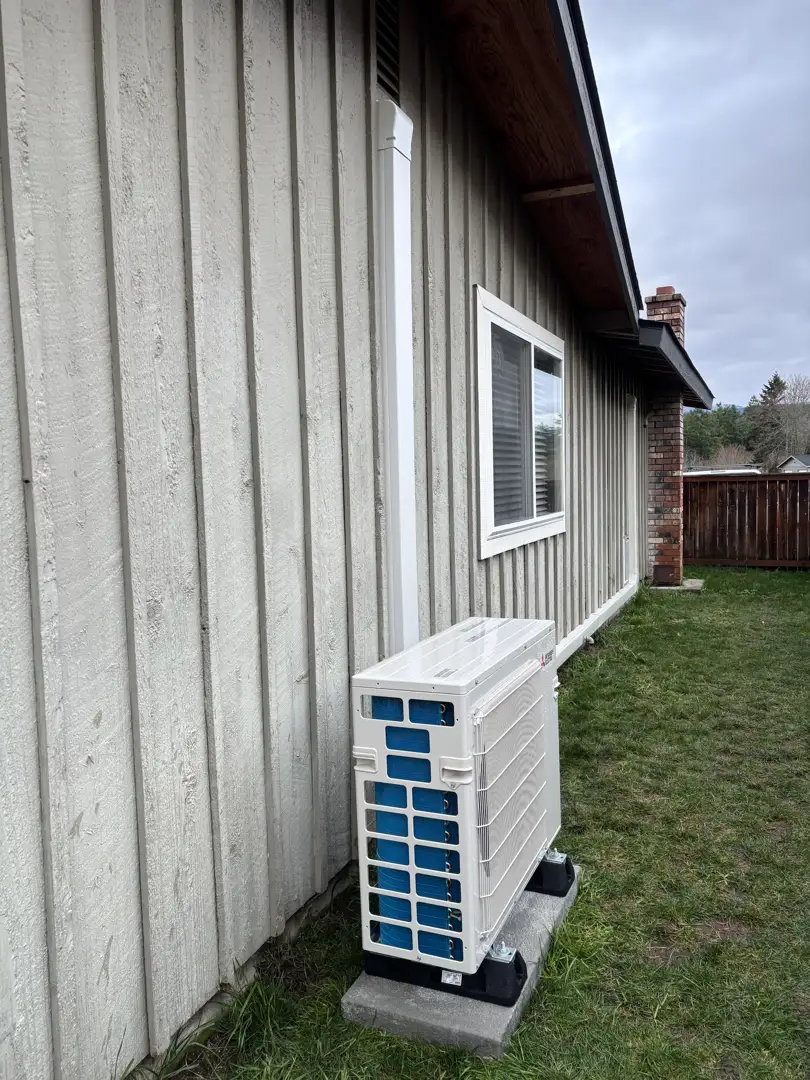
When we talk about heat domes, we aren't just talking about a couple of "hot days." We are talking about a massive high-pressure system that parks itself over the region, acting like a lid on a pot, trapping heat and preventing the usual evening cool-down we rely on in Washington. In recent years, these events have affected over 170 million Americans in a single week. For us in the South Sound, this means our HVAC systems are being asked to do something they were never originally designed for: run at maximum capacity for 72 to 100 hours straight.
Historically, air conditioning was a luxury here. Today, it is becoming a health and safety necessity. But it comes with a cost. Globally, air conditioning accounts for about 7% of electricity use and contributes to 3% of carbon emissions. In 2022 alone, cooling-related electricity produced 1 billion metric tons of CO2. As we transition to these more intense summers, the "right" system is no longer just the one that blows cold air—it’s the one that does so with extreme efficiency to protect your wallet and the local grid.
For many of our neighbors, the answer is a modern heat pump. If you are curious about how these systems are installed to handle our specific local conditions, check out our Heat Pump Installation Guide.
Local climate shifts: How the transition from mild to heat-dome summers affects which HVAC system is right for your home in Pierce County
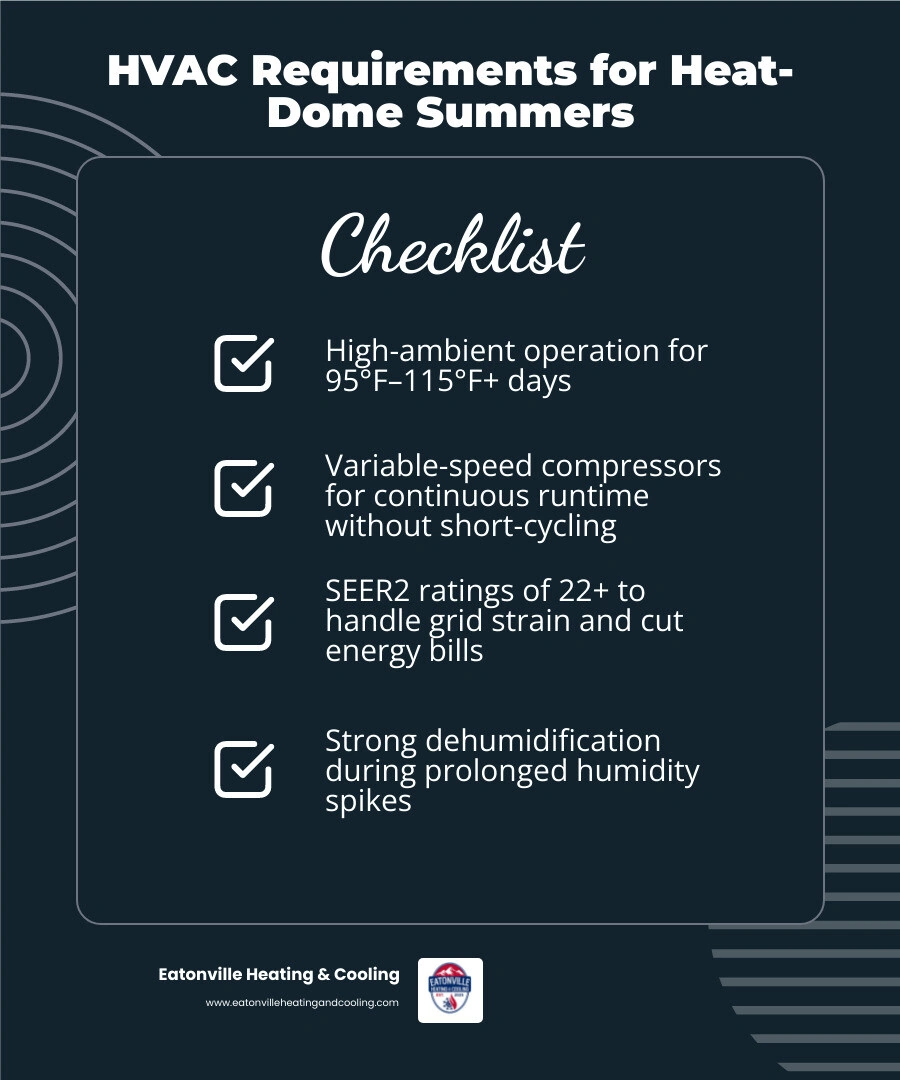
In Pierce County, we used to enjoy "maritime" summers—dry, mid-70s, with a crisp breeze off the water. Now, we are seeing 110°F and 115°F peaks that rival the desert southwest, but with one major difference: humidity. When a heat dome hits the South Sound, moisture from the Sound and the Pacific can get trapped under that "lid," making 95°F feel like 105°F.
This shift means that how the transition from mild to heat-dome summers affects which HVAC system is right for your home depends heavily on the system's ability to dehumidify. Traditional single-stage AC units are like a light switch—they are either 100% on or 100% off. In a heat dome, they often cycle on and off too quickly (short-cycling), failing to remove the moisture from the air and leaving your home feeling like a swampy basement.
Whether you are in Tacoma or Graham, you need a system that can handle these dramatic temperature swings. We’ve spent years refining our approach to these local shifts; you can learn more about our specific services in our Best Heat Pump Service in Tacoma guide.
Efficiency ratings: How the transition from mild to heat-dome summers affects which HVAC system is right for your home’s energy bills
In May 2026, energy prices are a primary concern for every homeowner we visit. This is where SEER2 (Seasonal Energy Efficiency Ratio 2) ratings become your best friend. As of 2023, the federal minimum SEER2 for northern states is 14.3. However, for a heat-dome summer, a minimum-efficiency unit is going to struggle.
Consider this: upgrading from an old 14 SEER unit to a modern 22 SEER2 system in a 2,000-square-foot home can save you between $400 and $700 per year in electricity costs. When the heat dome hits and your system is running 24/7, those savings multiply. High-efficiency systems don't just save money; they also put less strain on the Eatonville and Puyallup power grids, reducing the risk of brownouts during peak demand. For more details on maintaining these high-efficiency units, see our Heat Pump Service Guide Puyallup.
Comparing HVAC Performance: Which Systems Handle 110°F+ Best?
Not all cooling systems are created equal when the mercury crosses the 110°F mark. Here is how the most common options stack up:
Central AC (Single-Stage)Air-Source Heat PumpDuctless Mini-SplitEvaporative CoolerThe clear winners for our region are systems equipped with variable-speed compressors or inverter technology. Unlike traditional units, these systems can adjust their output in tiny increments. If your home only needs 30% of the system's cooling power to maintain 72°F, it will run at 30%. This prevents the constant "on-off" cycle that wastes energy and wears out parts. If you're in the state capital looking for expert advice, our Best Heat Pump Service in Olympia covers these comparisons in even more depth.
The Advantage of Inverter-Driven Systems
We like to use the "dimmer switch" analogy. A standard AC is like a light switch—it’s either blindingly bright or pitch black. An inverter-driven system is like a dimmer switch—it provides exactly the amount of "light" (cooling) you need at any given moment.
During a heat dome, this is a game-changer. These systems can actually deliver above their rated capacity for short periods. This is vital for "recovery periods"—like when you come home from work and want to drop the temperature a few degrees quickly. Because they run for longer cycles at lower speeds, they are also world-class at pulling humidity out of the air, which is essential for comfort in places like Lacey and Steilacoom.
Why Home Infrastructure Matters as Much as the HVAC Unit
You could buy the most expensive, high-tech HVAC system in the world, but if your home is "leaking" cold air, you're essentially trying to cool the entire neighborhood. Data shows that 90% of U.S. homes are under-insulated. In Washington, many older homes in Tacoma and Puyallup were built with R-19 attic insulation, which was fine for mild 1980s summers but is woefully inadequate for a 2026 heat dome.
Upgrading your attic insulation from R-19 to R-49 can reduce your cooling load by 15% to 25%. Furthermore, air leaks around windows, doors, and rim joists can cause 15% to 45% energy waste. When we evaluate how the transition from mild to heat-dome summers affects which HVAC system is right for your home, we always look at the "envelope" first. If your system is struggling, it might not be a mechanical failure; it might be an insulation failure. If you're experiencing issues, our Best Heat Pump Repair in Puyallup team can help diagnose whether it's the unit or the house.
Sizing and Maintenance for Extreme Reliability
"Bigger is better" is a dangerous myth in the HVAC world. If a system is oversized, it will cool the house so fast that it shuts off before it can dehumidify, leaving you with a "cold and clammy" home. If it's undersized, it will run forever and never reach the set point, eventually burning out the compressor.
We use Manual J calculations to determine the exact size your home needs, taking into account your square footage, window orientation, and insulation levels. Once the right system is in place, maintenance is non-negotiable. A simple coil cleaning or filter change can boost efficiency by up to 20%. During a heat dome, a dirty filter is the number one cause of system "freeze-ups." For those in Thurston County, we have an Affordable Heat Pump Repair Guide Olympia that highlights how to keep your system running without breaking the bank.
Strategic Cooling: Staying Comfortable During a 2026 Heatwave
How you use your system is just as important as which system you choose. The Department of Energy recommends setting your thermostat to 78°F when you are home. We know that sounds high to some, but raising your thermostat from 72°F to 78°F can save you 10% to 15% on cooling costs.
One of the best strategies for a heat dome is pre-cooling. This involves dropping your thermostat 4 to 6 degrees early in the morning (between 4:00 AM and 8:00 AM) when the air outside is cool and electricity demand is low. This "charges" the thermal mass of your home—the walls, furniture, and floors—with cold. When the afternoon sun hits, your HVAC system won't have to work nearly as hard to maintain comfort. This is especially effective for homes with high-efficiency heat pumps. For more on maximizing these systems, see our Ultimate Heating Installation Guide Tacoma.
Supplemental Cooling and Passive Shading
Don't underestimate the power of low-tech solutions to help your high-tech HVAC.
• Ceiling Fans: Ensure they are rotating counterclockwise. This creates a downdraft that provides a "wind chill" effect, allowing you to feel comfortable even if the thermostat is set a few degrees higher.
• Window Treatments: Closing blinds or using reflective curtains on south and west-facing windows can reduce your cooling load by up to 35%.
• Architectural Shading: Planting deciduous trees or installing awnings can block the sun in the summer while still allowing heat in during the winter.
Frequently Asked Questions About Heat-Dome Cooling
Do heat pumps actually work when it hits 115°F?
Yes! While older models used to struggle once temperatures rose above 95°F, modern air-source heat pumps are designed to operate efficiently up to 115°F or even 120°F. Because they transfer heat rather than generating cold, they remain the most efficient option available. In extreme heat, they simply work a bit harder, but they are far more resilient than traditional central AC units.
Is it better to leave the AC on all day or turn it off when I leave?
During a heat dome, it is almost always better to leave it on, but at a higher setting (around 82°F–85°F). If you turn the system completely off, the humidity and heat build-up in your walls and furniture will be so intense that your system may take 8 to 10 hours to recover once you turn it back on. This puts massive strain on the compressor and can lead to mold growth in humid conditions. A smart thermostat can automate this for you, ensuring you never come home to an oven.
Why is my AC running constantly but the house is still warm?
This is a common "heat dome" complaint. It usually points to one of three things:
1. Undersized Unit: The system simply doesn't have the "oomph" to overcome the heat gain of the house.
2. Duct Losses: You might be losing 20% to 30% of your cold air into your attic or crawlspace through leaky ducts.
3. Insulation Gaps: Your home is losing its "cool" as fast as the AC can produce it. If your system is running non-stop but the temperature is climbing, it’s time for a professional inspection.
Conclusion
At Eatonville Heating & Cooling, we are a family-owned business that lives and works in the same communities you do—from Auburn and Bonney Lake to Spanaway and Yelm. We’ve watched the weather change over the decades, and we know that how the transition from mild to heat-dome summers affects which HVAC system is right for your home is a challenge we have to face together.
Choosing a system for 2026 isn't just about surviving the next heatwave; it's about building long-term climate resilience for your family. Whether you need a high-efficiency heat pump, a ductless mini-split for that stubborn upstairs bedroom, or just a professional tune-up to ensure your current system is ready for the "big one," we are here to help. We pride ourselves on quality, customer satisfaction, and the kind of local expertise you can only get from a neighbor.
Don't wait until the next heat dome is parked over the South Sound. Schedule your professional cooling consultation today and let’s make sure your home stays the sanctuary it’s meant to be.
Recent Posts

Adapting Yelm Wood-Framed Homes for Modern Central Air
Adding central air to an older wood-framed home takes careful planning. See how attic framing, ductwork and wiring shape a safe, effective upgrade.
Differentiating Between Normal Expansion Noises and Furnace Failure
Hearing a loud bang on the first chilly fall morning can be terrifying. Decide with confidence whether to let the system run or shut it down for emergency service.
How Federal Way's Fall Humidity Affects Indoor Air Quality
The transition to damp autumn weather creates a tricky shoulder season for your HVAC system. Without the AC running, ambient moisture gets trapped inside. See how to manage ventilation.
Deciding Between a Modulating and Two-Stage Furnace for Lacey Climates
Upgrading your heating system before the damp winter hits? Find out whether the precise comfort of a modulating unit or the reliability of a two-stage system fits your home.

What a Comprehensive Fall Furnace Inspection Actually Entails
A professional heating tune-up requires much more than a basic filter change. We pull back the curtain on the exact electrical and combustion tests that prevent winter breakdowns.
Repurposing Old AC Pads When Upgrading to a New Heat Pump
Preparing for a fall system upgrade? Reusing a sunken 1990s concrete base can cause poor drainage and oil starvation for modern equipment—see why leveling matters.