

How to Apply for a Puget Sound Energy Heat Pump Rebate
What South Sound Homeowners Need to Know About PSE Heat Pump Rebates If you're researching how to apply for a Puget Sound Energy rebate on a new heat pump in the South Sound , here's the quick answer: How to Ap
What South Sound Homeowners Need to Know About PSE Heat Pump Rebates
If you're researching how to apply for a Puget Sound Energy rebate on a new heat pump in the South Sound, here's the quick answer:
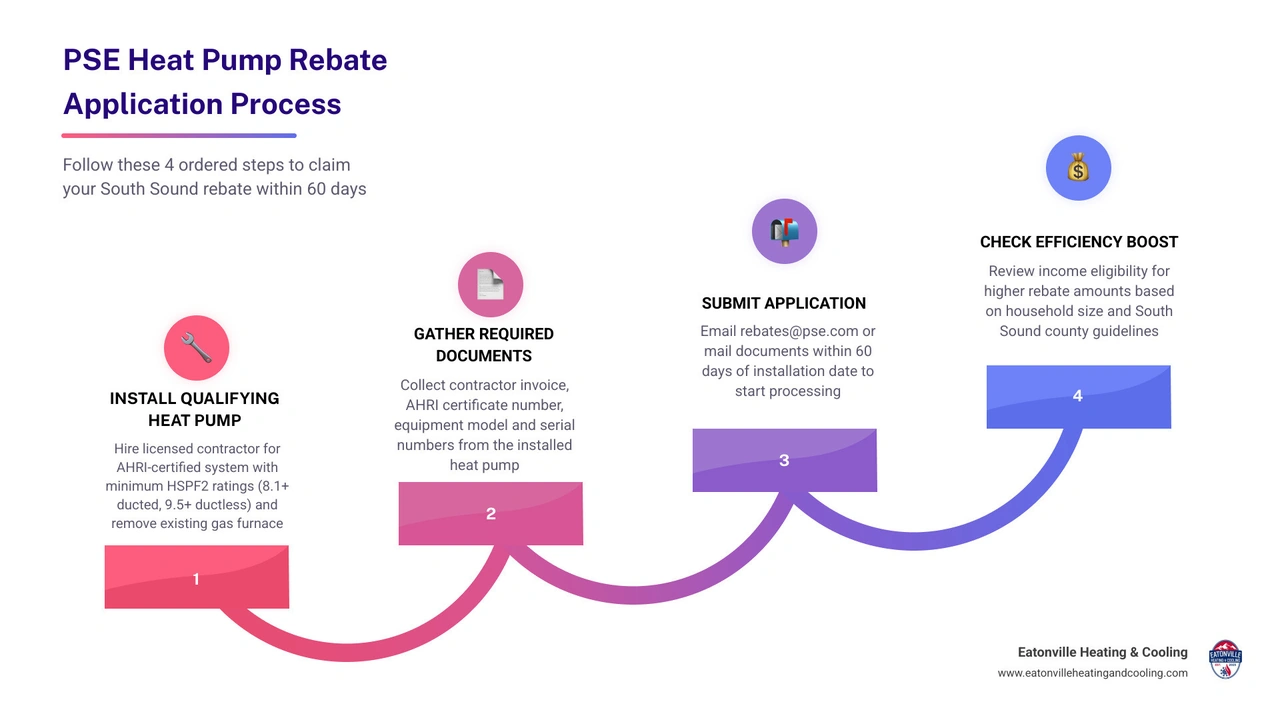
How to Apply for a PSE Heat Pump Rebate (Quick Steps)
1. Install a qualifying heat pump through a licensed contractor — it must be AHRI-certified and meet minimum HSPF2 ratings (8.1+ for ducted, 9.5+ for ductless)
2. Remove or decommission your existing gas furnace — keeping it as a backup disqualifies you
3. Collect your documents — contractor invoice, AHRI certificate number, and equipment model/serial numbers
4. Submit your application within 60 days of installation by emailing rebates@pse.com or mailing to PSE's rebate processing address
5. Check for Efficiency Boost eligibility — roughly half of PSE customers qualify for higher rebate amounts based on household income and county
Switching to a heat pump is one of the smartest energy upgrades a South Sound homeowner can make right now — and PSE makes it more affordable with rebates for qualifying systems. But the application process has specific rules around equipment specs, documentation, and deadlines that trip up a lot of homeowners. Miss a step, and you could lose out on significant savings.
I'm Matthew Percy, owner of Eatonville Heating & Cooling, and I've helped South Sound homeowners navigate exactly this process — from choosing the right qualifying equipment to making sure every document is in order before the 60-day window closes. In this guide, I'll walk you through everything you need to know about how to apply for a Puget Sound Energy rebate on a new heat pump in the South Sound, so you don't leave money on the table.
Understanding PSE Heat Pump Rebate Programs in the South Sound
Navigating utility incentives can feel like a full-time job. In the South Sound, Puget Sound Energy (PSE) offers some of the most robust incentives in Washington State to encourage homeowners to move away from fossil fuels. As of May 2026, the primary focus for PSE is the conversion of natural gas systems to high-efficiency electric heat pumps.
The rebate amounts are significant, typically ranging from $2,400 to $4,000 for a full system replacement. These incentives are specifically designed for dual-fuel customers—those who currently use PSE natural gas for heating and PSE electricity for their power needs. By making the switch, you aren't just changing your equipment; you're changing how your home interacts with energy.
To ensure you qualify, it is vital to start with a professional Heat Pump Installation. PSE requires that the system be installed in a single-family residence and that the existing gas furnace is completely removed or decommissioned. If you're looking for ways to make this upgrade even more affordable, we always recommend checking our Promotions page for additional local savings that can be paired with utility offers.
Qualifying System Types
Not every "heat pump" on the shelf qualifies for these top-tier rebates. PSE categorizes systems into several groups:
• Ducted Central Air Heat Pumps: These use your home's existing ductwork to distribute air.
• Ductless Mini-Split Systems: Perfect for homes without ducts or for specific room additions, these consist of an outdoor unit and one or more indoor heads.
• Air-Source Heat Pumps: These are the standard for our region, extracting heat from the outside air even in our chilly South Sound winters.
To keep these systems running at peak efficiency and maintain your eligibility for long-term support, regular Heat Pump Service is a must.
The Benefits of Switching from Gas
Why is PSE offering thousands of dollars to get you off gas? It comes down to carbon reduction and efficiency. Heat pumps move heat rather than creating it through combustion, which can be up to three times more efficient than a gas furnace.
For homeowners in Lacey or Tacoma, this means lower monthly bills and the added luxury of built-in air conditioning for our increasingly warm summers. When we perform a Heating Installation, we often see families amazed at how much more consistent their home temperature becomes, eliminating those stubborn "cold spots" in the back bedrooms.
How to Apply for Puget Sound Energy Rebate on a New Heat Pump in the South Sound
The application process is where the "rubber meets the road." The most important thing to remember is the 60-day deadline. From the day your new system is purchased or installed (depending on the specific program wording), you have exactly two months to get your paperwork to PSE.
First, you must ensure your contractor provides a detailed invoice. This isn't just a receipt; it needs to show the installation date, the full model numbers of the indoor and outdoor units, and the AHRI (Air-Conditioning, Heating, and Refrigeration Institute) certificate number. This certificate is the "gold standard" proof that your equipment meets the efficiency ratings PSE demands.
If the upfront cost of a high-efficiency system feels daunting, we offer Financing options to help bridge the gap while you wait for your rebate check to arrive in the mail.
Gathering Documentation for Your South Sound Heat Pump Rebate
Don't wait until the last minute to hunt down model numbers. Your contractor should provide these, but it’s always a good idea to double-check the data plates on the units themselves. You will need:
1. The Contractor’s Invoice: Must show "Paid in Full" or a financing agreement.
2. AHRI Certificate: This proves the SEER2 and HSPF2 ratings.
3. Model and Serial Numbers: For both the outdoor compressor and the indoor air handler or heads.
If you ever run into trouble with your system shortly after installation, don't panic—our team is available for Heat Pump Repair to ensure your system continues to meet the performance standards required by PSE.
Online vs. Mail-In: How to Apply for Puget Sound Energy Rebate on a New Heat Pump in the South Sound
You have two main paths for submission. The fastest method is emailing your completed rebate form and all attachments to rebates@pse.com. Alternatively, you can use the online portal if available for your specific rebate tier, or go the traditional route by mailing your packet to:PSE Rebates, P.O. Box 97034 BOT-02O, Bellevue, WA 98009-9734.
Processing timelines usually range from 6 to 10 weeks. During this time, PSE may contact you for a "post-installation verification" to ensure the unit was installed correctly. If you're upgrading an older home and need a Heating Service check-up before the winter hits, it’s best to schedule that early so your system is in top shape for any potential inspections.
Eligibility and Equipment Requirements for Maximum Savings
To get the full $2,400 to $4,000 rebate, your system must meet strict technical specifications. PSE uses the "HSPF2" and "SEER2" metrics, which are the updated Department of Energy standards for measuring heating and cooling efficiency.
In addition to these ratings, the system must be AHRI-certified and meet CEE (Council for Energy Efficiency) specifications. One "gotcha" for many homeowners is the gas decommissioning requirement. To qualify for the highest rebate tiers, you cannot keep your gas furnace as a "backup." The system must be fully electric, or use electric resistance heat as the secondary source.
Technical Specifications for South Sound Homeowners
Beyond the efficiency numbers, PSE requires an electric resistance lockout. This means your thermostat must be configured so that the "emergency" electric heat doesn't kick in until the outside temperature drops below a certain point (usually 5°F above the system's balance point). This ensures the heat pump does the heavy lifting, saving you the most money.
We specialize in these configurations during our Heat Pump Service calls, ensuring your sensors are placed correctly to satisfy PSE's requirements.
Property and Customer Qualifications
To be eligible for the standard residential rebates, you must:
• Be a current PSE residential customer (electric or dual-fuel).
• Live in a single-family residence (manufactured homes often qualify for even higher amounts—up to $4,000).
• Use the heat pump as your primary heating source.
• Not be a new construction project (rebates are for retrofitting existing homes).
Maximizing Your Investment with Efficiency Boost and Tax Credits
Did you know that approximately 50% of PSE customers qualify for even higher rebates? This is through the Efficiency Boost program. This program is designed for income-qualified households, providing an extra layer of savings that can make a high-end heat pump installation incredibly affordable.
For example, while a standard rebate might be $2,400, an Efficiency Boost customer might receive $4,000 for the exact same equipment. This is a game-changer for families in Graham or Spanaway who are looking to lower their long-term overhead. Check our Promotions page to see how we can help you navigate these enhanced programs.
How to Apply for Puget Sound Energy Rebate on a New Heat Pump in the South Sound with Efficiency Boost
The application for Efficiency Boost requires a bit more legwork. You'll need to provide:
• Household size (everyone living in the home).
• Gross monthly income for all adults.
• County of residence (Pierce, Thurston, and King counties have different income thresholds).
If you qualify, you'll fill out an additional form along with your standard rebate application. This ensures you get the "boosted" amount rather than the standard residential rate.
Stacking Incentives for Greater Savings
The best part about 2026 is the ability to "stack" incentives. On top of the PSE rebate, most high-efficiency heat pumps qualify for the Inflation Reduction Act (IRA) Federal Tax Credit, which can cover 30% of the project cost up to $2,000 annually.
When you combine a $4,000 PSE rebate with a $2,000 federal tax credit, the net cost of your system drops significantly. We also offer Financing to help manage the remaining balance, making it easier to invest in a Tier 3 or Tier 4 system that will save you more on your monthly bills for the next 15 years.
Frequently Asked Questions about South Sound Heat Pump Rebates
Can I keep my gas furnace as a backup?
Generally, no. For the primary PSE conversion rebates, the gas furnace must be removed or permanently decommissioned. PSE wants to see a total transition to electric heating. If you keep a "dual-fuel" setup (gas furnace + heat pump), the rebate amount is usually much lower or non-existent under the current 2026 guidelines.
How long does it take to receive the rebate check?
Once you've submitted your application to rebates@pse.com, it typically takes 6 to 10 weeks to receive your check. If there are errors in your paperwork—like a missing AHRI certificate—it can take longer, which is why working with an experienced contractor is so important.
Do I need to use a specific contractor for eligibility?
While you can technically use any licensed contractor, PSE highly recommends using a member of their Trade Ally Network. As a family-owned company deeply embedded in the South Sound, we stay up-to-date on all PSE requirements to ensure our customers' applications are approved the first time.
Conclusion
Applying for a Puget Sound Energy rebate doesn't have to be a headache. By following the 60-day rule, ensuring your equipment meets the HSPF2 8.1+ or 9.5+ standards, and checking your eligibility for Efficiency Boost, you can save thousands on a system that will keep your home comfortable for decades.
At Eatonville Heating & Cooling, we take pride in being your local South Sound experts. Whether you're in Puyallup, Olympia, or right here in Eatonville, our family-owned team is dedicated to providing quality service and helping you maximize every available incentive. We don't just install equipment; we help you build a more efficient, comfortable home.
Ready to make the switch? Schedule your heat pump service in Federal Way or any of our surrounding service areas today and let us help you navigate the rebate process from start to finish!
Recent Posts

Adapting Yelm Wood-Framed Homes for Modern Central Air
Adding central air to an older wood-framed home takes careful planning. See how attic framing, ductwork and wiring shape a safe, effective upgrade.
Differentiating Between Normal Expansion Noises and Furnace Failure
Hearing a loud bang on the first chilly fall morning can be terrifying. Decide with confidence whether to let the system run or shut it down for emergency service.
How Federal Way's Fall Humidity Affects Indoor Air Quality
The transition to damp autumn weather creates a tricky shoulder season for your HVAC system. Without the AC running, ambient moisture gets trapped inside. See how to manage ventilation.
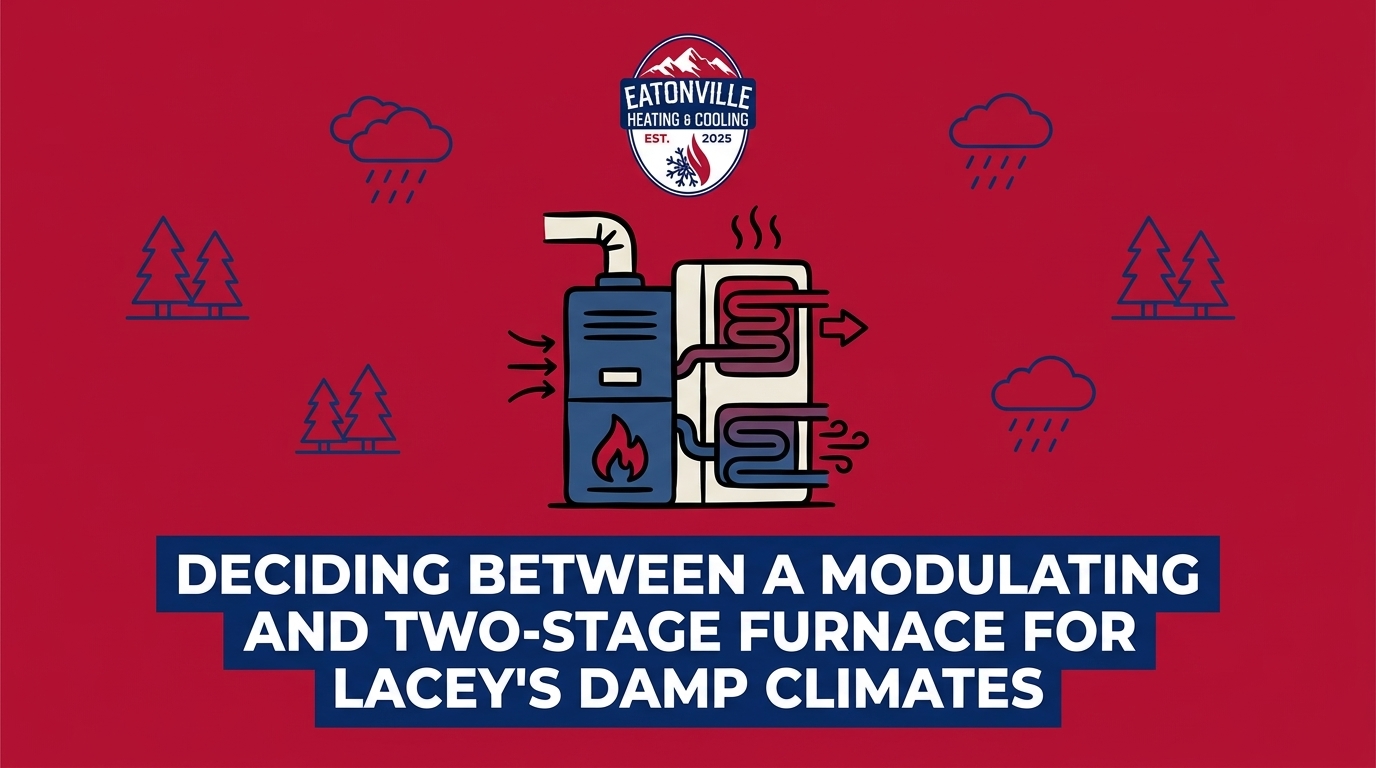
Deciding Between a Modulating and Two-Stage Furnace for Lacey Climates
Upgrading your heating system before the damp winter hits? Find out whether the precise comfort of a modulating unit or the reliability of a two-stage system fits your home.
What a Comprehensive Fall Furnace Inspection Actually Entails
A professional heating tune-up requires much more than a basic filter change. We pull back the curtain on the exact electrical and combustion tests that prevent winter breakdowns.
Repurposing Old AC Pads When Upgrading to a New Heat Pump
Preparing for a fall system upgrade? Reusing a sunken 1990s concrete base can cause poor drainage and oil starvation for modern equipment—see why leveling matters.