


Differentiating Between Normal Expansion Noises and Furnace Failure
Hearing a loud bang on the first chilly fall morning can be terrifying. Decide with confidence whether to let the system run or shut it down for emergency service.
Startling Sounds on the First Frost: Is Your Heating System Safe?
You turn on the thermostat, wait a few moments, and suddenly hear a loud, startling noise echoing through the house. Differentiating between normal expansion noises and furnace failure is one of the most critical steps you can take during that first chilly fall morning temperature drop. At Eatonville Heating & Cooling, our dispatch center fields dozens of calls every September from homeowners startled by these exact sounds. That unexpected pop or bang can instantly create anxiety, leaving you wondering if your equipment is safe to operate or if it poses an immediate hazard to your home. Acoustic troubleshooting is the very first step in diagnosing the health of your heating equipment. By paying close attention to the type, location, and timing of the sound, you can make an informed decision about whether to let the system run or shut it down immediately.
If you are unsure about the safety of your equipment, it is always best to have professional heating systems evaluated by an expert who handles furnace repair.
The Anxiety of the First Startup
After sitting idle for months, your heating equipment undergoes a significant physical transition when it fires up for the first time. The sudden introduction of heat into a cold environment naturally causes materials to react. However, because gas appliances rely on controlled combustion, any unusual sound naturally triggers a safety concern. In our experience, homeowners often find themselves standing near the vents, listening intently, trying to determine if the noise they just heard was a harmless structural adjustment or a warning sign of a dangerous gas issue. Understanding the difference between these two categories of sound empowers you to protect your home without panicking over normal mechanical processes.
The Science of Thermal Expansion: Why Cold Ductwork Pops
To understand why your vents might sound like they are tapping or cracking, you have to look at the physical properties of the materials hidden behind your walls. Thermal expansion is a basic scientific principle that dictates how materials change shape, area, and volume in response to a change in temperature. In residential HVAC applications, your ductwork is primarily constructed from thin sheet metal. This metal is highly conductive and reacts rapidly to temperature fluctuations.
Here in Eatonville WA, our early fall temperature drops create cold, ambient conditions in crawlspaces, basements, and attics. In our years of inspecting local homes, we see firsthand how the sheet metal ductwork running through these unconditioned spaces becomes thoroughly chilled overnight. When your thermostat calls for heat, the furnace suddenly blasts air heated to over 120 degrees Fahrenheit directly into these cold metal channels. This extreme and sudden temperature differential causes the sheet metal to physically expand.
How Metal Reacts to Sudden Heat
As the metal walls of the ductwork heat up and expand, they push against the joints, hangers, and fasteners holding them in place. This physical movement creates a distinct auditory signature. You will typically hear ticking, pinging, light popping, or creaking sounds. Because the air travels throughout the entire house, our technicians often remind customers that these noises originate in the ductwork itself rather than inside the main furnace unit. The sound might seem to travel along the ceiling or floorboards as the warm air reaches different sections of the house.
It is important to emphasize that this is a completely normal physical reaction. The metal is simply adjusting to the rapid 70-degree temperature shift. The ticking and popping will usually subside after the first few minutes of the heating cycle once the metal reaches a stable operating temperature. This harmless expansion does not require emergency intervention, and it does not indicate that your equipment is failing or operating unsafely.
Delayed Gas Ignition: Recognizing the Sound of Furnace Failure
While thermal expansion is harmless, our repair crews know that other noises demand immediate attention. One of the most serious safety hazards our technicians encounter in a residential heating system is a condition known as delayed gas ignition. This occurs when the combustion process inside the unit does not sequence correctly, leading to a dangerous buildup of combustible fuel.
During a normal heating cycle, the gas valve opens, and the igniter or pilot light immediately ignites the fuel, creating a smooth, steady flame. However, if the igniter is weak, misaligned, or coated in debris from the long off-season, it may struggle to light the gas right away. Because the gas valve remains open, raw fuel continues to pool inside the enclosed combustion chamber. When the igniter finally manages to spark, it ignites a much larger volume of gas all at once.
The Auditory Signature of a Miniature Boom
The resulting sound is unmistakable. Instead of a light metallic ticking, delayed ignition sounds like a loud boom, a heavy bang, or a deep thump. In severe cases, the force of the ignition can cause the entire metal cabinet of the unit to physically shake or rattle. This is essentially a miniature combustible explosion happening inside your equipment.
This violent force is highly destructive. Repeated delayed ignition events put immense stress on the heat exchanger—the critical metal shield that separates the toxic combustion gases from the breathable air circulating into your home. Over time, these small explosions can cause the heat exchanger to crack, potentially allowing carbon monoxide to leak into your living spaces. If you suspect this is happening and your furnace is making a strange noise, it is critical to take action. Our team typically sees this issue peak during the September pre-heating season when dust has settled over the internal components.
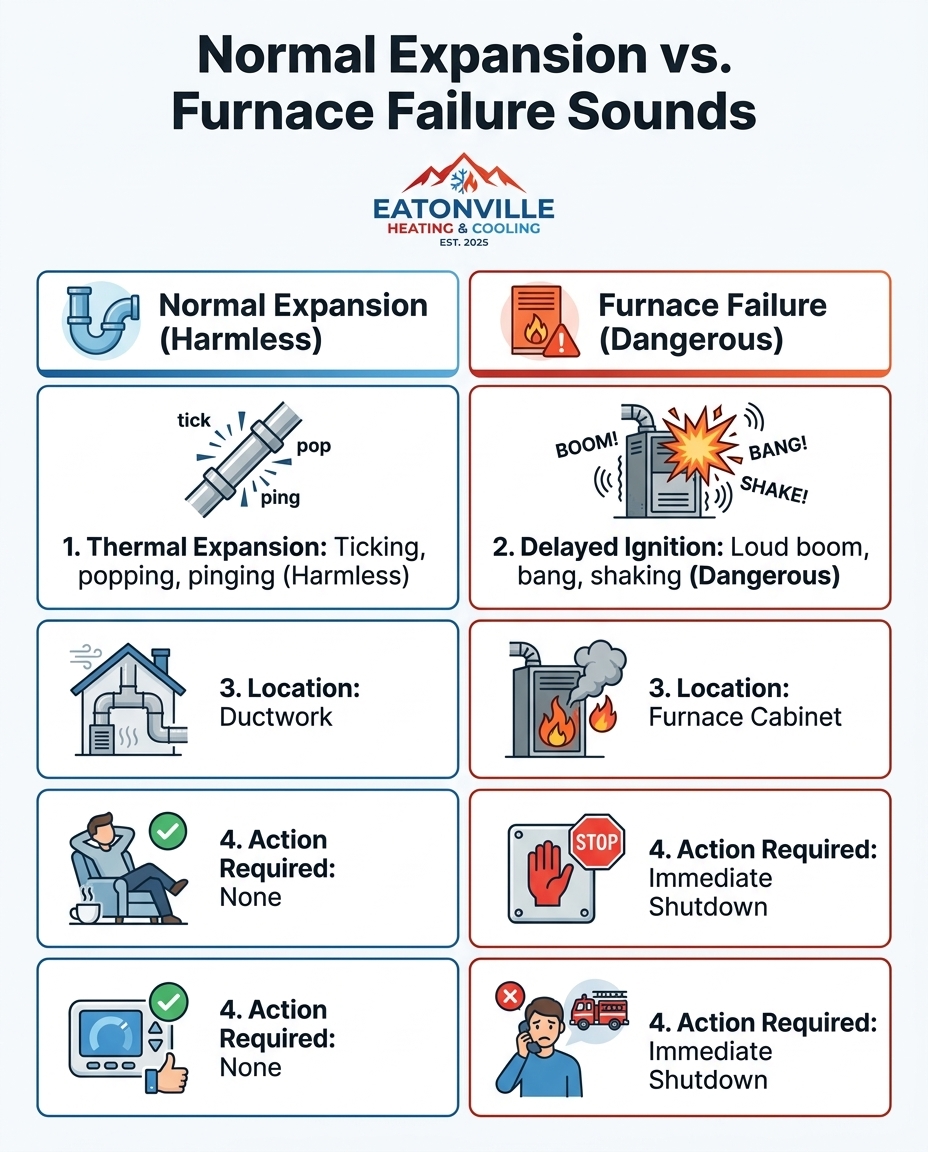
Auditory Guide: Normal Expansion Noises vs. Furnace Failure
Knowing exactly what to listen for can save you from unnecessary stress while ensuring you catch real hazards before they escalate. At Eatonville Heating & Cooling, we believe in providing honest diagnostics to our community. Our goal is to empower homeowners to identify real hazards without paying for unnecessary emergency calls for normal, harmless system sounds. If your system is just stretching its metal legs, you should know that you are safe. If it is struggling to ignite, you need to know exactly how that sounds.
• Sound Type — Normal Thermal Expansion: Ticking, light popping, pinging, creaking — Dangerous Delayed Ignition: Loud booming, gunshot-like bangs, heavy shaking
• Location — Normal Thermal Expansion: Vents, floors, ceilings (along the ductwork) — Dangerous Delayed Ignition: Inside the basement or utility closet (at the unit)
• Timing — Normal Thermal Expansion: Gradual, occurring as warm air begins to flow — Dangerous Delayed Ignition: Sudden, happening exactly when the burners attempt to light
• Physical Effect — Normal Thermal Expansion: None; purely auditory — Dangerous Delayed Ignition: May cause the metal cabinet to rattle or shake visibly
• Action Required — Normal Thermal Expansion: None; system is safe to operate — Dangerous Delayed Ignition: Immediate shutdown and professional inspection
Immediate Steps to Take If You Hear a Loud Furnace Bang
If you hear a loud boom or bang coming directly from the main unit when it tries to start, our team strongly advises you to treat the situation as a safety hazard. Do not wait to see if the sound goes away on the next cycle. Delayed ignition will not fix itself, and allowing the system to continue running puts your heat exchanger and your home at risk.
1. Step 1: Turn the thermostat off immediately. Walk to your thermostat and switch it from "Heat" to the "Off" position. This stops the control board from calling for more heat and prevents the gas valve from opening again.
2. Step 2: Locate and turn off the gas supply valve. Find the gas pipe running into the side or bottom of your unit. There should be a manual shutoff valve on this pipe. Turn the valve so that the handle is perpendicular (at a 90-degree angle) to the pipe, which cuts off the fuel supply entirely.
3. Step 3: Do not attempt to open the combustion chamber. Never try to clean the burners, adjust the igniter, or inspect the gas manifold yourself. Gas appliances require specialized tools and training to service safely. Tampering with these components without a license can lead to severe safety hazards.
4. Step 4: Contact a qualified local technician. Reach out to a professional who can safely diagnose the ignition failure. One local homeowner experienced a sudden system failure last summer when their A/C went out; our team showed up right away and identified the issue. That same level of urgent diagnostic response is exactly what we provide when dealing with a potential gas accumulation problem.
By following these strict safety guidelines, you eliminate the immediate risk and prepare the equipment for proper heating repair in Eatonville.
Preventing Ignition Issues Before the Cold Sets In
The vast majority of delayed ignition problems are entirely preventable. In fact, a pattern we see often is that they are almost always the result of seasonal neglect. When your heating equipment sits completely idle from spring through late summer, the internal components become a magnet for airborne particles. Dust, pet dander, lint, and even small household debris settle over the burner ribbons and the surface of the igniter.
During the September pre-heating season, our tune-up appointments frequently uncover this accumulated debris acting as an insulating barrier. When the thermostat calls for heat, the igniter struggles to generate enough uninterrupted heat to light the gas instantly. The gas pools behind the dust barrier until it finally finds a spark, resulting in the dangerous boom described earlier. Proactive care is the only way to prevent this buildup from threatening your system's safety.
The Value of Proactive Cleaning
Addressing minor wear and tear in the early fall prevents major component failure later in the winter. A professional inspection ensures that every part of the combustion process is clean, aligned, and functioning safely. A comprehensive pre-season checklist performed by our technicians typically includes:
• Burner cleaning: Removing all dust and soot from the burner assembly to ensure a smooth, even flame.
• Igniter inspection: Testing the hot surface igniter or pilot assembly for proper resistance and rapid response.
• Flame sensor polishing: Cleaning the sensor rod so the system can accurately detect when a safe flame is present.
• Gas pressure testing: Verifying that the manifold pressure matches the manufacturer's precise specifications.
By scheduling routine furnace maintenance before you rely on the system daily, you can enjoy peace of mind knowing that your equipment will operate quietly and safely all season long.
Frequently Asked Questions About Furnace Acoustics and Safety
Understanding the nuances of your HVAC system's acoustics can be challenging. Below, our experts address some of the most common questions Eatonville homeowners have when trying to decode the noises their equipment makes during operation.
Why does my furnace make a loud boom when it turns on?
A loud boom when the system turns on is almost always caused by delayed gas ignition. This happens when the burners are dirty or the igniter is failing, causing raw gas to build up inside the combustion chamber. When the gas finally ignites, it creates a small, forceful explosion that sounds like a boom or a bang. This is a serious safety hazard that requires you to shut the system down immediately. Allowing it to continue running can cause severe damage to the internal components and compromise the safety of your home.
Is it normal for heating ducts to pop?
Yes, it is completely normal for heating ducts to pop, ping, or tick when the warm air first begins to flow. This is caused by thermal expansion, a natural physical reaction where the cold sheet metal expands as it rapidly absorbs heat from the furnace. Thinner sheet metal or uninsulated ducts tend to pop more frequently and loudly because they experience sharper temperature swings. While the sound can be mildly annoying, it is harmless and does not indicate a mechanical failure.
What does delayed ignition sound like?
Delayed ignition sounds like a muffled explosion, a loud gunshot-like bang, or a heavy thump coming directly from the main cabinet of the unit. Unlike the light ticking of ductwork, this sound is forceful and sudden, occurring right at the moment the system attempts to light the burners. It is often accompanied by a physical vibration or rattling of the metal access panels. If you hear this specific auditory signature, it means gas is pooling dangerously before igniting.
Can a cracked heat exchanger cause banging noises?
While a cracked heat exchanger is one of the most dangerous conditions a heating system can develop, it typically does not cause a loud initial boom on its own. Instead, a cracked heat exchanger might cause rattling sounds as the blower motor forces air through the crack, or it might cause visible changes in the burner flame, making it dance or turn yellow. However, repeated banging from delayed ignition is often the primary cause of a cracked heat exchanger, as the force of the miniature explosions weakens the metal over time.
When should I worry about furnace noises?
As a general rule of thumb, gradual ticking, pinging, or light popping as the system warms up is fine and requires no action. You should worry and take immediate action if you hear sudden loud bangs, heavy booming, metal-on-metal screeching, or loud grinding noises. These violent or harsh sounds indicate that a critical component is failing, whether it is a delayed gas ignition issue or a seized blower motor. If you ever feel uncertain, the safest choice is to turn the thermostat off and call our professionals for an inspection.
Get Honest Diagnostics for Your Heating System
Differentiating between normal expansion noises and furnace failure doesn't have to be a guessing game. While a few ticks and pops from your ductwork are perfectly normal during the changing seasons, you should never ignore a loud boom or bang coming from your main unit. Peace of mind is paramount when dealing with gas appliances in your home. If a sound seems unusually loud, violent, or out of character for your equipment, always trust your instincts.
You deserve to know exactly what is happening inside your system without fear-mongering or technical runarounds. If you are hearing concerning noises this season, schedule an inspection with our team at Eatonville Heating & Cooling. Clear, non-technical auditory descriptions paired with strict safety guidelines ensure that you can keep your home warm, comfortable, and completely safe all winter long.
Recent Posts
How Federal Way's Fall Humidity Affects Indoor Air Quality
The transition to damp autumn weather creates a tricky shoulder season for your HVAC system. Without the AC running, ambient moisture gets trapped inside. See how to manage ventilation.
Deciding Between a Modulating and Two-Stage Furnace for Lacey Climates
Upgrading your heating system before the damp winter hits? Find out whether the precise comfort of a modulating unit or the reliability of a two-stage system fits your home.
What a Comprehensive Fall Furnace Inspection Actually Entails
A professional heating tune-up requires much more than a basic filter change. We pull back the curtain on the exact electrical and combustion tests that prevent winter breakdowns.
Repurposing Old AC Pads When Upgrading to a New Heat Pump
Preparing for a fall system upgrade? Reusing a sunken 1990s concrete base can cause poor drainage and oil starvation for modern equipment—see why leveling matters.
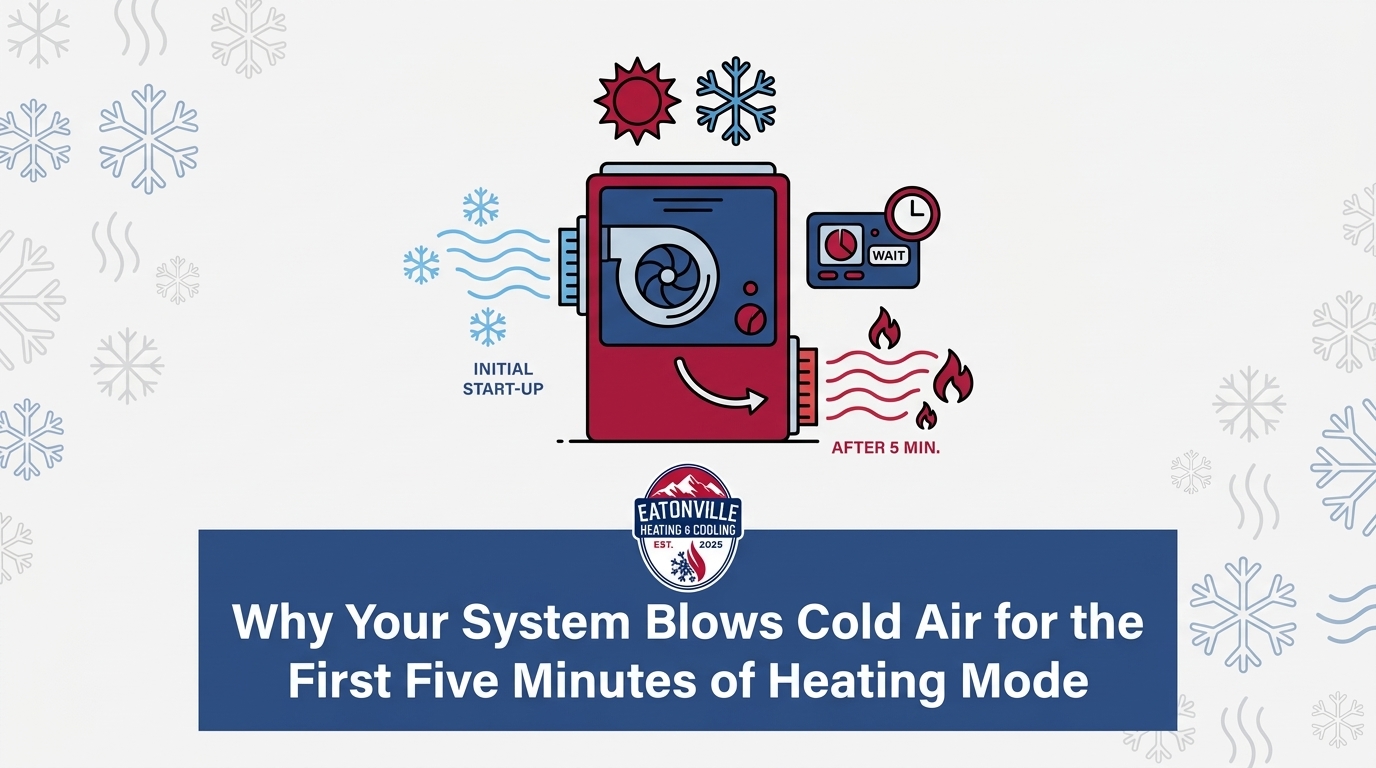
Why Your System Blows Cold Air for the First Five Minutes of Heating Mode
Turning on your furnace on a chilly fall morning only to feel a freezing breeze is stressful. Find out if that initial blast of cold air is normal or a sign of trouble.
Evaluating Dual-Fuel Systems vs Standard Heat Pumps for Auburn Winters
Sub-freezing overnight temperatures force electric heat pumps to work harder. Explore the efficiency tipping point between standard electric and dual-fuel gas backups to choose the right system.