


The Definitive Guide to Heat Dome Frequency in the Pacific Northwest
Heat Dome Frequency in the Pacific Northwest Is Rising — Here's What Eatonville Homeowners Need to Know How often do heat dome events happen in the Pacific Northwest now is a question more homeowners are asking — an
Heat Dome Frequency in the Pacific Northwest Is Rising — Here's What Eatonville Homeowners Need to Know
How often do heat dome events happen in the Pacific Northwest now is a question more homeowners are asking — and for good reason. Here's a quick summary before we dive deeper:
• Before 2021: A heat dome of the 2021 magnitude was considered a once-in-200 to once-in-10,000-year event based on historical climate data
• Today (2026): With roughly 1.2°C of warming since pre-industrial times, events like the 2021 heat dome are estimated to be at least 150 times more likely than they were before human-caused climate change
• At 2°C of warming: A 2021-scale heat dome could become as frequent as a 10-year event
• Trend: Warm-night heat waves in Washington and Oregon are already showing statistically significant increases in both frequency and duration
• Bottom line: Heat domes are not happening more because the atmospheric pattern itself is changing — background temperatures are rising, which means more days now cross the threshold that triggers an extreme heat event
The summer of 2021 changed everything for the Pacific Northwest. A massive heat dome settled over the region from late June through early July, sending temperatures in Western Washington and Oregon soaring past 110°F, buckling roads, overwhelming emergency rooms, and killing over 1,400 people across the region. For communities like Eatonville and the broader South Sound area — where air conditioning has historically been rare — it was a wake-up call that extreme heat is no longer a distant risk.
What made 2021 so alarming wasn't just how hot it got. It was how far temperatures exceeded anything the region had ever recorded. Many locations broke all-time records by more than 5°C. Scientists described the event as something that should statistically occur only once in hundreds or even thousands of years — yet climate change had already made it far more likely. And as background temperatures continue to climb, events like this will become a more regular part of Pacific Northwest summers.
I'm Matthew Percy, owner of Eatonville Heating & Cooling, and after years of serving homeowners across the South Sound region, I've watched how the conversation around how often do heat dome events happen in the Pacific Northwest now has shifted from curiosity to urgent concern. Understanding what's driving this change is the first step toward protecting your home and family.
What is a Heat Dome and How Does It Differ From a Standard Heat Wave?
While the terms "heat wave" and "heat dome" are often used interchangeably in casual conversation, they actually refer to very different meteorological phenomena. Understanding the difference is crucial for grasping why heat domes are so uniquely dangerous to our communities in Pierce, Thurston, and King counties.
A heat wave is a general, somewhat subjective term. It refers to a period of abnormally hot weather lasting more than two days, relative to the historical baseline of a specific area.
A heat dome, on the other hand, is defined by strict atmospheric and circulation criteria. It requires two main components:
1. An Extreme Heat Object: An unusually hot air mass sitting at the Earth's surface.
2. An Upper-Level High-Pressure System: A strong, high-pressure ridge in the upper troposphere (typically around 500 hPa) that acts like a physical lid.
This high-pressure ridge pushes warm air down toward the ground, compressing it. Through the laws of thermodynamics, as air compresses, it heats up further. This process creates a self-reinforcing loop. The high-pressure "dome" blocks cooling maritime winds from the Pacific Ocean, pushes away cloud cover, and allows intense summer sunlight to bake the surface directly.
In the Pacific Northwest, heat domes are often amplified by unique regional patterns:
• The Rex Block Pattern: This atmospheric blocking configuration occurs when a high-pressure system is sandwiched between stationary low-pressure systems, locking the hot air mass in place for days or even weeks.
• Jet Stream Deformation: Warm sea surface temperatures in the Pacific Ocean can trigger convective mixing, releasing heat aloft and creating atmospheric Rossby waves. These waves can become stationary over our region, reinforcing the high-pressure ridge.
• The West Coast Thermal Trough (WCTT): This low-pressure trough creates strong offshore winds that blow from east to west over the Cascade Range. As this dry air moves downslope, it compresses and warms rapidly, superheating communities from Enumclaw and Buckley down to Puyallup and Eatonville.
• Upstream Diabatic Heating: Scientific research indicates that the extreme intensity of the 2021 event wasn't just caused by air compression. Upstream diabatic heating (heat released by condensation in clouds far out over the Pacific) contributed roughly 78% of the temperature anomaly, while local adiabatic compression accounted for 22%.
Atmospheric DriverAir MovementCloud CoverDurationRegional ImpactHow Often Do Heat Dome Events Happen in the Pacific Northwest Now?
To understand how often do heat dome events happen in the Pacific Northwest now, we have to look at the statistical shift in our climate baseline.
If we look at the 2021 event through a purely historical lens, it was a "black swan" anomaly. Climate model simulations analyzing the historical record from 1850 onward classified it as a one-in-10,000-year event. However, background global warming has altered the math entirely.
Today, in 2026, global average temperatures have warmed by approximately 1.2°C compared to pre-industrial baselines. This warming has supercharged extreme weather patterns:
• The 150-Fold Increase: Rapid attribution studies show that anthropogenic climate change made the 2021 heat dome at least 150 times more likely to occur than it would have been in a pre-industrial climate.
• Current Frequency: What was once an impossible event is now a real threat. While a maximum-intensity dome remains rare, smaller-scale heat domes and extreme heat events are occurring with much higher frequency.
• The 2°C Threshold: If global warming reaches 2°C, scientists project that a 2021-scale heat dome will transition from a multi-millennial anomaly into a 10-year event. That means homeowners in Tacoma, Lacey, and Olympia could experience historic, life-threatening heat multiple times in a single generation.
Historical Baseline vs. How Often Do Heat Dome Events Happen in the Pacific Northwest Now?
For decades, Western Washington enjoyed mild summers. Historical observations from 1950 through 2019 show that extreme heat events were rare, and when they did happen, they were brief.
At Seattle-Tacoma International Airport (Sea-Tac), the median daily maximum temperature (Tmax50) warmed at a rate of 0.22°C per decade between 1950 and 2019. The 95th-percentile hot days (Tmax95) warmed at a very similar rate of 0.24°C per decade. Historically, hot days weren't warming much faster than normal days.
However, high-resolution regional climate models (such as the Weather Research and Forecasting, or WRF, model) project a dramatic divergence. Under high-emission scenarios, the warmest days are projected to warm up to 0.28°C per decade faster than median summer days.
The biggest shift we are seeing right now is the failure of nighttime cooling. Historically, the Puget Sound region benefited from marine air pulling temperatures down into the 50s overnight. But recent trends show statistically significant increases in both the frequency and duration of "warm night" heat waves. During the 2021 event, 41.7% of all daily minimum temperature records across Washington, Oregon, and British Columbia were broken or tied. When the night stays hot, homes cannot vent heat, and the human body cannot recover, dramatically increasing health risks.
The Role of Climate Change: Why We Ask How Often Do Heat Dome Events Happen in the Pacific Northwest Now
The physical structure of a heat dome is an atmospheric weather pattern, but climate change acts as a force multiplier.
Roughly 70% of all extreme heat events across North America are associated with a heat dome at some point in their lifecycle. Climate change doesn't necessarily make the high-pressure ridges themselves more frequent, but it raises the baseline temperature of the air trapped inside them.
When you superimpose a classic high-pressure blocking pattern onto a world with warmer oceans and drier soils, the results are explosive:
1. Warmer Sea Surface Temperatures (SSTs): Warmer waters in the Pacific drive stronger convection, shifting wind patterns and amplifying the Rossby waves that lock high-pressure systems in place over the West Coast.
2. Soil Moisture Feedback: When a heat dome begins, the sun quickly bakes the moisture out of the soil. Once the soil is dry, the sun's energy can no longer go toward evaporating water (latent heating). Instead, all of that solar energy goes directly into heating the air (sensible heating). In the 2021 event, this soil moisture-temperature feedback contributed to 50.6% of the extreme high temperatures.
3. The Thermodynamic Boost: The 2021 heat dome was 59% longer (lasting 27 days compared to a simulated 17-day detrended counterpart), 34% larger in geographic area, and had a 6% higher maximum amplitude due to background warming. Overall, the physical strength of the event was 86% greater than it would have been without human-caused emissions.
The Devastating Impacts of Extreme Heat on the Puget Sound Region
When a heat dome settles over the Puget Sound, the consequences cascade through our infrastructure, ecosystems, and homes. For local communities stretching from Tacoma and Lakewood to Graham, Spanaway, and Eatonville, these impacts are no longer theoretical.
• Public Health and Excess Deaths: High heat is the deadliest weather hazard in America. During the 2021 event, over 250 people died in the U.S. Pacific Northwest, and more than 400 died in Canada. The majority of these deaths occurred in private residences, disproportionately affecting vulnerable populations living in neighborhoods with lower tree canopy cover and no access to cooling.
• Infrastructure Strain: Our infrastructure was not built for triple-digit heat. During recent heat events, sections of Interstate 5 and State Route 162 buckled due to thermal expansion. Power grids faced unprecedented strain as thousands of households ran portable air conditioners simultaneously. In Portland, light rail power lines melted, shutting down transit systems.
• Agricultural and Forestry Losses: Extreme heat causes plants to close their stomata to preserve water, halting transpiration. This can lead to rapid crop failure. During the 2021 heat dome, berry farmers in the region experienced massive crop losses, with fruit literally cooking on the vine. In our local Coast Range forests, western hemlocks dropped their needles, and young tree saplings died by the thousands.
• Wildfire Risk: The rapid drying of forest fuels under a heat dome creates prime conditions for explosive wildfires. Just one day after setting a national temperature record of 121.3°F (49.6°C), the village of Lytton, British Columbia, was largely destroyed by a fast-moving wildfire.
• Marine Intertidal Die-offs: The low tides during our summer solstice coincided with the peak of the 2021 heat dome, exposing marine life to lethal temperatures. Scientists estimated that over a billion seashore animals—including mussels, clams, and starfish—died along the Salish Sea coastlines.
Preparing Your Eatonville Home for Unprecedented Summer Heat
As a family-owned HVAC company rooted in Eatonville, Washington, we have committed ourselves to helping our neighbors adapt to this new climate reality. Historically, air conditioning was considered a luxury in the South Sound. Today, reliable home cooling is a fundamental safety measure.
If you want to protect your family from the next major heat event, here are the most effective steps you can take:
• Install a High-Efficiency Heat Pump: Heat pumps are the gold standard for Pacific Northwest homes. They provide incredibly efficient heating in the winter and whisper-quiet, highly effective air conditioning during our hot summers. Because they transfer heat rather than creating it, they use a fraction of the electricity of traditional portable or window AC units, keeping your utility bills manageable during a heat wave.
• Upgrade to Professional Air Conditioning: If you have an existing furnace, adding a central air conditioning system can transform your home into a safe haven. Explore our Eatonville air conditioning services to find a system tailored to your home's unique layout.
• Prioritize Indoor Air Quality (IAQ): Heat domes and wildfires go hand-in-hand. When smoke fills the Puget Sound air, you cannot open your windows to cool down. A closed home needs advanced filtration—such as media filters or electronic air purifiers—to scrub out fine particulate matter (PM2.5) and keep your indoor air safe to breathe.
• Schedule Seasonal Maintenance: Your cooling system is only as reliable as its last tune-up. Waiting until a 100-degree forecast to find out your AC is broken is a recipe for stress. Regular preventative maintenance ensures your system is primed to handle the heavy load of a multi-day heat event.
Frequently Asked Questions About Pacific Northwest Heat Domes
How rare was the 2021 Pacific Northwest heat dome?
By historical standards, the June 2021 heat dome was an absolute anomaly. It broke the Canadian national temperature record when Lytton, British Columbia, hit 121.3°F (49.6°C) on June 29. Across Washington, Oregon, and British Columbia, 52.9% of all daily maximum temperature records were tied or broken during that six-day window.
Statistical analyses of historical data classified it as a one-in-10,000-year event even after accounting for early climate change. However, because greenhouse gases continue to accumulate, the return period is shrinking rapidly. What was historically a "once-in-a-millennium" event is fast becoming a realistic threat for our near future.
Can meteorologists accurately predict a heat dome in advance?
Yes, but the lead time depends on the forecasting tools used.
Medium-range ensemble forecasts (like the North American Ensemble Forecast System) are highly reliable at identifying the atmospheric blocking patterns that cause heat domes about 7 to 10 days in advance.
Sub-seasonal to seasonal (S2S) forecasts—which look at larger atmospheric waves and ocean-atmosphere interactions—are improving rapidly. Scientists can now identify an increased probability of extreme temperature anomalies 10 to 20 days before a heat dome actually forms. This gives local municipalities, utility companies, and homeowners a crucial window to prepare.
Why is air conditioning now a necessity in Western Washington?
For generations, Western Washington had some of the lowest air conditioning adoption rates in the country. In the late 2010s, only about 33% to 44% of homes in the Seattle-Tacoma metro area had some form of air conditioning.
However, our baseline climate has warmed. With summer temperatures regularly pushing into the 90s—and the real threat of triple-digit heat domes—passive cooling (like opening windows at night) is no longer sufficient. This is especially true during wildfire season, when outdoor air quality makes open windows hazardous. Modern air conditioning is now a vital health-intervention tool, preventing heat exhaustion and heat stroke in children, seniors, and sensitive individuals.
Conclusion
The atmospheric mechanics behind heat domes may be complex, but the takeaway for South Sound homeowners is simple: extreme summer heat is no longer a rare exception. It is a recurring part of our climate reality. Knowing how often do heat dome events happen in the Pacific Northwest now allows us to stop reacting to emergencies and start proactively preparing our homes.
At Eatonville Heating & Cooling, we take pride in being a trusted, family-owned partner for our communities in Eatonville, Puyallup, Tacoma, Bonney Lake, Lacey, and beyond. We don't just install equipment; we build long-term relationships based on quality, honesty, and genuine care for our neighbors' comfort and safety.
Don't wait for the next major heat advisory to secure your family's comfort. Contact us today to explore our Eatonville air conditioning solutions and ensure your home is ready for whatever the Pacific Northwest summer brings.
Recent Posts

Adapting Yelm Wood-Framed Homes for Modern Central Air
Adding central air to an older wood-framed home takes careful planning. See how attic framing, ductwork and wiring shape a safe, effective upgrade.
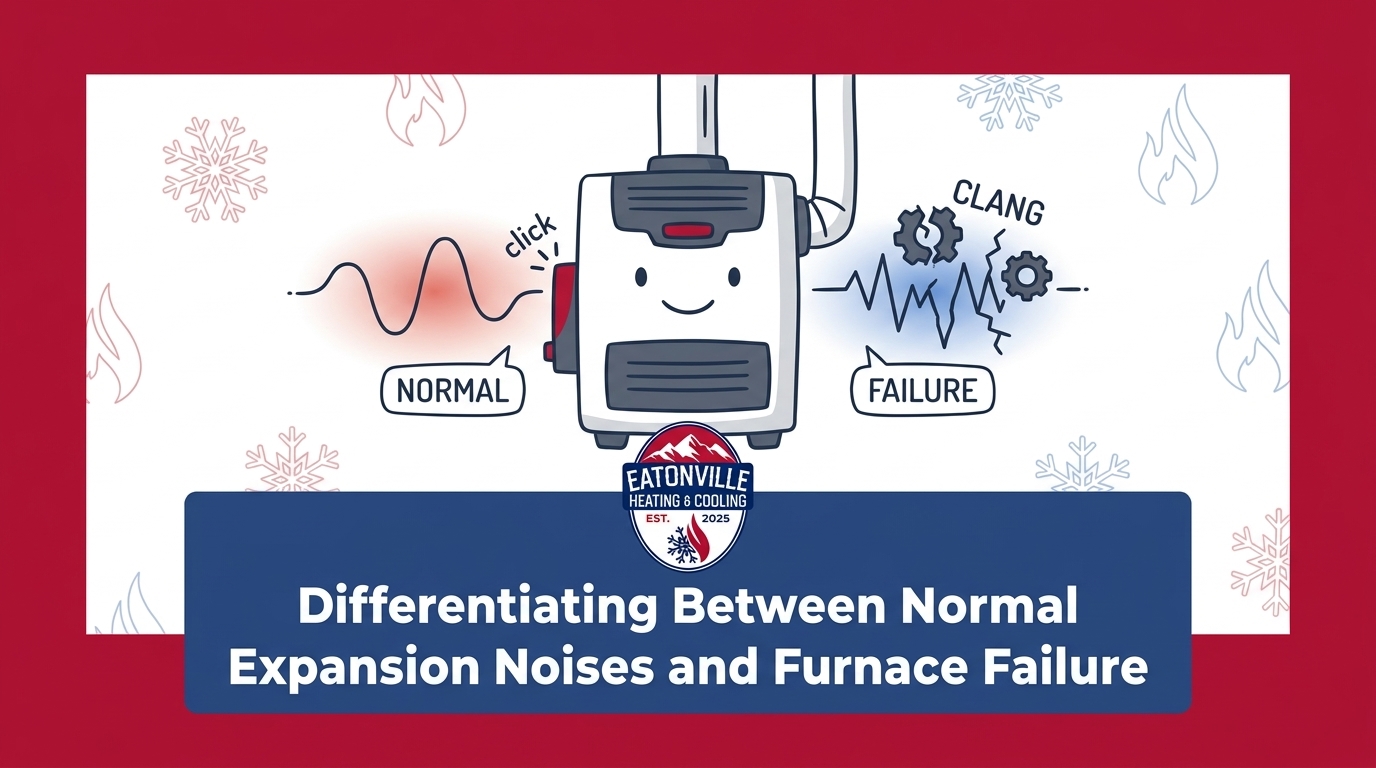
Differentiating Between Normal Expansion Noises and Furnace Failure
Hearing a loud bang on the first chilly fall morning can be terrifying. Decide with confidence whether to let the system run or shut it down for emergency service.
How Federal Way's Fall Humidity Affects Indoor Air Quality
The transition to damp autumn weather creates a tricky shoulder season for your HVAC system. Without the AC running, ambient moisture gets trapped inside. See how to manage ventilation.
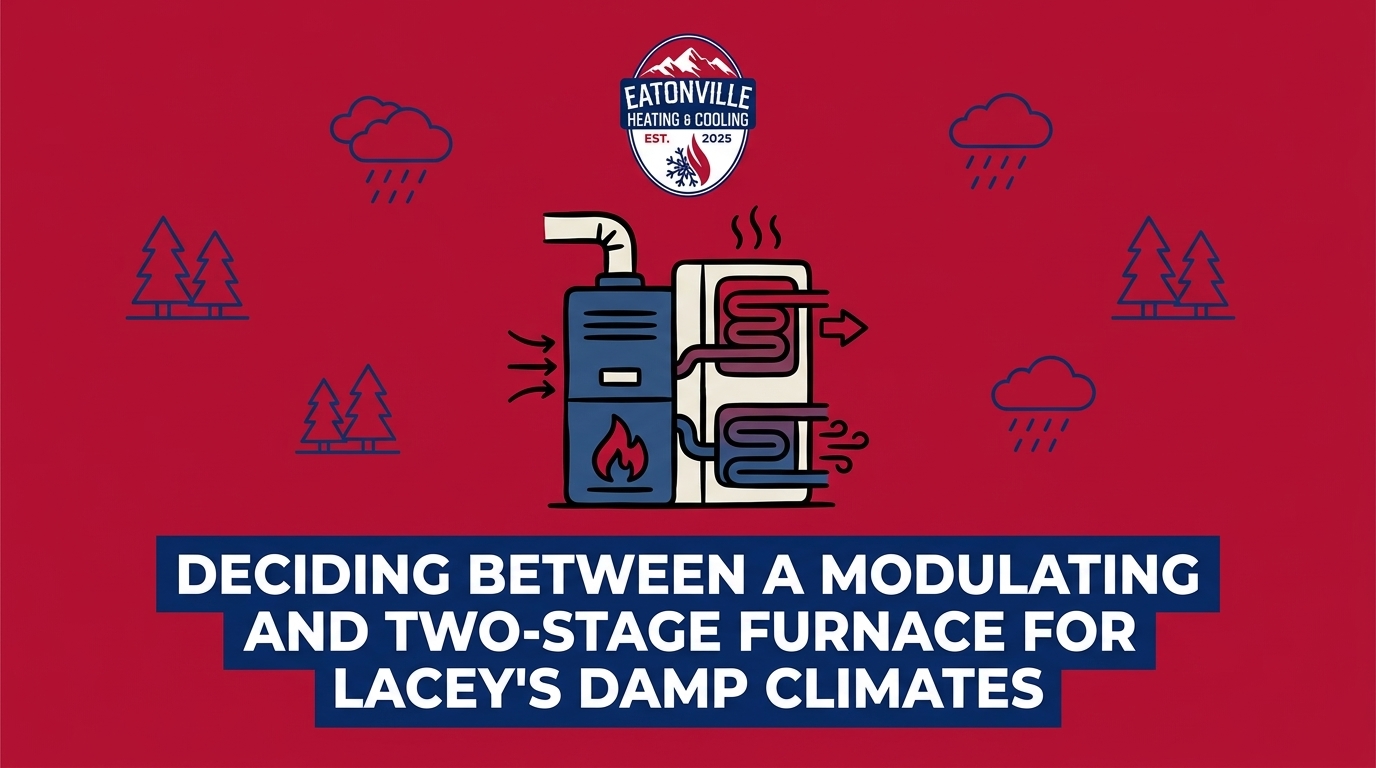
Deciding Between a Modulating and Two-Stage Furnace for Lacey Climates
Upgrading your heating system before the damp winter hits? Find out whether the precise comfort of a modulating unit or the reliability of a two-stage system fits your home.

What a Comprehensive Fall Furnace Inspection Actually Entails
A professional heating tune-up requires much more than a basic filter change. We pull back the curtain on the exact electrical and combustion tests that prevent winter breakdowns.
Repurposing Old AC Pads When Upgrading to a New Heat Pump
Preparing for a fall system upgrade? Reusing a sunken 1990s concrete base can cause poor drainage and oil starvation for modern equipment—see why leveling matters.