

Diagnosing a Tripped AC Breaker During a 90-Degree Afternoon
A tripped AC breaker during an August heatwave forces a critical decision at your electrical panel. See why repeatedly resetting it risks a fire, and the safe steps to take instead.
When the Heat Peaks and the Power Drops: Facing a Sudden AC Shutdown
At Eatonville Heating & Cooling, we know that when an August heatwave strikes, the last thing you want to be doing is diagnosing a tripped AC breaker during a 90-degree afternoon. The late-summer sun beats down, the indoor temperature climbs rapidly, and you suddenly find yourself standing in front of the metal electrical panel in your garage or hallway. Your finger hovers over the tripped switch, and you face a critical decision: do you just flip it back on and hope for the best, or is there a deeper problem hiding in your cooling system?
In the Pacific Northwest, sudden heat spikes are notoriously uncomfortable because our homes are built to retain heat, not shed it. When the cooling stops, the indoor climate becomes unbearable within an hour. However, a tripped breaker is a vital safety mechanism, not just a random nuisance designed to interrupt your comfort. It is actively protecting your home from a serious electrical hazard. Before you attempt to restore power, you need to understand what caused the system to overload in the first place. If you are ever in doubt about the safety of your system, reaching out for AC repair in Eatonville is the smartest way to protect both your equipment and your home.
The Hidden Danger of the 'Just Flip It Back' Mentality
It is incredibly tempting to treat a tripped breaker like a temporary glitch. Most homeowners assume the system just needs a quick reset to get back to work. However, in our years of serving local homes, our technicians frequently see the dangerous aftermath of this "just flip it back" mentality. It ignores the fundamental physics of how your electrical panel operates. Circuit breakers are thermal-magnetic devices designed with one specific job: preventing the wires inside your walls from melting and starting a fire.
When your cooling equipment draws more electrical current (amperage) than the wiring can safely handle, the breaker detects the dangerous heat and physically breaks the circuit. This is a deliberate, protective action. The National Fire Protection Association (NFPA) and the U.S. Consumer Product Safety Commission (CPSC) consistently warn against ignoring these safety trip events.
The physical risks of repeated resets:
• Spring degradation: Every time a breaker trips under a heavy load, the internal spring mechanism weakens. If you reset it repeatedly, the breaker may eventually fail to trip when a real emergency occurs.
• Wire insulation melting: Forcing a failing compressor to restart pushes massive amounts of electricity through the wires. The protective plastic coating on the wires can melt, exposing bare copper.
• Arc faults: Exposed wires can arc, throwing sparks inside your walls or inside the cabinet of your outdoor unit.
By constantly forcing the switch back to the "on" position, you are overriding the exact safety net designed to protect your home. A system that repeatedly shuts down needs professional diagnostics, which is why we continually stress that regular care for your air conditioning systems is so important to prevent these dangerous overloads.
Why Late-Summer Mechanical Strain Pushes Systems Over the Edge
Our team typically fields a massive rush of emergency calls right around the back-to-school transition. Electrical overloads rarely happen on mild spring days; they almost always occur at the end of the cooling season. To understand why your breaker is tripping on an August 90-degree afternoon, you have to look at the cumulative mechanical strain your system has endured over the past few months.
Western Washington experiences a very specific climate pattern. Our equipment often sits entirely unused through a long, damp spring and early summer. Then, suddenly, a late-summer heat dome arrives, and that idle machinery is pushed to a 100-percent duty cycle. Many older homes in Eatonville WA have electrical panels and outdoor units that were simply not sized for sustained, extreme heatwaves.
As the summer progresses, dust builds up, parts lose their lubrication, and the system has to work harder just to produce the same amount of cooling. Working harder requires more electricity. Eventually, the amperage draw exceeds the safety limit.
• System runs nonstop without cooling — The Mechanical Cause: Dust buildup on coils acts as insulation, trapping heat — The Preventative Solution: Annual chemical coil cleaning
• Breaker trips instantly on startup — The Mechanical Cause: Degraded capacitor failing to boost the motor — The Preventative Solution: Electrical testing and component replacement
• Weak airflow from vents — The Mechanical Cause: Clogged filter from summer pollen and wildfire smoke — The Preventative Solution: Frequent filter replacements
By the time August arrives, a system that hasn't been serviced is running on borrowed time. The mechanical components are literally pulling too much power just to stay moving. Investing in routine AC maintenance earlier in the year clears away this strain, keeping the electrical draw low and preventing late-season shutdowns.
Common Culprits Behind an Overloaded Cooling System
When an electrical panel detects an overload, our team finds that the root cause is almost always mechanical. The outdoor unit is a complex machine, and when one part struggles, it leans on the electrical supply to compensate. Here are the specific component failures that we typically see triggering a shutdown during a heatwave.
Airflow Restrictions and Overheating
1. Suffocated Blower Motors: The indoor unit relies on a steady stream of air to keep the blower motor cool. If your air filter is completely packed with pet hair, dust, or smoke particles, the motor has to strain against the blockage.
2. Thermal Overload: As the motor strains, it heats up. Once it reaches a critical temperature, it draws excess electrical current until the safety switch cuts the power entirely.
3. Frozen Evaporator Coils: Poor airflow also causes the indoor coil to freeze solid. A block of ice further restricts airflow, creating a vicious cycle of strain and electrical draw.
Hard-Starting Compressors
1. Aging Parts: The compressor is the heart of your outdoor unit. As it ages, the internal metal parts can begin to seize up, requiring massive amounts of power just to complete a single rotation.
2. Failing Capacitors: The capacitor is a large battery that provides a massive jolt of electricity to help the compressor start. When the capacitor degrades from late-summer heat, the compressor tries to start without that boost, pulling too much power directly from your home's panel.
3. Grounded Compressors: This is a worst-case scenario where the electrical windings inside the compressor break and touch the metal casing. This creates an instant short circuit, and the breaker will trip immediately every single time power is applied.
Diagnosing these specific internal faults requires specialized tools and training. We recently helped an Eatonville homeowner who experienced a frustrating unit issue that other technicians couldn't identify. After reaching out to us, our lead technician promptly tracked the problem down to a hidden electrical fault causing intermittent breaker trips and successfully resolved the issue. Proper diagnosis through professional AC service is the only way to catch these complex mechanical failures before they destroy the entire unit.
Safe, Non-DIY Troubleshooting: What You Can Do Before Calling a Pro
While we strongly advise that you never attempt to test electrical components yourself, our technicians recommend a few safe, practical steps you can take to troubleshoot the problem without violating safety rules or risking injury.
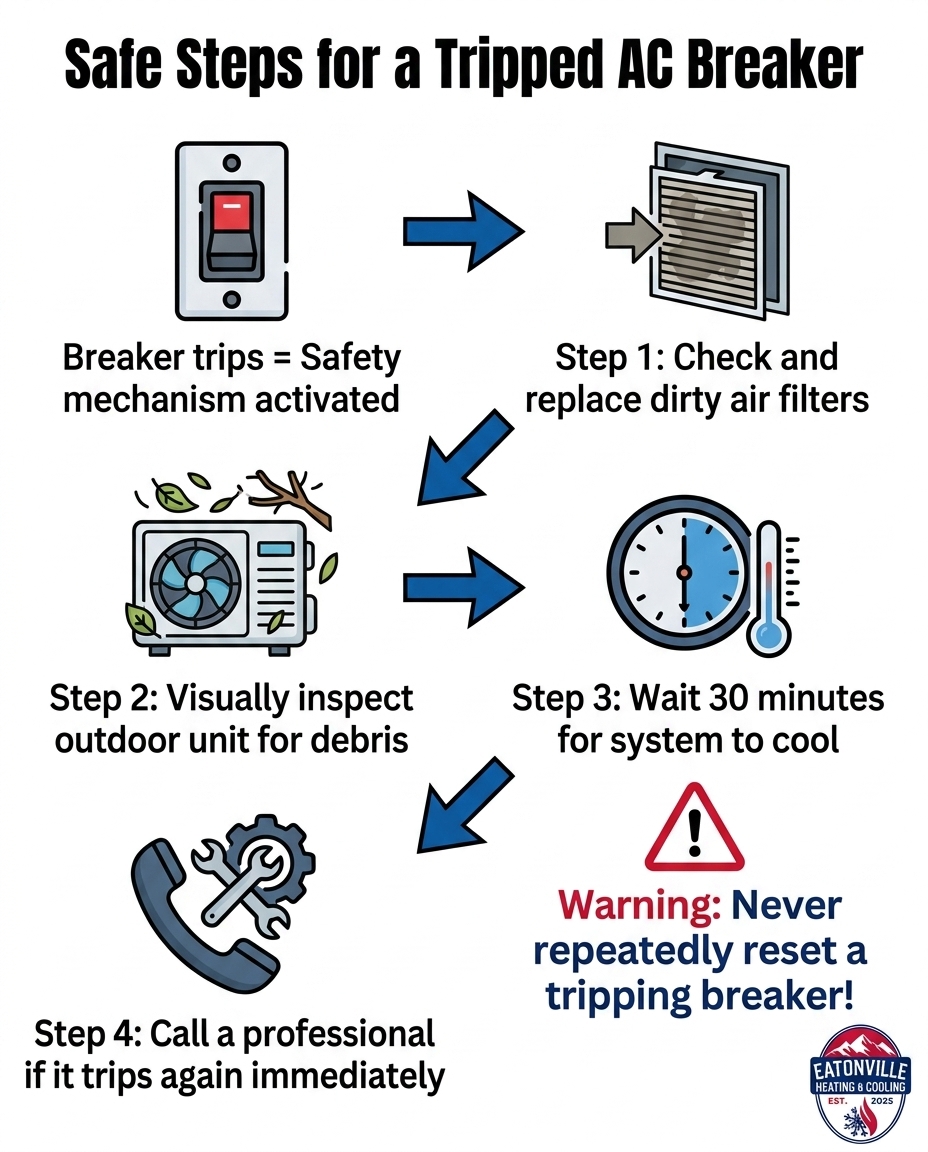
• Check the indoor air filter: Turn your thermostat to the "off" position. Pull out your air filter and hold it up to a light. If you cannot see light shining through it, the filter is suffocating your system. Replace it with a clean one immediately.
• Inspect the outdoor unit visually: Walk outside and look at the metal cabinet. Are there overgrown bushes pressing against it? Is it blanketed in cottonwood seeds or grass clippings? Clear away any exterior debris to give the unit room to breathe, but do not open the cabinet panels.
• Wait 30 full minutes: Compressors have internal thermal overload switches. If the unit overheated, it physically cannot restart until the metal cools down. Leave the breaker off for at least half an hour to let the machinery rest.
• Attempt one single reset: After the system has cooled and you have replaced a dirty filter, you may firmly switch the breaker back to the "on" position one time. If the system starts and runs normally, monitor it closely.
The hard rule of DIY safety: Never open your electrical panel to inspect wires, never attempt to test a high-voltage capacitor, and never try to bypass a safety switch to force the unit to run. These actions require a licensed professional.
When to Stop Testing and Request Emergency Diagnostic Help
If you have waited 30 minutes, flipped the switch once, and the breaker instantly snaps back to the "off" position with a loud pop, your troubleshooting journey is over. An immediate trip indicates a hard short circuit. The system is telling you that applying power is actively dangerous.
Similarly, if the breaker switch itself feels hot to the touch, or if you notice a faint smell of burning plastic near the electrical panel or the outdoor unit, leave the power off. Evacuate the immediate area and call for help. Electrical fires can smolder inside walls before becoming visible.
At this stage, one of our licensed technicians must connect a multimeter and a clamp meter to measure the exact amperage draw of your equipment. We will test the capacitor, verify the integrity of the compressor windings, and ensure your home's wiring has not been compromised by the heat.
The good news is that you do not have to suffer through the heatwave alone. Fast, local emergency response is available right here in Eatonville WA from our team. Another local homeowner whose air conditioning unit went out entirely during a heat spike found that our technician showed up promptly, quickly diagnosed the electrical fault, and resolved the issue safely. You don't need to risk a dangerous DIY fix when professional help from Eatonville Heating & Cooling is just a phone call away. Knowing when to call for emergency AC repair vs waiting until morning can save you from a miserable night and protect your property from serious electrical damage.
Frequently Asked Questions
Is it dangerous if my AC trips the breaker?
Yes, it can be highly dangerous if ignored. A tripped breaker is a deliberate safety response indicating that your system is pulling more electricity than the wires can safely carry. Repeatedly resetting it without fixing the root cause can melt wire insulation and lead to an electrical fire.
Why does my AC trip the breaker on hot days?
Hot August days force your system to run at maximum capacity for hours at a time. This heavy workload causes mechanical components to heat up and draw more amperage. If the system is already strained by dirty filters or failing parts, the extreme heat pushes the electrical draw over the safety limit.
Can I just reset my AC breaker once to see if it works?
We recommend you safely attempt a single reset, provided you take precautions first. Turn off the thermostat, check for a clogged filter, and wait 30 minutes for the equipment to cool down. If the breaker trips again immediately after that single reset, leave it off and call our professionals.
How long should I wait to reset a tripped AC breaker?
You should wait at least 30 full minutes before attempting a reset. This resting period allows the internal thermal overload switch inside the compressor to cool down and reset itself. Trying to restart a hot compressor will only cause it to pull excess power and trip the breaker again.
Why does my AC keep tripping the breaker after a few minutes?
A delayed trip usually points to an overheating motor or a failing compressor struggling to maintain pressure. The system starts fine, but as it runs, mechanical friction or electrical resistance builds up until the amperage exceeds the breaker's limit. This requires professional diagnostics to pinpoint the failing part.
What does it mean if the AC breaker is hot to the touch?
A hot breaker is a major warning sign of a severe electrical issue, such as a loose connection, a failing breaker switch, or wire insulation that is actively degrading. Do not touch it further, leave the switch in the off position, and contact an emergency technician immediately.
Restoring Safe, Reliable Cooling to Your Home
Diagnosing a tripped AC breaker during a 90-degree afternoon is stressful, but understanding that it is a protective safety mechanism gives you the power to make the right call. By avoiding dangerous DIY resets and relying on proper diagnostics, you protect your home from fire hazards. (And if it turns out your old unit is beyond repair, upgrading to a high-efficiency model may even qualify you for generic federal tax credits or utility incentive programs—though we always advise verifying current programs with your utility or tax professional). Keep your family safe, secure, and comfortably cool by letting the experienced team at Eatonville Heating & Cooling handle the heavy lifting.
Recent Posts

Adapting Yelm Wood-Framed Homes for Modern Central Air
Adding central air to an older wood-framed home takes careful planning. See how attic framing, ductwork and wiring shape a safe, effective upgrade.
Differentiating Between Normal Expansion Noises and Furnace Failure
Hearing a loud bang on the first chilly fall morning can be terrifying. Decide with confidence whether to let the system run or shut it down for emergency service.
How Federal Way's Fall Humidity Affects Indoor Air Quality
The transition to damp autumn weather creates a tricky shoulder season for your HVAC system. Without the AC running, ambient moisture gets trapped inside. See how to manage ventilation.
Deciding Between a Modulating and Two-Stage Furnace for Lacey Climates
Upgrading your heating system before the damp winter hits? Find out whether the precise comfort of a modulating unit or the reliability of a two-stage system fits your home.
What a Comprehensive Fall Furnace Inspection Actually Entails
A professional heating tune-up requires much more than a basic filter change. We pull back the curtain on the exact electrical and combustion tests that prevent winter breakdowns.
Repurposing Old AC Pads When Upgrading to a New Heat Pump
Preparing for a fall system upgrade? Reusing a sunken 1990s concrete base can cause poor drainage and oil starvation for modern equipment—see why leveling matters.