



Navigating Lakewood Permit Requirements for New Heat Pump Installations
Upgrading your comfort system involves strict municipal codes and zoning rules. Discover how to manage the paperwork and inspections needed to legally clear your Lakewood heat pump installation.
The Hidden Bureaucracy of HVAC Upgrades in Pierce County
Your current heating and cooling system is failing, and you are ready to upgrade to a modern, energy-efficient alternative. However, navigating Lakewood permit requirements for new heat pump installations often presents a frustrating roadblock before the actual work even begins. Upgrading home comfort systems involves far more than simply swapping out old equipment. Local building regulations, municipal codes, and strict zoning requirements create a complex web of administrative tasks. At Eatonville Heating & Cooling, our team has spent years guiding homeowners through this exact process, ensuring precision to avoid costly project delays, failed inspections, or legal compliance issues.
For homeowners within the Lakewood municipal jurisdiction, understanding this regulatory framework is critical. The concrete problem lies in deciphering which permits are required by the city versus the state, and ensuring the sequence of permitting and inspections is handled correctly. For complete heat pump services, including seamless heating installation in Lakewood, relying on a qualified professional to manage this bureaucracy is the smartest decision a homeowner can make.
Why Local Regulations Matter for Your Upgrade
Municipal codes are not designed to create unnecessary hurdles; they exist to ensure public safety, energy efficiency, and structural integrity. When a high-voltage, high-capacity system like a heat pump is integrated into a home, it impacts the electrical panel, the structural envelope, and the overall energy footprint of the property. The City of Lakewood enforces specific codes to verify that equipment is sized correctly for the dwelling, placed at an appropriate distance from property lines to comply with noise ordinances, and wired safely to prevent fire hazards.
In our experience serving Pierce County, attempting to bypass these regulations often results in immediate stop-work orders from municipal inspectors. If an inspector notices unpermitted work occurring, they have the authority to halt the project indefinitely until the proper paperwork is filed and approved. This leaves the home without adequate climate control while the administrative backlog is sorted out. By understanding the hidden bureaucracy upfront, homeowners can set realistic timelines and ensure their chosen contractor is taking the necessary legal steps to protect the property.
Decoding City Mechanical vs. State Electrical Permits
One of the most frequent points of confusion for property owners is the division of regulatory authority. A legal heat pump installation requires sign-off from two entirely separate governing bodies. The City of Lakewood handles the mechanical side of the installation, while the state governs the electrical connections required to power the new system.
The Municipal Mechanical Permit
The City of Lakewood requires a mechanical permit for all new HVAC installations and major replacements. This permit focuses on the physical equipment, the ductwork, the refrigerant lines, and the overall airflow dynamics of the system. Municipal reviewers look at the manufacturer specifications to ensure the unit meets local zoning requirements, particularly concerning exterior unit placement and noise decibel limits near property lines. If the ductwork is being modified to accommodate the new system, the mechanical permit also covers those structural alterations.
The Washington State L&I Electrical Permit
Because heat pumps require dedicated, high-amperage electrical circuits, the wiring falls under the jurisdiction of the Washington State Department of Labor & Industries (L&I). An electrical permit is mandatory for the installation of the new circuit breaker, the outdoor disconnect box, and the high-voltage wiring connecting the electrical panel to the heat pump. L&I inspectors are strictly concerned with electrical safety, ensuring the wire gauge matches the breaker size and that all connections are properly grounded to prevent electrical fires.
• Mechanical Permit — Governing Body: City of Lakewood — Primary Focus of Inspection: Equipment placement, ductwork, structural impact, zoning compliance — Required Before Work Begins?: Yes
• Electrical Permit — Governing Body: Washington State L&I — Primary Focus of Inspection: Breaker sizing, wire gauge, outdoor disconnects, grounding safety — Required Before Work Begins?: Yes
Both permits must be secured before the physical installation begins to remain compliant with local laws. When planning an AC installation in Lakewood or a full heat pump transition, coordinating these two separate administrative tracks is essential for a smooth project timeline.
Washington State Energy Code (WSEC) Testing Requirements
Beyond basic safety and zoning regulations, Washington enforces some of the most stringent energy efficiency standards in the country. The Washington State Energy Code (WSEC) dictates how homes consume and conserve energy, and these state-level mandates heavily impact local municipal inspections within the Lakewood municipal jurisdiction.
Mandatory Efficiency Standards
The WSEC requires that all new HVAC systems meet specific efficiency thresholds. When a heat pump is installed, the equipment must carry an AHRI (Air-Conditioning, Heating, and Refrigeration Institute) certificate proving it meets the state's minimum Seasonal Energy Efficiency Ratio (SEER) and Heating Seasonal Performance Factor (HSPF) ratings. The city building department will review these specifications during the initial permit application phase. If the proposed equipment does not meet WSEC standards, the permit application will be rejected outright.
Duct Leakage Testing Verification
One of the most rigorous requirements under the WSEC involves the home's ductwork. When a new heat pump is connected to existing ducts, the state requires verification that conditioned air is not escaping into unconditioned spaces like attics or crawlspaces. A certified technician must perform a pressurized duct leakage test. If the leakage rate exceeds the state's maximum allowable percentage, the ducts must be sealed before the municipal inspector will grant final approval. This ensures the high-efficiency equipment actually delivers high-efficiency performance inside the living space.
Precise Sizing and Documentation
The WSEC also mandates that heating and cooling equipment be precisely sized for the home's thermal envelope. Contractors must submit a Manual J load calculation—a complex mathematical formula that determines the exact heating and cooling demands of the specific house. Oversized equipment wastes energy and causes humidity issues, while undersized equipment runs constantly and fails prematurely. Precise sizing documentation is necessary to pass final municipal inspections, which is why proper installation affects heat pump efficiency and warranty outcomes so heavily.
Step-by-Step: The Heat Pump Permitting and Inspection Sequence
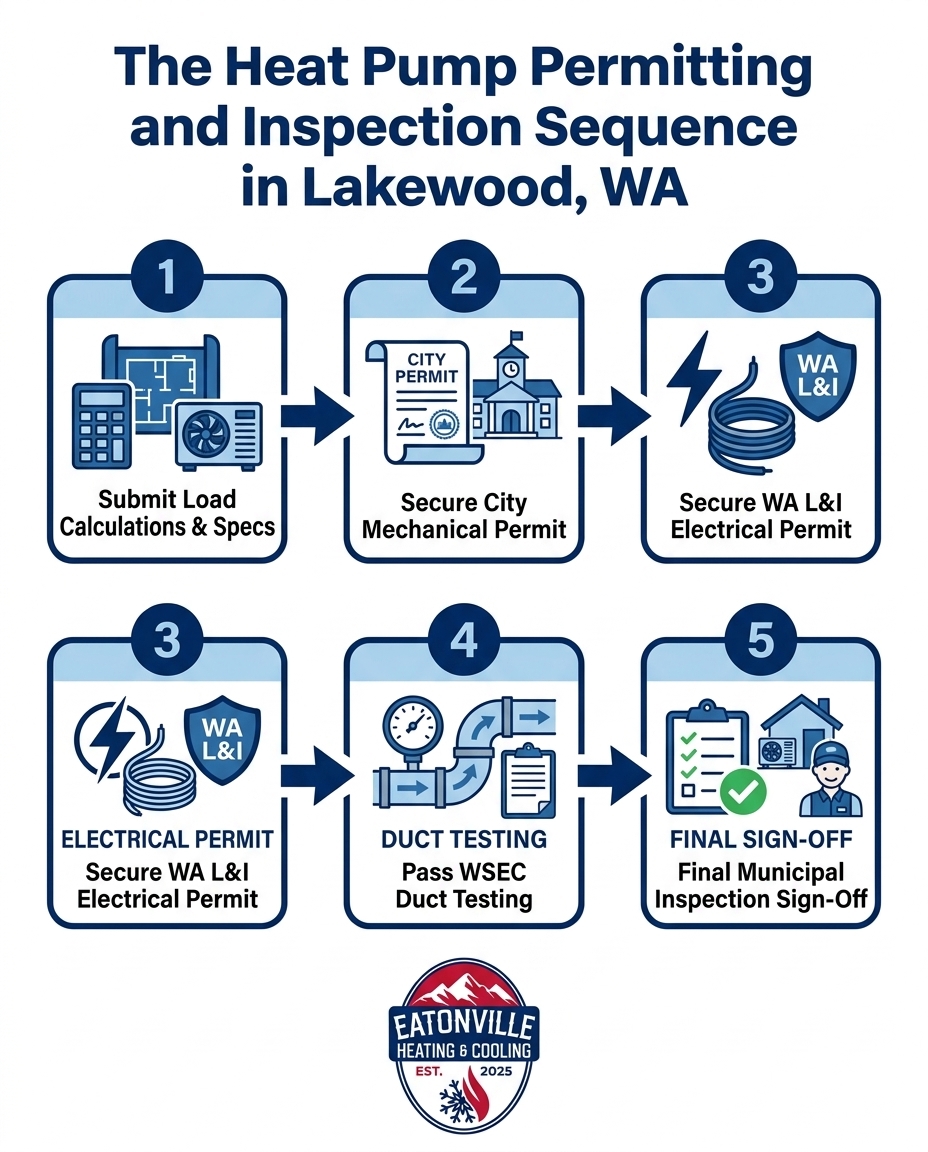
Navigating the administrative timeline requires patience and a clear understanding of the exact sequence of events. Municipalities operate on strict procedural rules, and skipping a step can result in significant delays. Here is the sequential roadmap our team follows for clearing a heat pump installation in Lakewood.
1. Submission of load calculations and equipment specifications: The contractor compiles the Manual J load calculation, the AHRI equipment certificates, and a site plan showing where the outdoor unit will sit. This packet is submitted to the Lakewood building department for review.
2. Securing the municipal mechanical permit and state L&I electrical permit: Once the city approves the mechanical plans, the mechanical permit is issued. Simultaneously, the contractor pulls the electrical permit through the Washington State L&I online portal. Only after both permits are active can the physical installation begin.
3. Scheduling the rough-in electrical and mechanical inspections: If the installation involves opening walls or running new concealed ductwork, a "rough-in" inspection is required before the walls are closed. The L&I inspector checks the bare wiring, while the city inspector checks the concealed mechanical components.
4. Finalizing WSEC duct testing and completing the final municipal sign-off: After the equipment is fully installed and operational, the mandatory duct leakage testing is performed. The results are submitted to the city. Finally, the L&I inspector signs off on the live electrical connections, and the Lakewood municipal inspector performs the final mechanical walkthrough, granting the official certificate of completion.
How Unpermitted Work Jeopardizes Warranties and Insurance
Homeowners are sometimes tempted to skip the permitting process to save time or avoid administrative fees. However, framing the permit process as a critical protection for your financial investment reveals why this is a dangerous gamble. Unpermitted work exposes the property owner to severe long-term risks that far outweigh the temporary convenience of bypassing the building department.
Voiding Manufacturer Warranties
Modern heat pumps are sophisticated pieces of technology backed by extensive manufacturer warranties, often covering major components like the compressor for a decade or more. However, the fine print on virtually every major brand's warranty states that the equipment must be installed by a licensed professional in accordance with all local building codes. If a premature failure occurs and the manufacturer discovers the system was installed without a permit or final inspection, they will void the warranty entirely. Furthermore, fully permitted and documented installations are often required if you plan to apply for generic federal tax credits or local utility incentive programs—though you should always verify current programs with your utility provider or tax professional. One local homeowner we recently helped replace an older system with a new heat pump avoided this exact pitfall; by having our team ensure the installation was fully permitted and documented, they secured their equipment warranty and gained long-term protection for their investment.
Insurance Claim Denials
Homeowners insurance policies are designed to protect against sudden, accidental damage. If an unpermitted electrical connection on a new heat pump causes a fire, or if improper condensate drainage causes severe water damage to the home's foundation, the insurance adjuster will investigate the source. When they discover the work was performed without the required L&I electrical permit or city mechanical permit, the claim will almost certainly be denied. The homeowner is then left entirely responsible for the repair costs, which can be financially devastating.
• Warranty invalidation: Manufacturers require proof of permitted, code-compliant installation to honor parts replacements.
• Liability exposure: Unpermitted electrical work that causes property damage is generally excluded from insurance coverage.
• Real estate complications: Unpermitted HVAC upgrades are flagged during buyer appraisals and home inspections, often stalling or killing property sales until retroactive permits (which carry heavy penalties) are secured.
Securing the proper permits is the ultimate form of property protection. Whether you are installing a brand new system or seeking Lakewood heating repair for an existing unit, ensuring all work is legally documented safeguards your home.
Managing Municipal Timelines During Peak Cooling Seasons
The administrative timeline for permit approval and inspection scheduling is not static; it fluctuates wildly based on the time of year. Understanding seasonal urgency and the reality of municipal inspector backlogs is vital for setting realistic expectations, especially when the weather turns extreme.
The Reality of Inspector Backlogs
As we transition into late summer and families prepare for the back-to-school rush, municipal building departments and state L&I offices experience a massive surge in permit applications and inspection requests. As older air conditioners fail under the strain of end-of-season cooling demands, emergency replacement requests skyrocket. Lakewood municipal inspectors, who cover a wide geographic area, often face severe scheduling backlogs. An inspection that might take two days to schedule in April can easily take two weeks to schedule in August.
Proactive Permit Management
This late-summer urgency creates a critical need for fast, accurate permit approvals so homeowners do not suffer through delays caused by failed inspections or paperwork errors. If a permit application is submitted with missing load calculations or incorrect equipment specifications, it is kicked back to the bottom of the reviewer's pile. At Eatonville Heating & Cooling, our team proactively manages these permits. By submitting flawless documentation on the first attempt, we ensure the project moves through the municipal queue as quickly as legally possible.
Minimizing the Gap
Professional scheduling minimizes the gap between the physical installation and the final legal sign-off. In many emergency replacement scenarios, municipalities allow a licensed contractor to perform the physical swap to restore climate control immediately, provided the permit application was filed simultaneously and the inspection is scheduled promptly. Navigating this emergency allowance requires a deep understanding of local code enforcement protocols, ensuring the home remains comfortable without violating local laws.
The Contractor's Role: Shielding Homeowners from Bureaucracy
Navigating the Lakewood municipal jurisdiction and Washington state electrical codes is not a DIY project. The burden of compliance should never fall on the homeowner's shoulders. A licensed HVAC contractor should always be the one pulling the permits, managing the documentation, and scheduling the inspectors.
Transferring Liability
When a contractor pulls a permit, their state contractor's license and bonding information are attached to the official public record. This transfers the liability of the installation from the homeowner to the professional. If the municipal inspector finds a flaw during the final walkthrough, the contractor is legally obligated to return to the site and correct the issue at their own expense. If a homeowner pulls a "homeowner permit" (which some municipalities allow for certain trades), the homeowner assumes all liability for code violations, testing failures, and necessary corrections.
An Advocate for Compliance
Eatonville Heating & Cooling's deep expertise in local Lakewood municipal codes provides an invaluable shield against bureaucracy. Having our team act as an advocate who understands the nuances of Pierce County regulations, WSEC duct testing requirements, and L&I electrical routing means the property owner never has to decipher legal jargon or argue with a municipal reviewer. Another recent project our technicians handled involved a property requiring multiple heat pumps to address distinct temperature zones; because we handled all compliance paperwork and inspection scheduling seamlessly behind the scenes, the customers enjoyed a completely hassle-free experience, never having to step foot inside a municipal building.
Securing Your Home's Comfort with a Compliant Installation
Proper permitting is not just a bureaucratic hoop to jump through; it provides lasting peace of mind and protects the structural and financial integrity of the home. From securing the initial mechanical and electrical approvals to passing the rigorous WSEC efficiency tests, every step of the process ensures the new system operates safely, efficiently, and legally.
Homeowners in the Lakewood municipal jurisdiction do not have to tackle these administrative hurdles alone. When you partner with Eatonville Heating & Cooling, we manage the entire sequence, ensuring all paperwork is flawless and inspections are passed without delay. If you are preparing for a system upgrade, reach out to our local experts today to discuss your compliant heat pump upgrade and ensure your home stays comfortable and fully protected.
Frequently Asked Questions
Do I need a permit to install a heat pump in Lakewood, WA?
Yes, a mechanical permit from the City of Lakewood is mandatory for all new heat pump installations and major HVAC replacements. This ensures the equipment meets local zoning laws, noise ordinances, and structural safety codes. Bypassing this requirement can lead to stop-work orders and significant municipal fines.
Who is responsible for pulling HVAC permits in Pierce County?
A licensed HVAC contractor should always pull the necessary permits for your project. When the professional files the paperwork, their license and bonding are attached to the job, transferring the liability for code compliance away from the homeowner. Reputable contractors handle the entire administrative process on your behalf.
Are electrical permits required for heat pumps in Washington state?
Yes, an electrical permit is required because heat pumps operate on dedicated, high-voltage circuits. In Washington state, electrical permits and inspections are typically governed by the Department of Labor & Industries (L&I). This ensures all wiring, breakers, and disconnects are installed safely to prevent fire hazards.
What happens if I install a heat pump without a permit in Lakewood?
Installing a system without proper permits can void your manufacturer's warranty and lead to denied homeowners insurance claims if the equipment causes damage. Additionally, unpermitted work will be flagged during real estate appraisals, complicating or preventing the future sale of your property until retroactive permits are obtained.
What inspections are required for a new heat pump under the WSEC?
The Washington State Energy Code (WSEC) requires strict efficiency verifications, most notably a pressurized duct leakage test when connecting to existing ductwork. An inspector will review the results to ensure conditioned air isn't escaping into attics or crawlspaces. The equipment's sizing and efficiency ratings are also verified against state standards.
How long does the HVAC permitting process take during the summer?
During peak summer cooling months, municipal building departments and state inspectors often experience significant scheduling backlogs. While the initial permit approval might take a few days to a couple of weeks, scheduling the final walkthrough can take longer. Proactive contractors manage these timelines carefully to minimize disruptions to your home comfort.
Recent Posts

Adapting Yelm Wood-Framed Homes for Modern Central Air
Adding central air to an older wood-framed home takes careful planning. See how attic framing, ductwork and wiring shape a safe, effective upgrade.
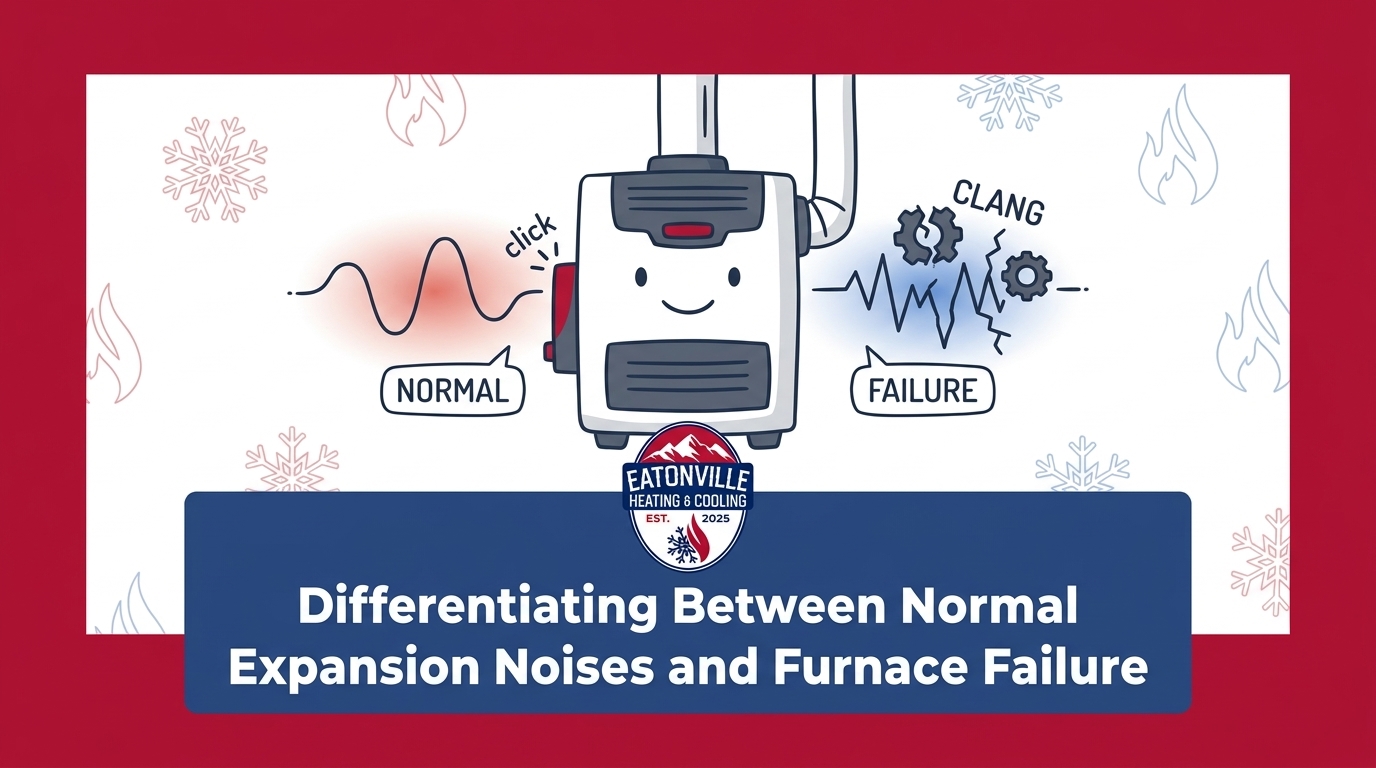
Differentiating Between Normal Expansion Noises and Furnace Failure
Hearing a loud bang on the first chilly fall morning can be terrifying. Decide with confidence whether to let the system run or shut it down for emergency service.

How Federal Way's Fall Humidity Affects Indoor Air Quality
The transition to damp autumn weather creates a tricky shoulder season for your HVAC system. Without the AC running, ambient moisture gets trapped inside. See how to manage ventilation.
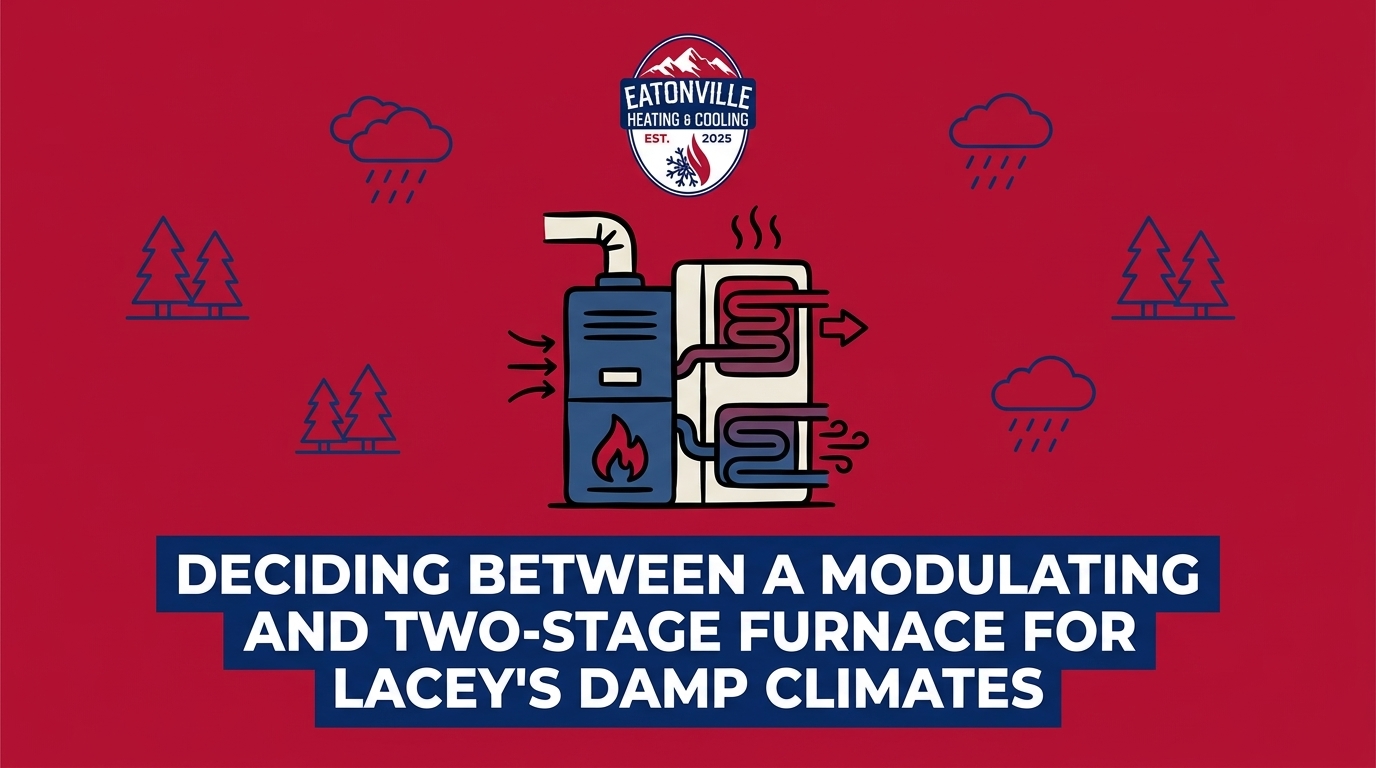
Deciding Between a Modulating and Two-Stage Furnace for Lacey Climates
Upgrading your heating system before the damp winter hits? Find out whether the precise comfort of a modulating unit or the reliability of a two-stage system fits your home.

What a Comprehensive Fall Furnace Inspection Actually Entails
A professional heating tune-up requires much more than a basic filter change. We pull back the curtain on the exact electrical and combustion tests that prevent winter breakdowns.
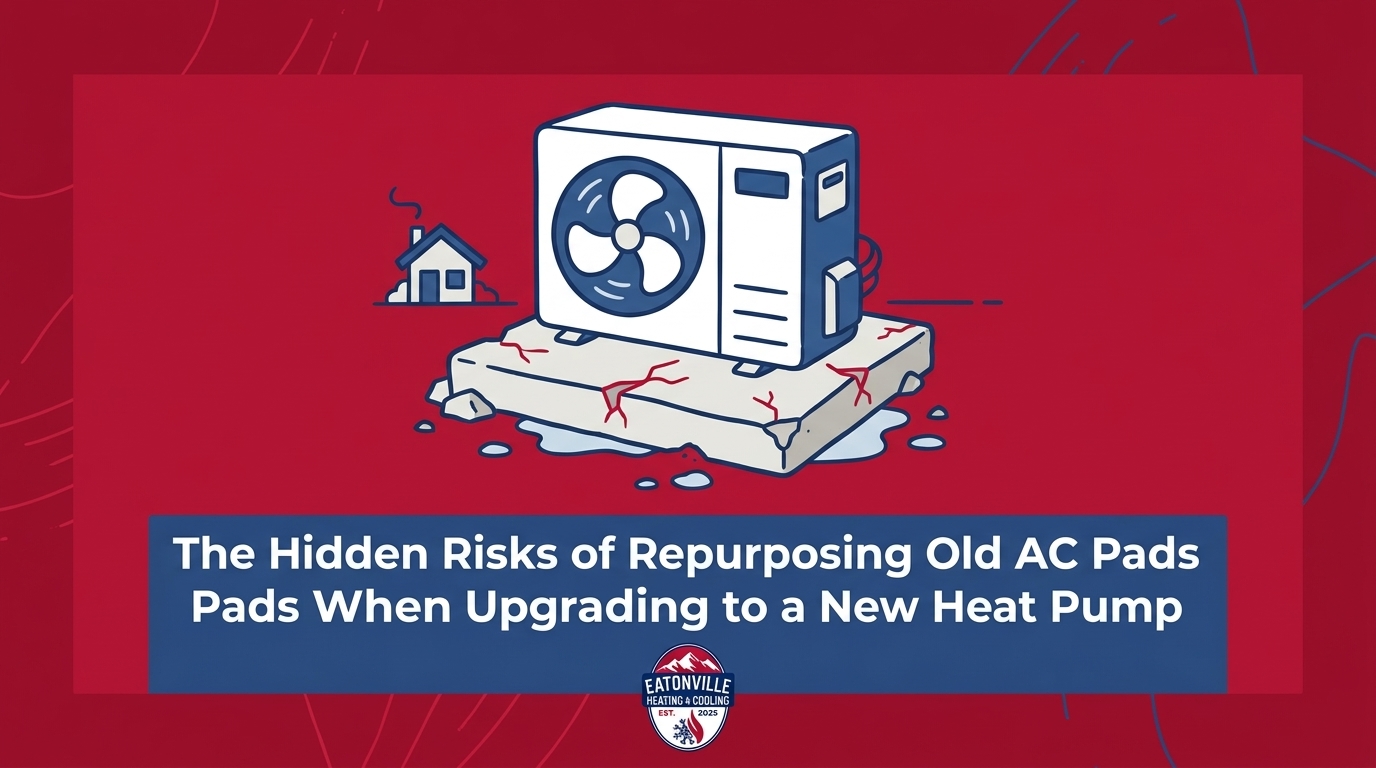
Repurposing Old AC Pads When Upgrading to a New Heat Pump
Preparing for a fall system upgrade? Reusing a sunken 1990s concrete base can cause poor drainage and oil starvation for modern equipment—see why leveling matters.