



How to Calculate Mini Split Size for Your Room
Why Getting the Right Mini Split Size Matters for Your Western Washington Room or Addition If you're wondering what size mini split do I need for a room or addition in Western Washington , here's a quick answer
Why Getting the Right Mini Split Size Matters for Your Western Washington Room or Addition
If you're wondering what size mini split do I need for a room or addition in Western Washington, here's a quick answer based on room size and standard conditions:
Important: These are starting estimates only. Western Washington's mild but humid marine climate, older home construction, and high rainfall mean your actual needs may differ. Factors like ceiling height, insulation quality, and whether the unit is your primary heat source all shift the final number.
Getting the size right matters more than most people expect. An undersized unit runs constantly and never quite reaches your comfort setpoint. An oversized unit short-cycles — turning on and off too quickly to properly remove moisture from the air, which is a real problem in the Pacific Northwest's damp climate.
I'm Matthew Percy, owner of Eatonville Heating & Cooling, and I've helped homeowners across Western Washington figure out exactly what size mini split they need for a room or addition — from drafty older homes in Eatonville to new bonus rooms with vaulted ceilings. In this guide, I'll walk you through everything you need to know to size your system with confidence.
What Size Mini Split Do I Need for a Room or Addition in Western Washington?
When we talk about the "size" of a mini split, we aren't talking about the physical dimensions of the unit on the wall. We are talking about its capacity to move heat, measured in British Thermal Units (BTUs). One BTU is the amount of energy needed to raise the temperature of one pound of water by one degree Fahrenheit. In the HVAC world, we look at BTU per hour (BTU/h).
In Western Washington, sizing is a unique challenge. Unlike the scorching heat of the desert or the sub-zero winters of the Midwest, our marine climate is defined by moderation and moisture. We design for a heating temperature of about 21°F and a cooling temperature of 83°F. Because our summers are relatively cool but our winters are long and damp, your mini split needs to be a "jack of all trades."
For a room addition where there is no existing ductwork, a mini split is often the perfect solution. However, you can't just pick a unit off a shelf based on square footage alone. While a 12,000 BTU unit (often called a "one-ton" unit) typically covers 500–600 square feet in standard conditions, a room with poor insulation or massive windows might need significantly more power to stay cozy in February.
A quick BTU starting chart for common room sizes
If you are looking for a baseline, use these standard increments. Most manufacturers produce heads in 6k, 9k, 12k, 15k, 18k, and 24k BTU capacities.
• Small Bedrooms (150–250 sq ft): 6,000 to 9,000 BTU.
• Medium Rooms/Master Suites (300–450 sq ft): 9,000 to 12,000 BTU.
• Large Living Areas or Great Rooms (500–600 sq ft): 12,000 to 15,000 BTU.
• Large Additions or Open Floor Plans (600–800 sq ft): 18,000 BTU.
How to estimate what size mini split do i need for a room or addition in western washington
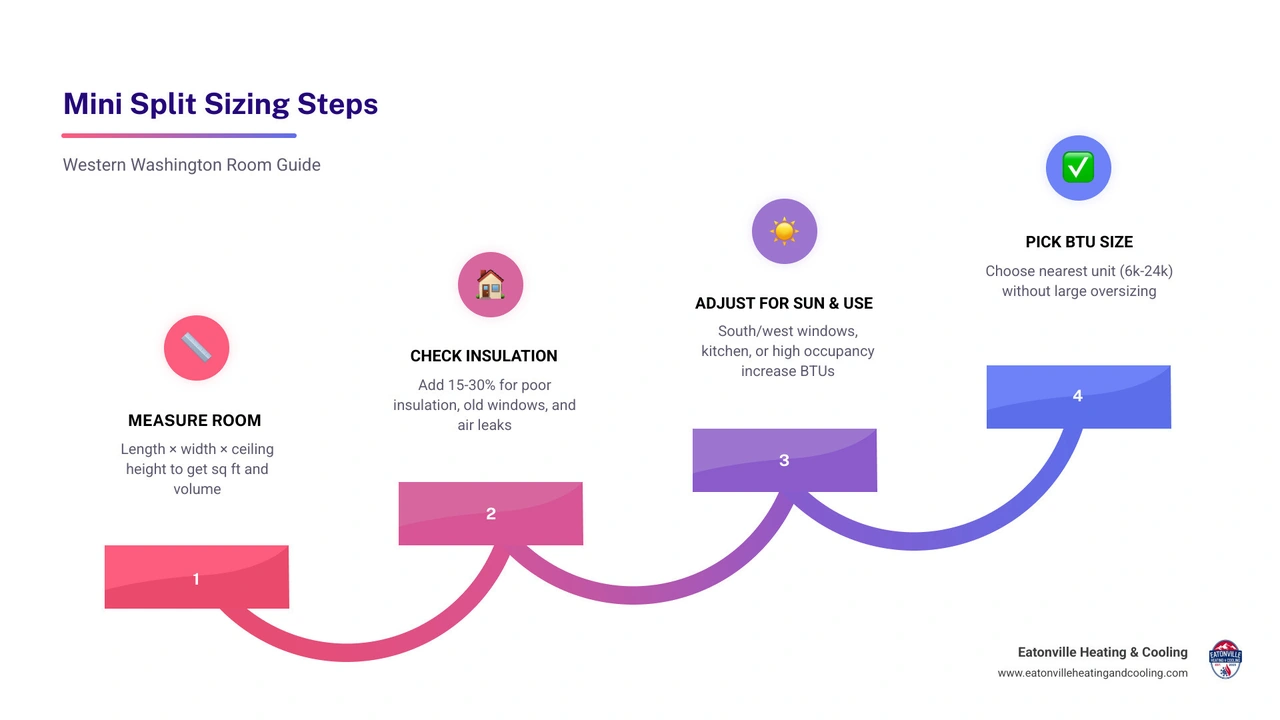
To get a rough estimate, start with the "25 BTU Rule." Measure the length and width of your room to find the square footage, then multiply that number by 25. For example, a 20x20 foot addition is 400 square feet. 400 x 25 = 10,000 BTUs.
In this scenario, you would likely look at a 12,000 BTU unit to ensure you have enough "headroom" for those colder nights. However, this rule assumes standard 8-foot ceilings and decent insulation. If your new addition has vaulted ceilings or is built over a cold crawlspace, that multiplier needs to move closer to 30 or 35.
Why Western Washington usually needs balanced sizing instead of extreme oversizing
In some parts of the country, "bigger is better" is the mantra. Not here. Our shoulder seasons (spring and fall) are long. During these times, your mini split doesn't need to run at full blast. Modern mini splits use inverter technology, which allows them to speed up or slow down like a dimmer switch rather than just turning on and off.
If you install a massive 24,000 BTU unit in a space that only needs 9,000 BTUs, the unit will "short cycle." It will blast the room with air, reach the temperature in three minutes, and shut off. Because it doesn't run long enough, it never gets a chance to pull the humidity out of the air. You’ll end up with a room that is technically 70 degrees but feels clammy and uncomfortable. Proper sizing ensures the unit runs in long, low-energy cycles that keep the air fresh and dry.
How to Calculate Mini Split Size Step by Step for a Single Room or Addition

Calculating the right size is part science and part experience. We use what’s called a Manual J load calculation to be precise, but you can follow these steps to get very close to the professional requirement.
Step 1: Measure square footage and ceiling height correctly
Don't just guess the room size. Use a tape measure or a laser tool. If your addition is an L-shape, break it into two rectangles, calculate the area of each, and add them together.
Ceiling height is the "hidden" variable. Most BTU charts assume 8-foot ceilings. If you have 10-foot ceilings or a sloped vault that reaches 12 feet, you have more air volume to condition. As a rule of thumb, add 10% to your BTU requirement for every two feet of ceiling height above 8 feet.
Step 2: Adjust for insulation, windows, and home construction
The "envelope" of your room determines how much heat leaks out in the winter and creeps in during the summer.
• New Additions: If your addition was built recently in places like Puyallup or Tacoma, it likely follows modern energy codes with great insulation. You can stick closer to the base BTU estimates.
• Older Homes: If you are adding a mini split to a pre-1980 home in Eatonville or Graham, you might have thinner wall cavities or original single-pane windows. Poor insulation can require a 15–30% increase in BTU capacity to offset the heat loss.
• Windows: Large glass sliders or floor-to-ceiling windows are beautiful, but glass has a very low R-value (insulation rating). If more than 25% of your wall space is windows, round up to the next unit size.
Step 3: Adjust for sun, moisture, and room use
Which way does the room face? A south-facing sunroom in Federal Way will get significantly warmer in July than a north-facing bedroom shaded by Douglas firs. Add 10% for high sun exposure.
Also, consider what happens inside the room.
• Kitchens: If the addition is a kitchen extension, add 4,000 BTUs to account for the stove and oven.
• Occupancy: Each person in a room generates about 600 BTUs of heat. If the room is a dedicated "man cave" or family theater meant for five or six people, you need to account for that extra heat load.
Step 4: Choose the nearest available unit size without guessing too high
Once you have your final adjusted number, match it to the nearest available manufacturer size. If your math says you need 10,500 BTUs, a 12,000 BTU head is your best bet. Avoid jumping all the way to an 18,000 BTU unit "just to be safe," as this leads back to the short-cycling issues we discussed.
Western Washington Factors That Change Mini Split Sizing
Our region has a specific "flavor" of HVAC needs. Between the Puget Sound breeze and the constant drizzle, our homes face unique stresses.
What size mini split do i need for a room or addition in western washington if the home is older?
Many homes in Auburn, Lakewood, and University Place feature older construction styles. Plaster walls, lack of house wrap, and drafty crawlspaces mean these rooms lose heat much faster than a modern "tight" home. When sizing for an older space, we almost always lean toward a slightly higher BTU-per-square-foot ratio. We also have to look at the electrical panel—older homes may need an upgrade to handle the dedicated 240V circuit a mini split requires.
How additions, garages, and converted spaces size differently
We see a lot of "bonus rooms" over garages in areas like Bonney Lake and Buckley. These are notoriously difficult to heat and cool because they are exposed on almost every side—roof above, cold garage below, and three or four exterior walls.
• Garages: If you're converting a garage into a workshop, garage doors are rarely insulated well. You may need 12,000 BTUs for a space that would normally only need 9,000.
• Attics: Roof loads are intense. Even with good insulation, the sun beating down on shingles creates a massive heat load that requires extra cooling power.
Why humidity and run time matter for comfort in the Pacific Northwest
In Western Washington, "comfort" is often about dryness. Our "shoulder seasons" are famous for being 55 degrees and 90% humidity. If your mini split is sized perfectly, it will run at a very low, quiet speed for a long time. This allows the cold coils to pull gallons of water out of your indoor air every day. If the unit is too big, the room stays damp, which can lead to that "musty" smell and even mold issues in corners or behind furniture.
Single-Zone vs Multi-Zone Mini Split Sizing for Western Washington Homes
When deciding what size mini split do I need for a room or addition in Western Washington, you also have to decide if that room is going to be its own "island" or part of a larger system.
When a single-zone mini split is best for one room or one addition
A single-zone system consists of one outdoor condenser and one indoor head. This is the most efficient and straightforward way to condition a single addition or a detached "mother-in-law" cottage. Sizing is simple: you size the outdoor unit to match the indoor unit exactly. If you need 12,000 BTUs in the room, you buy a 12,000 BTU system.
For more information on general AC sizing, you might find our guide on What Size Air Conditioner Do You Really Need for Your Home helpful.
How multi-zone systems are sized differently
Multi-zone systems connect up to five (and sometimes more) indoor heads to one large outdoor condenser. This is common when a homeowner wants to heat an addition plus two existing bedrooms. Sizing here is a bit of a puzzle. You size each indoor head for the specific room it lives in (e.g., 9k for the bedroom, 12k for the addition). However, the outdoor unit doesn't necessarily have to be the sum of all those numbers. Because it's rare that every room will need maximum power at the exact same second, we use a "diversity factor." A 36,000 BTU outdoor unit can often support 42,000 BTUs worth of indoor heads.
If you're considering a larger project, check out our Heat Pump Installation Tacoma WA page for local insights.
Why one oversized outdoor unit is not the same as proper zone sizing
We sometimes see DIY installs where someone buys a massive 4-ton outdoor unit but only connects two small heads to it. This is a recipe for disaster. The outdoor unit can only "turn down" so far. If the demand from the indoor rooms is lower than the outdoor unit's minimum operating speed, the system will struggle, vibrate, and eventually fail prematurely.
Signs Your Mini Split Is Sized Wrong and When to Call for a Professional Load Calculation
How do you know if you (or the previous owner) got it wrong? There are several red flags that suggest your BTU count is off.
Signs a mini split is undersized
• Constant Operation: The unit never cycles off, even on a mild 65-degree day.
• The "Gap": You set the thermostat to 70°F, but the room never gets warmer than 64°F during a cold snap in Olympia or Lacey.
• Hot/Cold Spots: The air coming out of the unit is warm, but it doesn't have the "throw" to reach the far corners of the addition.
Signs a mini split is oversized
• Short Cycling: You hear the outdoor unit ramp up and then shut down every 5 to 10 minutes.
• High Humidity: The room feels cold but "heavy" or "sticky."
• Temperature Swings: You’re freezing one minute and then, as soon as the unit stops, the room feels stuffy.
When a simple chart is enough and when Manual J is worth it
If you are putting a mini split in a standard 12x12 bedroom with one window and a normal ceiling, a sizing chart is usually just fine. However, you should call us for a professional Manual J calculation if:
• The addition has vaulted ceilings or "walls of glass."
• The space is a converted garage or attic.
• The mini split will be the only source of heat for the home.
• You are planning a multi-zone system for the whole house.
For those in the state capital area, we offer specialized Heat Pump Service Olympia WA to ensure your system is running at peak efficiency.
Efficiency ratings, incentives, and installation details homeowners should check
In 2026, the standards for efficiency have shifted to SEER2 (for cooling) and HSPF2 (for heating). In Western Washington, the HSPF2 rating is actually more important because we spend so much more time heating than cooling.
• Rebates: Many local utilities in Pierce and Thurston counties offer significant rebates for switching to high-efficiency ductless systems.
• Tax Credits: Federal tax credits up to $2,000 are often available for qualifying heat pump installations.
• Electrical: A mini split requires a dedicated circuit. If your panel is full, you'll need to factor in the cost of a subpanel or upgrade.
For more tips on the process, check out our Heat Pump Installation Eatonville WA Tips.
How to Make Sure Your Mini Split Is Correctly Sized and Installed
The best equipment in the world will perform poorly if it’s sized incorrectly or installed sloppily. At Eatonville Heating & Cooling, we take a "measure twice, cut once" approach to every project.
Questions to ask before installation day
Before you sign a contract, ask your installer these four questions:
1. "Did you perform a load calculation, and can I see the BTU requirements for each room?"
2. "Is this unit rated for 'cold climate' operation (important for those rare but freezing WA snow weeks)?"
3. "Where exactly will the indoor head be placed to ensure the best airflow across the room?"
4. "Does my electrical panel have the capacity for this specific breaker size?"
Final steps for reliable comfort in your Western Washington home
Choosing the right size is the foundation of your home's comfort. Whether you're in Tacoma, Federal Way, or right here in Eatonville, we want to make sure your new addition is the most comfortable room in the house.
As a family-owned company, we pride ourselves on being honest with our neighbors. We won't sell you a system that's too big just to make a buck, and we won't undersize a system just to give you the lowest bid. We want it to work perfectly for the next 20 years.
If you're ready to get an expert opinion on your project, we’re here to help. From the initial sizing to the final startup testing, we ensure every detail is handled. Visit our Heat Pump Installation Eatonville WA page to book a consultation and take the guesswork out of your home comfort.
Recent Posts
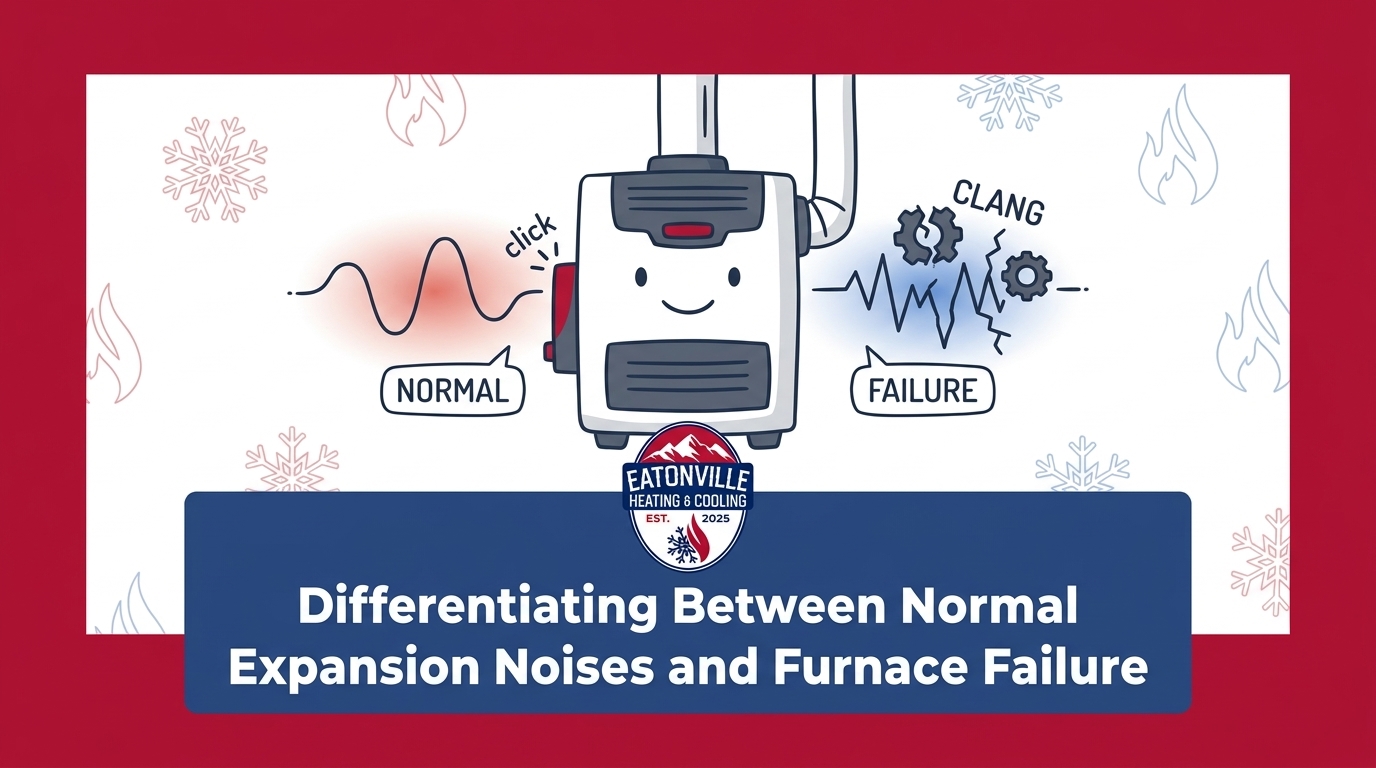
Differentiating Between Normal Expansion Noises and Furnace Failure
Hearing a loud bang on the first chilly fall morning can be terrifying. Decide with confidence whether to let the system run or shut it down for emergency service.

How Federal Way's Fall Humidity Affects Indoor Air Quality
The transition to damp autumn weather creates a tricky shoulder season for your HVAC system. Without the AC running, ambient moisture gets trapped inside. See how to manage ventilation.
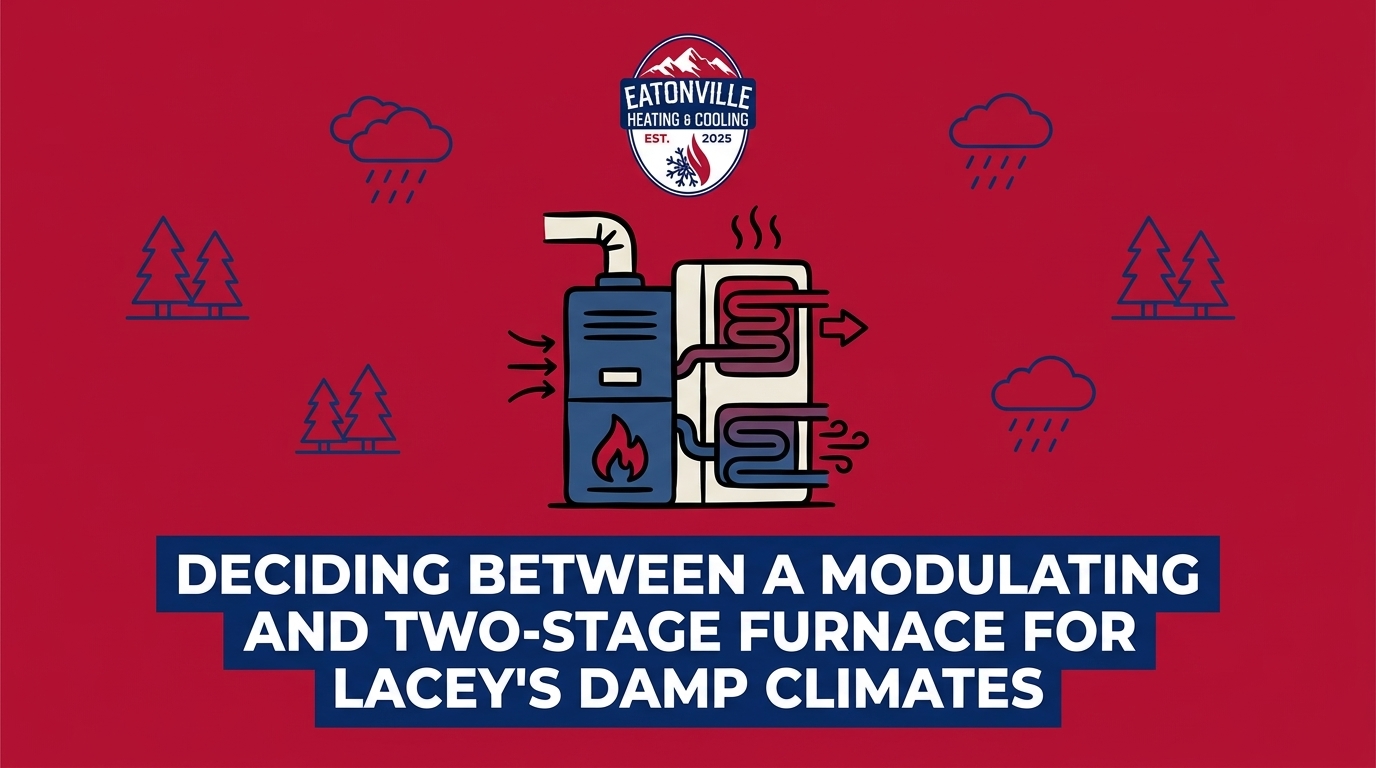
Deciding Between a Modulating and Two-Stage Furnace for Lacey Climates
Upgrading your heating system before the damp winter hits? Find out whether the precise comfort of a modulating unit or the reliability of a two-stage system fits your home.

What a Comprehensive Fall Furnace Inspection Actually Entails
A professional heating tune-up requires much more than a basic filter change. We pull back the curtain on the exact electrical and combustion tests that prevent winter breakdowns.
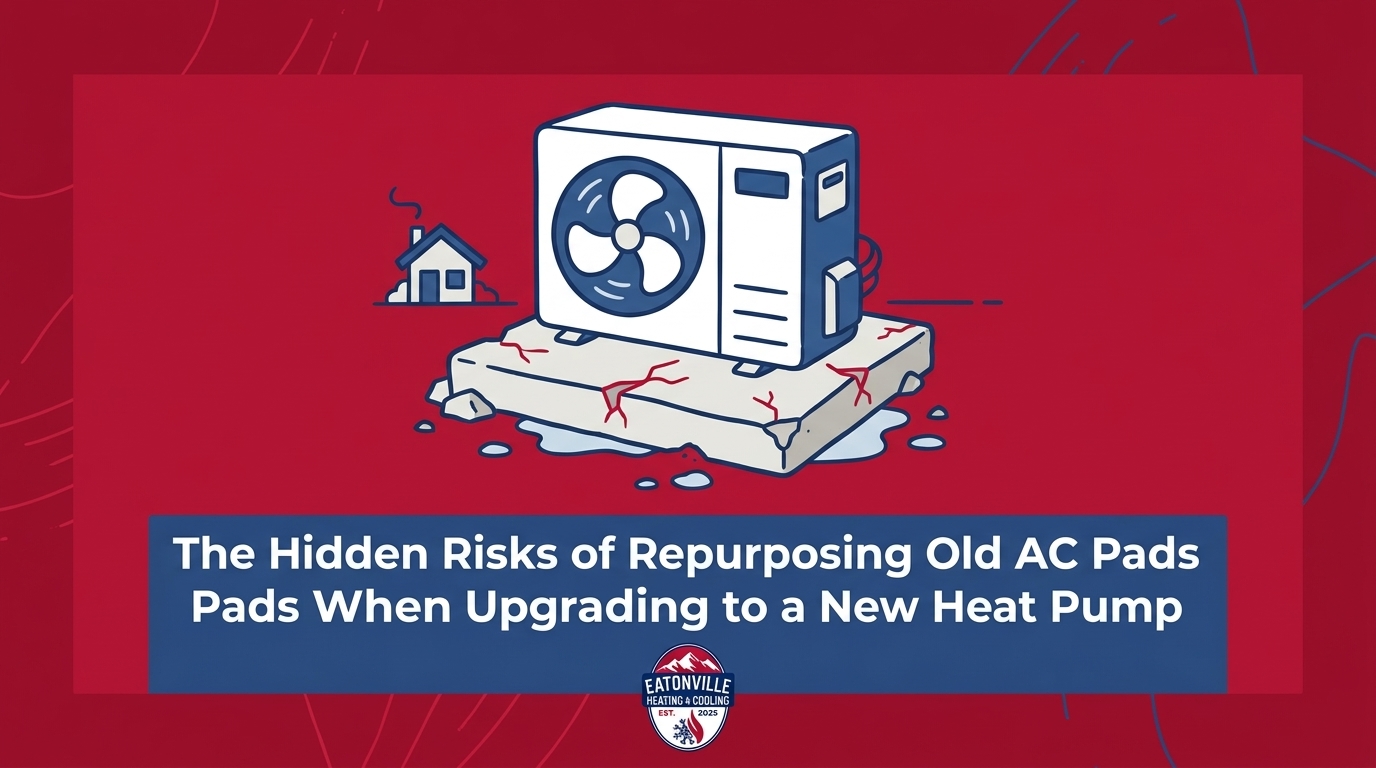
Repurposing Old AC Pads When Upgrading to a New Heat Pump
Preparing for a fall system upgrade? Reusing a sunken 1990s concrete base can cause poor drainage and oil starvation for modern equipment—see why leveling matters.
Why Your System Blows Cold Air for the First Five Minutes of Heating Mode
Turning on your furnace on a chilly fall morning only to feel a freezing breeze is stressful. Find out if that initial blast of cold air is normal or a sign of trouble.