



How Far Your HVAC Contractor Should Actually Travel for Warranty Service
A slightly lower installation bid from an out-of-town company can leave you stranded during late-summer heatwaves. Understand how geographic distance impacts your warranty response times.
Will Your Contractor Actually Drive Out for Minor Warranty Repairs?
Is your brand-new cooling system really protected if the company that installed it is based an hour away? When homeowners ask our team how far your HVAC contractor should actually travel for warranty service, the question usually arises at the worst possible time. What good is a comprehensive manufacturer's warranty if the contractor refuses to make the drive to fulfill it?
Many homeowners are tempted to hire distant companies from larger metropolitan areas based on a slightly lower initial installation bid. However, we consistently see that perceived upfront savings quickly evaporate when the system encounters a minor hiccup down the road. During late-summer August heatwaves across Western Washington, emergency cooling calls flood dispatch boards. Suddenly, that out-of-town contractor becomes "too busy" to send a technician out for a minor warranty repair in the foothills, leaving your family stranded in a sweltering house while their crews prioritize calls closer to their home base.
This dynamic creates a critical decision point for homeowners: weighing the initial bid of a distant contractor against the long-term reality of geographic distance impacting response times. The geographic location of your contractor dictates their reliability when you need them most. If you need reliable Air Conditioning Services, including prompt AC repair in Eatonville, partnering with a team that operates right in your backyard is essential for true peace of mind.
Understanding HVAC Service Radiuses and Route Density
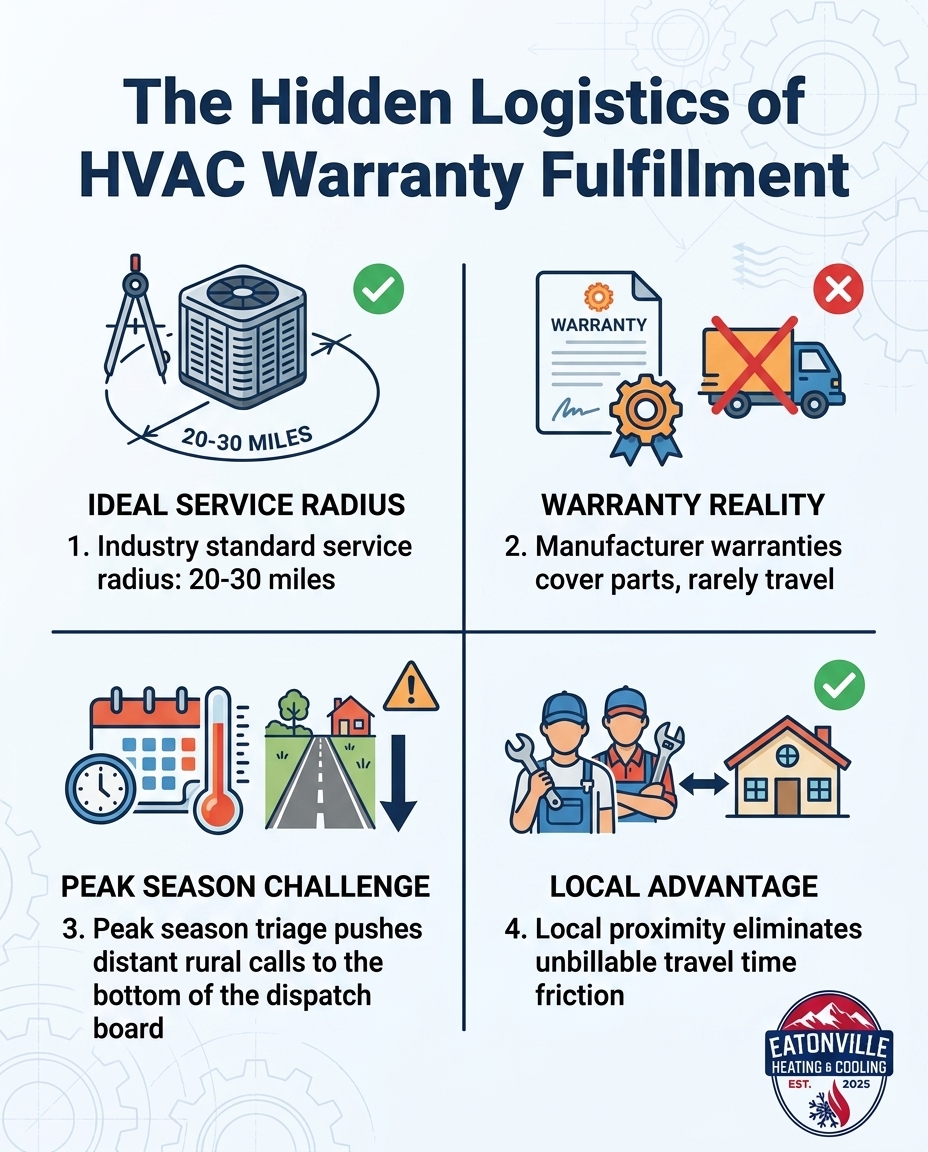
To understand why distant contractors hesitate to honor warranty calls, you have to look at how HVAC companies map their service territories. In our years of serving the area, we know the industry standard service radius for most heating and cooling companies is typically 20 to 30 miles from their central shop. Within this radius, dispatchers can efficiently route technicians from one neighborhood to the next with minimal windshield time.
The core concept driving this logistics model is route density. Contractors prefer clustering jobs in highly populated urban centers to maximize efficiency and technician utilization. When technicians spend less time driving and more time turning wrenches, the company operates smoothly. Locations outside these high-density routes are often treated as out-of-the-way exceptions rather than primary service stops.
• Drive Time Between Calls — High-Density Urban Routes: 10 to 15 minutes — Rural & Foothill Routes: 45 to 60+ minutes
• Daily Call Volume per Tech — High-Density Urban Routes: 5 to 7 service calls — Rural & Foothill Routes: 3 to 4 service calls
• Dispatch Priority — High-Density Urban Routes: High (easy to squeeze in emergencies) — Rural & Foothill Routes: Low (requires dedicated block of time)
• Fuel & Vehicle Wear — High-Density Urban Routes: Minimal impact per job — Rural & Foothill Routes: Significant overhead per job
For homeowners in Eatonville and surrounding Pierce County foothills, this logistical reality is incredibly important. If you hire a company based deep in the city, your home sits on the outer fringes of their map. During slow seasons, they might gladly make the drive. But when back-to-school season hits and demand spikes, your location becomes a logistical liability for their dispatch team.
Why the Installation Radius Differs from the Warranty Radius
A common point of confusion we hear from customers is why a distant contractor was perfectly willing to drive an hour to install the system, but balks at driving that same hour to fix it. The answer lies in the fundamental difference between installation math and warranty math.
Contractors will routinely drive longer distances for major system installations because these are highly profitable, scheduled projects. A crew will arrive at your home in the morning and stay there for the entire day. The travel time is absorbed by the scale of the project. Warranty calls, on the other hand, are often unbillable or yield very low profit. A minor warranty repair might only take twenty minutes to fix, but if it requires a ninety-minute round trip, geographic isolation forces the distant company to absorb a financial loss on travel time. This heavily disincentivizes long drives for minor fixes.
The Fine Print: Parts, Labor, and Unbillable Travel Time
Homeowners often assume that a "ten-year warranty" means they will never pay out of pocket if the system breaks down within a decade. The reality of HVAC warranties is much more complex, and geographic distance exacerbates these hidden complexities. Our technicians always recommend understanding the distinction between what the manufacturer covers and what the contractor is willing to do.
Manufacturer Parts Warranties: Standard manufacturer warranties cover the physical parts of the equipment. If your compressor or blower motor fails prematurely, the manufacturer provides a replacement part at no cost. However, the manufacturer does not cover the logistics of getting that part to your home, nor do they pay the technician's hourly rate to diagnose the issue.
Contractor Labor Warranties: Labor coverage is usually tied to the specific installing contractor's service agreement. This agreement dictates how long the contractor will provide free labor for warranty repairs—typically ranging from one to three years after installation. If you are evaluating HVAC contractor warranties, always check the duration of the labor coverage separately from the parts coverage.
Unbillable Travel Time: This is where distance becomes a financial burden. Travel time is rarely covered by manufacturers. If a contractor has to drive an hour each way to replace a covered part, they are eating two hours of unbillable driving time. To offset this, distant contractors will often charge hefty trip fees or diagnostic fees, even on "covered" warranty parts. When late-summer August heatwaves hit and technicians are working overtime, eating unbillable travel time is something out-of-town companies simply refuse to do.
How Peak Season Heatwaves Change Contractor Priorities
The true test of a warranty is not how a contractor responds in the mild days of spring, but how they handle emergencies when the weather turns extreme. Peak seasons completely alter the way HVAC companies manage their dispatch boards, and our team sees firsthand how rural or foothill locations often bear the brunt of these changes.
The Problem: Your air conditioning system is most likely to fail when it is working its hardest. August heatwaves in Western Washington severely stress both HVAC equipment and contractor schedules. When temperatures spike, a company might receive fifty emergency no-cooling calls in a single morning.
The Cause: Faced with overwhelming demand, dispatchers must implement seasonal triage. They prioritize calls based on route density and profitability. If a distant contractor has dozens of calls clustered in a major metropolitan area, a ninety-minute round trip to the foothills for an unbillable warranty call gets pushed to the absolute bottom of the list. The dispatcher simply cannot justify taking a technician out of a high-density area for half the afternoon.
The Solution: This triage process leads to the immense frustration of being told "we can fit you in next week" while your house sits at eighty-five degrees. A warranty is only as good as the contractor's availability to honor it promptly. To avoid being deprioritized during late-summer August heatwaves, we advise homeowners to rely on contractors whose primary service routes already encompass their neighborhood.
Why Local Proximity is Your Best Warranty Protection
Geographic proximity is not just a matter of convenience; it is a fundamental component of warranty reliability. When you hire a local company like ours, you are not just buying a piece of equipment—you are securing a position on our primary daily service routes. For a locally based company, Eatonville and surrounding Pierce County foothills are not out-of-the-way exceptions; they are our core territory.
We recently helped an Eatonville family who experienced this firsthand when their air conditioning system started blowing hot air over a busy back-to-school weekend in late August. Because they relied on our locally based team rather than a distant contractor, they weren't pushed to the back of the line. We dispatched a technician that Saturday to diagnose and fix the issue promptly, proving that true peace of mind comes from local availability. Our crew had the system repaired quickly, restoring comfort when it mattered most.
The benefits of local proximity include:
• Faster Dispatch Times: Local proximity eliminates the friction of unbillable travel time, making our dispatchers far more willing to send a technician out for a quick warranty fix.
• Accountability: A local business relies heavily on community reputation. We cannot afford to leave a neighbor stranded during a heatwave.
• Familiarity with the Environment: Our local technicians understand the unique environmental factors of the foothills, from dust levels to humidity changes, which aids in faster diagnostics.
• Year-Round Support: True local support extends beyond just summer cooling. When the seasons shift, that same proximity ensures rapid response for Eatonville heating repair, providing year-round reliability for your entire HVAC system.
Preventing Warranty Voids with Consistent Local Maintenance
Transitioning from reactive warranty calls to proactive maintenance is the best way to protect your investment. However, we consistently remind our customers that maintaining your warranty requires ongoing effort, and this is another area where a distant contractor can become a liability.
Most manufacturers explicitly require documented annual maintenance to keep their equipment warranties valid. If a compressor fails and you cannot produce records showing the system was professionally cleaned and tuned every year, the manufacturer has the right to deny the warranty claim entirely.
Partnering with a local provider makes this ongoing requirement effortless. Distant contractors are notoriously difficult to schedule for routine tune-ups during busy late-summer seasons because they reserve their long-distance travel for major installations. By choosing our local team, you gain several distinct advantages for ongoing care:
• Ease of Scheduling: We can easily fit a tune-up into our daily routes without requiring you to wait weeks for an opening.
• Consistent Documentation: Our local office keeps meticulous records of your service history, ensuring you always have the proof needed for manufacturer claims.
• System Familiarity: Our technicians get to know your specific system and home environment over time, allowing us to spot minor wear and tear before it escalates into a warranty-level failure.
• Streamlined Agreements: Enrolling in a local HVAC maintenance plan ensures the warranty remains intact without scheduling headaches, putting your system's health on autopilot.
For homes in Eatonville and surrounding Pierce County foothills, relying on a local team for maintenance means you never have to worry about a distant company skipping your tune-up because the drive was too far.
Frequently Asked Questions About HVAC Warranty Travel and Service Limits
Do HVAC contractors charge a trip fee for warranty work?
Yes, many contractors charge a trip fee for warranty work if the home is located outside their standard service radius. Manufacturer warranties cover the cost of the physical parts, not the contractor's travel expenses or vehicle overhead. If a contractor has to drive a significant distance, they will almost always pass that unbillable travel time onto the homeowner in the form of a trip charge or diagnostic fee to avoid absorbing financial losses on the call.
How long does it take for HVAC warranty repair?
Response times vary heavily based on the season, the severity of the weather, and the contractor's distance from your home. During peak late-summer or winter months, distant contractors may take days or even weeks to schedule a low-priority warranty visit because their local emergency calls take precedence. Conversely, our local team at Eatonville Heating & Cooling can often respond within twenty-four to forty-eight hours because your home is already on our daily service route.
Are travel costs covered under an HVAC warranty?
Standard equipment warranties issued by the manufacturer do not cover travel costs, vehicle expenses, or windshield time. Any travel coverage must be explicitly written into the specific installing contractor's labor agreement. Because travel is an out-of-pocket expense for the HVAC company, distant contractors are highly motivated to prioritize nearby calls, leaving out-of-town warranty customers to foot the bill for travel logistics.
Can any HVAC company do warranty work?
Most licensed HVAC contractors can perform manufacturer warranty work on parts, provided they are authorized to work on that specific brand. However, if you use a company other than your original installer, you will likely have to pay their full labor and travel rates, as the original installer's labor warranty does not transfer to a third party. This is why our team stresses choosing a reliable, local installer from day one.
Why do contractors prioritize new installations over warranty calls?
New installations are major, scheduled projects that keep crews fully utilized for the entire day in one location. Warranty calls are often unpredictable, require unbillable diagnostic time, and yield significantly lower revenue. During events like late-summer August heatwaves, dispatchers must maximize their technicians' time, making it incredibly hard to justify sending a technician on a long drive for a minor warranty repair.
Secure Reliable Warranty Support with a Local Expert
True peace of mind comes from knowing your contractor will actually show up when you need them, not just when it is convenient for their dispatch board. Geographic distance is a critical factor in post-installation support. A warranty on paper means very little if the company holding it refuses to make the drive during the hottest week of the year.
Working with our team at Eatonville Heating & Cooling means partnering with a dedicated, locally based crew that inherently includes Eatonville and the surrounding Pierce County foothills in our primary routes. This ensures prompt warranty fulfillment and ongoing maintenance without the long travel delays of out-of-town competitors. If you are evaluating your current system as the late-summer heat lingers, or looking for reliable warranty backing you can actually count on, reach out to us today to secure the responsive service your home deserves.
Recent Posts

What a Comprehensive Fall Furnace Inspection Actually Entails
A professional heating tune-up requires much more than a basic filter change. We pull back the curtain on the exact electrical and combustion tests that prevent winter breakdowns.
Repurposing Old AC Pads When Upgrading to a New Heat Pump
Preparing for a fall system upgrade? Reusing a sunken 1990s concrete base can cause poor drainage and oil starvation for modern equipment—see why leveling matters.
Why Your System Blows Cold Air for the First Five Minutes of Heating Mode
Turning on your furnace on a chilly fall morning only to feel a freezing breeze is stressful. Find out if that initial blast of cold air is normal or a sign of trouble.
Evaluating Dual-Fuel Systems vs Standard Heat Pumps for Auburn Winters
Sub-freezing overnight temperatures force electric heat pumps to work harder. Explore the efficiency tipping point between standard electric and dual-fuel gas backups to choose the right system.
Upgrading Crawlspace Insulation in Lacey Before Heating Season Begins
Don't let your furnace work overtime just to heat the damp air beneath your floorboards. Upgrading your crawlspace insulation stops hidden heat loss and keeps your living room warm all winter long.
Planning Your Pre-Winter HVAC Tune-Up Schedule in Eatonville
The first fall freeze always triggers a scheduling panic for heating repairs. Booking your maintenance in September guarantees priority service when temperatures drop.