


Managing Humidity Spikes in Lacey Homes When the AC Cycles Off
If your house feels clammy even when the AC blows cold air, dropping the temperature won't fix the mugginess. See why short-cycling traps moisture and what it takes to restore true comfort.
The Muggy House Mystery: Cold Air but High Humidity
Managing humidity spikes in Lacey homes when the AC cycles off can feel like an impossible puzzle when your thermostat says it is 70 degrees, but your skin still feels clammy. At Eatonville Heating & Cooling, our technicians see this frustrating scenario constantly: your air conditioner is running, the vents are blowing cold air, yet the living room feels heavy, damp, and uncomfortable. This frustrating scenario happens when you have high indoor relative humidity despite a low thermostat temperature reading. Colder air does not automatically equal comfortable air. If your home feels like a swamp the moment the cooling cycle ends, dropping the temperature setting even lower will not solve the underlying problem.
For expert help restoring your home's comfort, explore our air conditioning services or schedule an AC repair in Lacey today.
To truly fix a muggy house, you have to look beyond the thermometer. Air conditioning systems are designed to do two jobs at once: lower the temperature and remove moisture. When these two functions fall out of balance, your home becomes a trap for humidity. Understanding why lowering the thermostat fails to fix the mugginess is the first step toward a real solution. Ultimately, professional diagnostics are needed to solve the underlying system imbalance and get your indoor air quality back on track.
Why the Thermostat Tells Only Half the Story
Your thermostat only measures heat. It does not measure how heavy or damp the air feels. When the indoor humidity climbs above 50 to 60 percent, your sweat cannot evaporate from your skin. This is why a 72-degree room can feel refreshingly crisp in the dry winter but unbearably sticky during the August late-summer cooling season. If your system is failing to pull that moisture out of the air before it shuts off, you are left with cold, wet air.
Sensible vs. Latent Cooling: How Your AC Extracts Moisture
To understand why your home feels damp, you need to know how your air conditioner actually handles heat and water. HVAC professionals divide cooling into two distinct categories: sensible cooling and latent cooling. Both must happen for you to feel comfortable.
The Difference Between Dropping Temps and Pulling Moisture
Sensible cooling is the actual drop in room temperature that you can measure with a thermometer. When the air goes from 78 degrees down to 72 degrees, that is a sensible change. Latent cooling, on the other hand, is the removal of ambient moisture, or humidity, from the air. You cannot measure latent cooling with a standard thermometer, but your body feels it immediately.
• Sensible Cooling — What It Does: Lowers the air temperature — How You Measure It: Standard thermostat — Impact on Comfort: Stops you from feeling hot
• Latent Cooling — What It Does: Removes airborne moisture — How You Measure It: Hygrometer (humidity monitor) — Impact on Comfort: Stops you from feeling sticky and clammy
The Physics of the Evaporator Coil
Your air conditioner removes moisture using basic physics. Inside your home, usually attached to your furnace or air handler, is the evaporator coil. This coil gets extremely cold when the system runs. As warm, humid indoor air blows across these freezing coils, the air cools down. At the same time, the moisture in the air condenses onto the metal fins of the coil—exactly like water droplets forming on the outside of a cold glass of iced tea on a hot day. This condensation drips down into a drain pan and is carried safely out of your house.
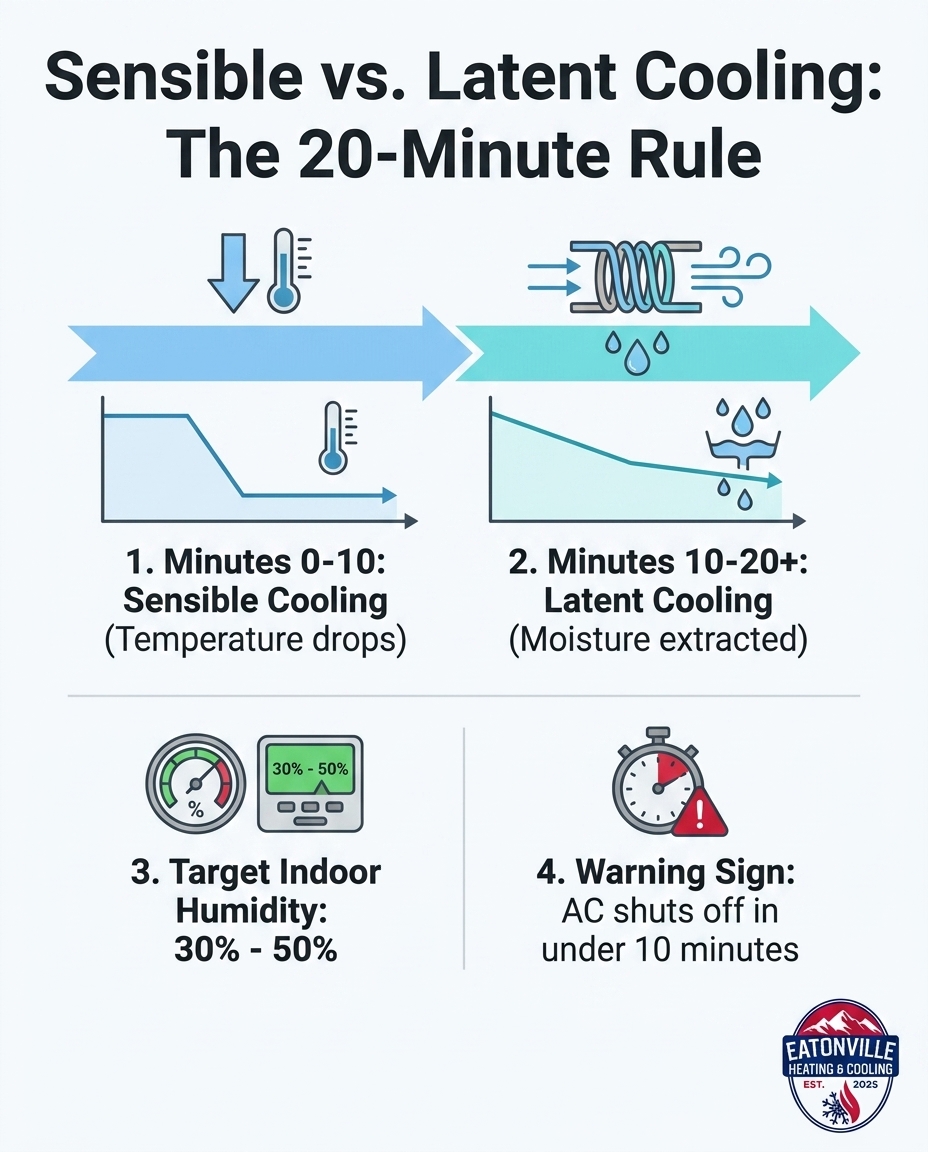
However, this process takes time. According to ASHRAE and Energy Star data, an AC unit typically needs to run for 15 to 20 minutes per cycle to effectively remove latent heat. The first 10 minutes of a cooling cycle are mostly dedicated to sensible cooling. It takes sustained run time for the coil to get cold enough, and stay cold enough, to wring the humidity out of your living space. If you have high indoor relative humidity despite a low thermostat temperature reading, your system is likely not running long enough to perform its latent cooling duties.
The Short-Cycling Trap: When Your AC Cools Too Quickly
The most common cause of high humidity in a cooled home is a mechanical behavior known as short-cycling. This happens when an air conditioner turns on and off rapidly, completing its cooling cycle in just five to ten minutes. While it might seem like a good thing that your house cools down fast, it is actually a major problem for your comfort and your equipment.
The Problem With Oversized Units
When an AC unit is too large for the square footage of the home, it blasts the rooms with a massive volume of cold air. The thermostat registers that the target temperature has been reached very quickly and shuts the system down. Because the cycle was so brief, the evaporator coil never had the necessary 15 to 20 minutes to pull moisture from the air. The result is a cold, clammy room with indoor relative humidity above 50 to 60 percent. A 72-degree room at 65 percent humidity feels far worse than a 76-degree room at 45 percent humidity.
Why Short-Cycling Ruins Comfort
Short-cycling does not just leave you sweating; it actively damages your equipment. The constant starting and stopping puts massive strain on the compressor, leading to premature wear and tear. Our team recently helped a local homeowner who encountered this exact issue with a mini split system that was acting erratically. We diagnosed the problem with the mini split and provided prompt service, resolving the short-cycling behavior so the homeowner didn't have to guess at the complex root cause.
If you suspect your system is shutting off too fast, you can learn more about short-cycling systems and why they require professional attention. Never attempt DIY refrigerant adjustments to try and fix a short-cycling unit. Handling refrigerant requires EPA certification, specialized gauges, and exact mathematical calculations. Adding or removing refrigerant blindly will severely damage your compressor and void your warranty.
Late Summer Marine Pushes: The South Sound Climate Factor
In Western Washington, local weather patterns play a massive role in how your HVAC system performs. The August late-summer cooling season introduces a unique challenge for homeowners in the area: the marine push. Grounding your understanding of humidity in our local climate explains why your AC might struggle more at certain times of the year.
The Sudden Surge of Ambient Moisture
During late summer, the South Sound region frequently experiences marine push events. After a stretch of hot, dry days, cooler, moisture-laden air from the Pacific Ocean pushes inland through the Chehalis Gap and the Strait of Juan de Fuca. This weather event brings a sudden, dramatic spike in outdoor humidity. While the outdoor temperature might drop, the ambient moisture in the air skyrockets.
When this heavy, damp air infiltrates your Lacey home, an air conditioner that is prone to short cycles gets completely overwhelmed. The system senses the cooler indoor temperature and shuts off quickly, but it fails to address the massive influx of marine moisture. This is why your home suddenly feels like a muggy cave in late August.
Local Expertise Matters
Because our climate dictates how an HVAC system should be tuned for optimal latent cooling, working with local experts is critical. In our years servicing homes throughout Eatonville and Lacey, our team has learned exactly how to tune systems to handle the specific dehumidification needs of our unique Western Washington weather patterns. Off-the-shelf settings that work in dry desert climates simply will not cut it when a late-summer marine push rolls into town.
Thermostat Mistakes That Trap Moisture Indoors
Sometimes, the clammy feeling in your home is made worse by how the thermostat is operated. Many homeowners accidentally trap moisture indoors by trying to force the system to cool down a muggy room. If you are dealing with high indoor relative humidity despite a low thermostat temperature reading, check these common thermostat behaviors.
Mistake 1: Dropping the Temperature Too Low
When the house feels sticky, the natural reaction is to walk over to the thermostat and drop the temperature from 72 degrees down to 68 degrees. This actually exacerbates the problem. Lowering the set point forces the unit to blast more cold air, but if the system is oversized or short-cycling, it still will not extend the cycle long enough to pull out the moisture. You end up shivering in a cold, damp room.
Mistake 2: Using the Wrong Fan Setting
Your thermostat fan switch usually has two options: "ON" and "AUTO". Understanding this switch is critical for managing late-summer humidity.
1. Leaving the fan set to "ON": The blower motor runs 24/7, even when the outdoor compressor is turned off.
2. The re-evaporation problem: When the cooling cycle ends, the evaporator coil is left dripping wet with the condensation it just pulled from your air.
3. Blowing moisture back inside: If the fan continues to run on the "ON" setting, it blows warm air over that wet coil. The water evaporates right back into your ductwork and is pushed back into your living rooms.
4. The "AUTO" solution: Always set your fan to "AUTO" during the cooling season. This ensures the fan only blows when the compressor is actively cooling, allowing the moisture on the coil to drip safely down the drain.
Professional Diagnostics for Airflow and System Sizing
If you have corrected your thermostat settings and your home still feels clammy during the August late-summer cooling season, it is time for professional diagnostics. Resolving short-cycling and sizing issues requires specialized tools, mathematical load calculations, and licensed expertise. This is not a weekend DIY project.
Evaluating the Cooling Load
A licensed technician will first evaluate if the system is oversized for your home's actual cooling load. They measure the square footage, check the insulation levels, note the window placements, and calculate exactly how many BTUs of cooling your home requires. If a previous contractor installed a 4-ton unit in a home that only needs 2.5 tons of cooling, the system will always short-cycle and fail to dehumidify.
Airflow Tuning and Refrigerant Checks
Next, the technician performs airflow tuning and a ductwork assessment. If your ductwork is too small, or if there are severe blockages, the system cannot move enough air over the coil to complete a proper cycle. They will measure the static pressure inside the ducts to ensure the blower motor is moving the correct cubic feet per minute (CFM) of air.
Professional refrigerant charge checks are also necessary. Improper refrigerant levels—whether overcharged or undercharged—can cause erratic cycling and poor moisture removal. Because refrigerant is highly regulated, these checks require professional gauges. For instance, when a recent customer's AC went out unexpectedly during an August heatwave, our technicians showed up right away to diagnose and fix the underlying AC issue. Having a trustworthy and knowledgeable professional from our team handle the system ensures that complex electrical and refrigerant components are serviced safely and effectively.
To keep your system running in peak condition and catch airflow issues early, staying on top of routine AC maintenance is highly recommended.
Dedicated Whole-Home Solutions to Conquer Clammy Air
Sometimes, a properly sized and perfectly tuned air conditioner still needs help. During extreme humidity spikes—like those heavy late-summer marine pushes—your AC might not run long enough to remove all the moisture simply because the outdoor temperature is not hot enough to trigger a long cooling cycle. When this happens, supplementary indoor air quality solutions are required.
The Power of Whole-Home Dehumidifiers
A whole-home dehumidifier is a dedicated solution that works in tandem with your existing HVAC system. Unlike a portable unit that you have to empty manually and drag from room to room, a whole-home system is installed directly into your ductwork. It monitors the moisture levels in the air 24/7 and pulls humidity out of the entire house automatically, draining the water directly into your plumbing system.
Energy Savings and Long-Term Protection
By utilizing dedicated dehumidification, you gain precise control over your comfort. Because dry air feels cooler than damp air, you can actually set your AC thermostat to a higher, energy-saving temperature—like 75 degrees—while maintaining perfect comfort. This reduces the workload on your air conditioner and lowers your monthly energy costs.
Beyond comfort, managing humidity provides massive long-term benefits for home preservation. Keeping indoor humidity below 50 percent prevents mold growth, stops hardwood floors from cupping, protects wooden furniture, and deters dust mites. If you are tired of dealing with high indoor relative humidity despite a low thermostat temperature reading, exploring indoor air quality solutions is the definitive way to take control of your home's climate.
Frequently Asked Questions
Why does my house feel muggy even with the AC on?
Your house feels muggy because the AC is lowering the temperature without running long enough to remove the ambient moisture. This is often caused by an oversized unit that cools the room too quickly and shuts off. To effectively pull humidity from the air, the system needs to run in longer, sustained cycles.
Why does my house get humid when the AC turns off?
Humidity rises when the AC turns off because the system is no longer actively extracting moisture from the indoor air. If your thermostat fan is set to "ON" instead of "AUTO," the blower will also push water that was left on the wet evaporator coil back into your living spaces. Ensuring your fan is set to "AUTO" helps prevent this re-evaporation.
Does an oversized AC cause high humidity?
Yes, an oversized AC is one of the leading causes of high indoor humidity. A unit that is too large for the space will blast cold air and satisfy the thermostat in just a few minutes. Because it short-cycles, it never gives the evaporator coil the 15 to 20 minutes required to condense and drain away the airborne moisture.
Should I leave my AC fan on or auto for humidity?
You should always leave your AC fan set to "AUTO" to control humidity. When set to "ON," the fan runs continuously and blows air over the wet indoor coil after the cooling cycle finishes. This evaporates the water right back into your ductwork, making your home feel clammy and damp.
How do I stop my AC from short cycling?
Stopping an AC from short-cycling requires a professional diagnostic check to determine the root cause. A licensed technician will inspect the system for restricted airflow, improper refrigerant charge, or incorrect equipment sizing. Because these fixes involve complex electrical and chemical components, they should never be attempted as a DIY project.
How long should an AC run to properly dehumidify a room?
An AC needs to run for at least 15 to 20 minutes per cycle to properly dehumidify a room. The first 10 minutes are primarily spent dropping the sensible air temperature and getting the evaporator coil cold. The remaining run time is when the heavy lifting of moisture extraction, or latent cooling, actually occurs.
Recent Posts
Differentiating Between Normal Expansion Noises and Furnace Failure
Hearing a loud bang on the first chilly fall morning can be terrifying. Decide with confidence whether to let the system run or shut it down for emergency service.
How Federal Way's Fall Humidity Affects Indoor Air Quality
The transition to damp autumn weather creates a tricky shoulder season for your HVAC system. Without the AC running, ambient moisture gets trapped inside. See how to manage ventilation.
Deciding Between a Modulating and Two-Stage Furnace for Lacey Climates
Upgrading your heating system before the damp winter hits? Find out whether the precise comfort of a modulating unit or the reliability of a two-stage system fits your home.
What a Comprehensive Fall Furnace Inspection Actually Entails
A professional heating tune-up requires much more than a basic filter change. We pull back the curtain on the exact electrical and combustion tests that prevent winter breakdowns.
Repurposing Old AC Pads When Upgrading to a New Heat Pump
Preparing for a fall system upgrade? Reusing a sunken 1990s concrete base can cause poor drainage and oil starvation for modern equipment—see why leveling matters.
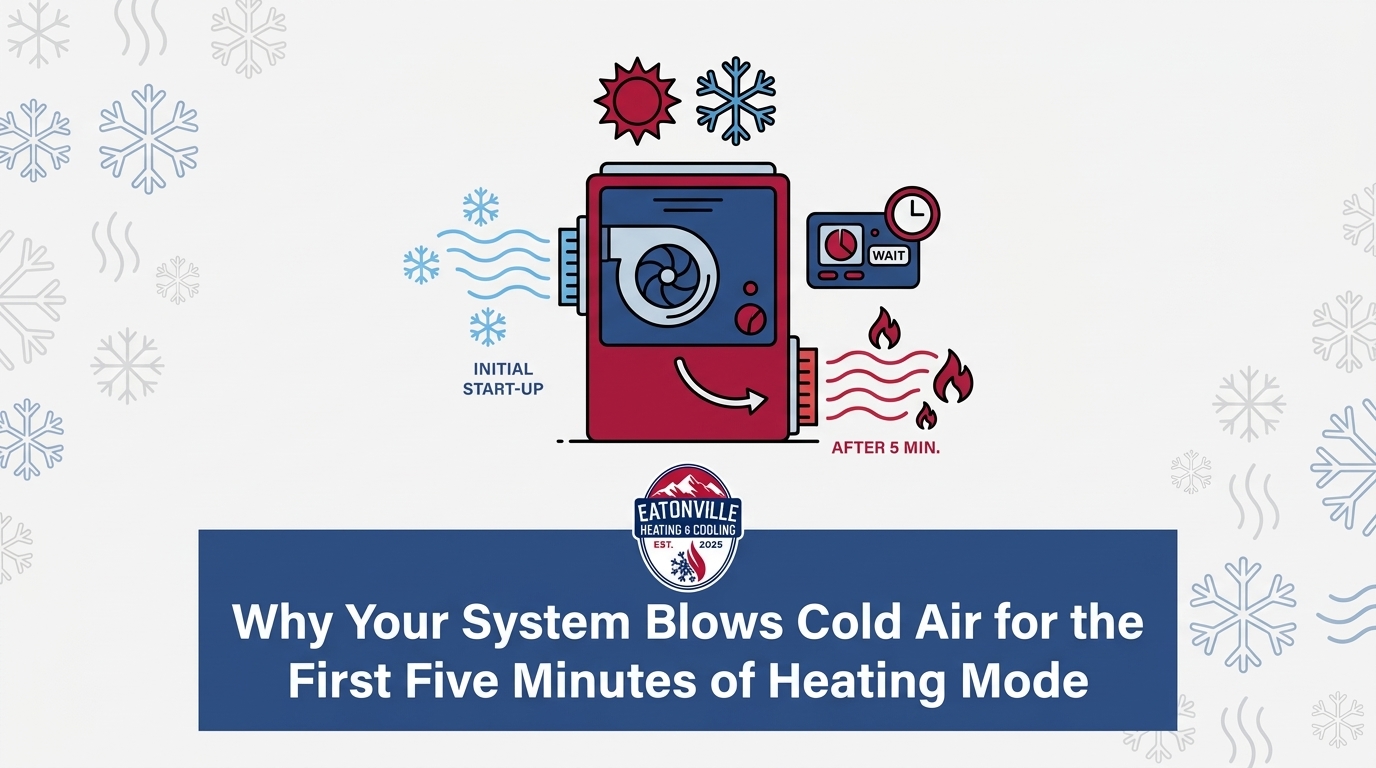
Why Your System Blows Cold Air for the First Five Minutes of Heating Mode
Turning on your furnace on a chilly fall morning only to feel a freezing breeze is stressful. Find out if that initial blast of cold air is normal or a sign of trouble.