



Dealing with Fine Dust Accumulation in Yelm HVAC Systems
Late-summer agricultural dust in Yelm can choke a standard 1-inch air filter in weeks. If you're tired of constant replacements, see why a high-capacity media cabinet is the best solution.
The Late-Summer Struggle with Yelm's Airborne Dust
At Eatonville Heating & Cooling, we constantly hear from customers who pull their air filter out expecting to see a light gray film, but instead, find something that looks like it was dragged down a dry dirt road. Dealing with Fine Dust Accumulation in Yelm HVAC Systems is a highly specific challenge that catches many homeowners off guard, especially as the August late-summer dry and harvest season peaks. Your air conditioner is running longer cycles to combat the heat, pulling massive volumes of air through return vents that are simultaneously drawing in fine silt from the surrounding environment. The result is a filter that cakes over rapidly, starving your system of the air it needs to function properly.
If you are tired of swapping standard filters every few weeks just to keep your system breathing, our team recommends upgrading to professional indoor air quality solutions and securing a proactive HVAC maintenance plan as the most effective path forward.
The underlying issue: Standard manufacturer advice is written for average, mild environments. When an HVAC manual suggests replacing a filter every three months, it assumes a typical suburban neighborhood with paved roads and minimal agricultural activity. Yelm's unique environment breaks those rules completely. During extended dry spells, we see the volume of airborne particulate matter spike dramatically. Continuing to rely on thin, basic filters means you are either sacrificing air quality by letting dust bypass the filter, or you are sacrificing system efficiency by forcing your blower motor to pull air through a brick wall of dirt. Understanding the mechanics of this local dust load is the first step to protecting your equipment and your home's air quality.
How Local Topography Impacts Your Indoor Air Quality
Airborne particulate matter does not behave identically across different regions. As a local team that has spent years servicing the South Puget Sound region, we see firsthand how Yelm's specific environmental challenges differ drastically from generic urban centers. The combination of proximity to farms and unpaved rural routes generates high volumes of fine silt that easily outmaneuver basic filtration systems.
The harvest season spike: During late summer, agricultural activities actively kick up microscopic particles known as PM2.5 and PM10. These particles are incredibly light and can remain suspended in the air for extended periods, carried by warm, dry winds directly toward residential neighborhoods. Unlike heavy dirt or pet hair, which gets trapped easily by cheap fiberglass filters, fine agricultural silt is small enough to slip through the loose weave of a basic filter and infiltrate your home's ductwork.
• Primary Particulates — Typical Urban Puget Sound Area: Vehicle exhaust, pollen, standard household dust — Yelm Agricultural Outskirts: Fine silt, agricultural dust, unpaved road dirt
• Peak Dust Season — Typical Urban Puget Sound Area: Spring (pollen heavy) — Yelm Agricultural Outskirts: August late-summer dry/harvest season
• Filter Load Rate — Typical Urban Puget Sound Area: Gradual accumulation over 60–90 days — Yelm Agricultural Outskirts: Rapid caking, often within 14–21 days
• HVAC Risk Factor — Typical Urban Puget Sound Area: Moderate (gradual efficiency loss) — Yelm Agricultural Outskirts: High (sudden static pressure spikes and coil freezing)
Once this fine dust enters your ductwork, it settles on internal components, coats blower wheels, and circulates back into your living spaces. Homeowners often tell our technicians about a persistent layer of dust on furniture, no matter how frequently they clean. This is a direct indicator that the local particulate load has exceeded the capacity of the current HVAC filtration setup. Acknowledging the reality of Yelm agricultural outskirts and unpaved rural routes is essential for designing a filtration strategy that actually works.
The Hidden Danger of Dust Strain on Your AC System
Fine dust accumulation is not merely an indoor air quality nuisance; it is a severe mechanical threat to your cooling equipment. When a filter becomes heavily caked with silt, it drastically increases the static pressure within your ductwork. Static pressure is essentially the resistance your blower motor must overcome to circulate air. As resistance rises, the motor works harder, runs hotter, and draws more electricity, all while delivering less conditioned air to your rooms.
The freezing coil chain reaction: When airflow drops due to a clogged filter, the evaporator coil inside your indoor unit does not receive enough warm return air to absorb heat. The refrigerant inside the coil drops below freezing, causing the ambient humidity to freeze directly onto the metal fins. A frozen coil completely blocks airflow and can cause liquid refrigerant to flood back to the outdoor compressor, leading to catastrophic system failure. Our repair crews find that ignoring these signs often leads to unexpected breakdowns during peak late-summer heat.
Just last August, one local Yelm homeowner experienced this firsthand when their AC went out unexpectedly during a late-summer heatwave. Our lead technician at Eatonville Heating & Cooling showed up right away, quickly diagnosed the issue as severe airflow restriction caused by a clogged filter, and got the system back online before the house became dangerously hot. If your system is struggling to keep up, scheduling professional AC service is critical to prevent a minor airflow issue from becoming a major component failure.
Why the 90-Day Filter Rule Is a Myth Here
The most common mistake our team sees homeowners make is treating filter replacement as a calendar event rather than a condition-based requirement. Standard 90-day replacement schedules are designed for mild, average conditions with low particulate loads.
• Visual inspections are mandatory: During peak harvest and dry seasons, a 1-inch filter can clog in a matter of weeks, not months. You must check your filter visually every 14 to 21 days.
• The flashlight test: If you hold your air filter up to a bright flashlight and cannot see light shining through the media, it is restricting airflow and must be replaced immediately.
• System runtimes matter: In August, your AC runs significantly longer cycles. More runtime means more air passes through the filter, accelerating the accumulation of fine dust.
The Mechanical Limits of Standard 1-Inch Filters
When our crews are called out for poor airflow, we often find that homeowners have instinctively purchased the highest MERV-rated 1-inch filter they could find at the hardware store. While the intention is good, this approach is mechanically dangerous for your HVAC system. MERV (Minimum Efficiency Reporting Value) measures how effectively a filter traps particles. A higher MERV rating means a tighter weave in the filter media.
The high-MERV trap: Squeezing a tight, restrictive high-MERV material into a standard 1-inch frame creates an immediate pressure drop. It is the equivalent of trying to breathe through a coffee straw while running a marathon. The blower motor is forced to pull massive amounts of air through a highly restrictive barrier. When you add heavy agricultural dust to that already tight filter, the system suffocates rapidly.
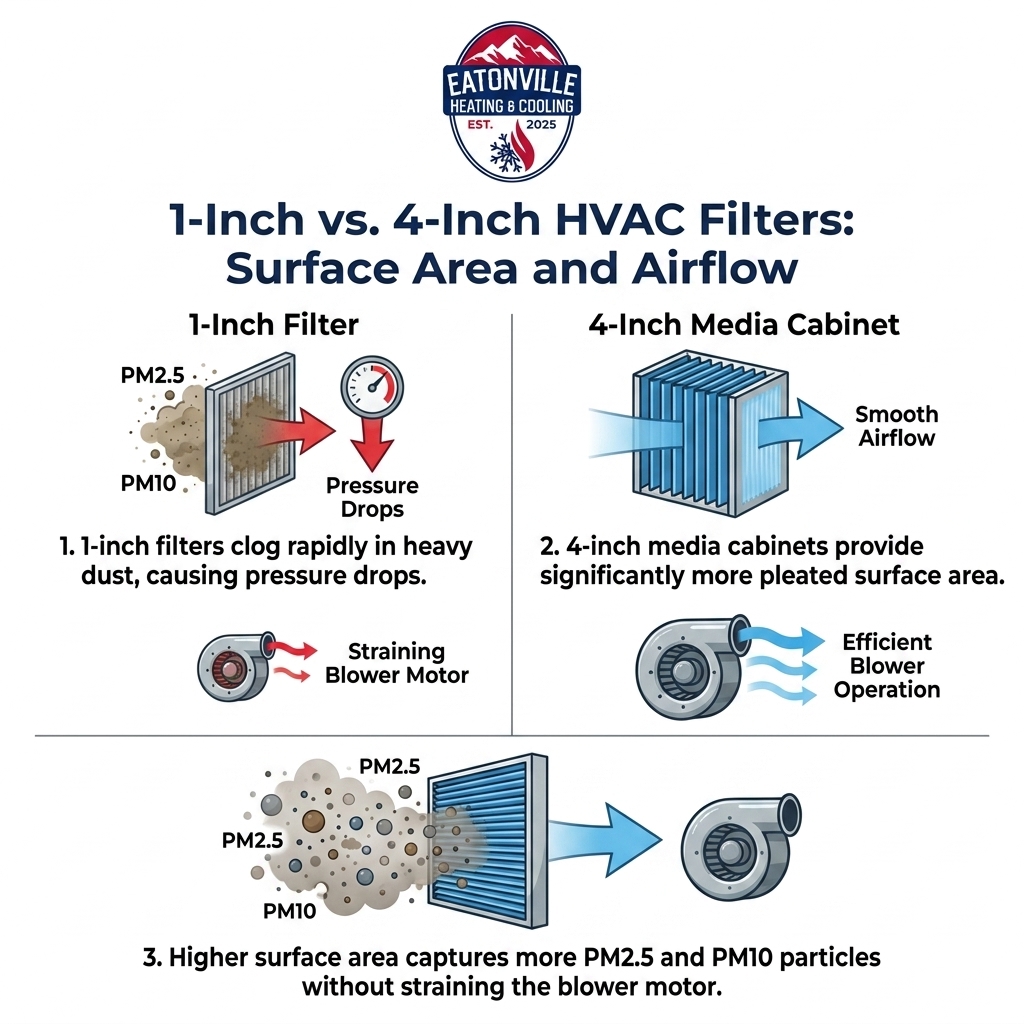
Standard 1-inch filters simply lack the physical surface area required to hold a large volume of dust while still allowing air to pass through. They rely entirely on their flat face area. If your return grille is 20x20 inches, you only have 400 square inches of filter media to capture debris. In an environment with heavy particulate matter, that surface area gets coated and sealed shut incredibly fast, leading to:
• Short-cycling: The system turns on and off rapidly because it overheats from lack of airflow.
• Whistling noises: High static pressure forces air through tiny gaps around the filter frame, creating a high-pitched whistle.
• Uneven cooling: Rooms furthest from the blower receive little to no conditioned air.
Upgrading to a High-Capacity Media Cabinet
Our installation team considers upgrading the physical capacity of the filtration system the ultimate professional solution to heavy, localized dust. This is where the comparison between Standard 1-inch filters vs. 4-inch/5-inch media cabinets becomes critical. A media cabinet is a specialized housing installed directly into your ductwork that accommodates a deeply pleated, thick filter.
The mathematics of surface area: A 4-inch or 5-inch media filter uses an accordion-like pleat design. If you were to unfold a 5-inch media filter and lay it flat, the actual surface area of the filter material would be exponentially larger than a flat 1-inch filter. This massive increase in surface area allows the system to capture grams of fine agricultural dust while maintaining healthy static pressure. The air has countless alternative pathways to flow through, even as sections of the filter begin to collect dirt.
Because installing a media cabinet requires cutting into the existing sheet metal and modifying the return plenum, this is not a do-it-yourself project. It requires a licensed professional to ensure the cabinet is sealed airtight and that the ductwork modifications do not negatively impact the system's aerodynamics.
Addressing airflow and filtration during the late summer is also an essential part of preparing your system for the upcoming seasonal shift. A clean, unrestricted blower motor is vital for efficient heating. Scheduling routine heater maintenance alongside a filtration upgrade ensures your entire HVAC system is calibrated to handle both the remaining heat and the winter months ahead.
Protecting Your Outdoor Equipment from Rural Dust
While indoor air quality gets the most attention from our customers, we always remind them that fine silt and dust don't just affect the inside of a home; they also severely impact the outdoor condenser unit. The outdoor unit is fully exposed to the harsh local environment, and as the fan pulls air through the exterior coils to release heat, it also pulls in the same agricultural dust and unpaved road dirt that plagues your indoor filter.
The insulation effect: The outdoor condenser coils are made of tightly spaced aluminum fins designed to transfer heat from the hot refrigerant inside to the outdoor air. When fine dirt coats these fins, it acts as a thermal blanket. The system loses its ability to release heat efficiently. As a result, the compressor must run longer and work harder to achieve the desired indoor temperature, driving up your energy consumption and accelerating wear and tear on the components.
Regularly inspecting the outdoor unit is necessary in dusty environments. While heavy debris like leaves and twigs are easy to spot, the fine silt that coats the coils is often harder to see until it forms a thick, mud-like layer after a light rain. For detailed guidance on properly maintaining the exterior unit and why a simple spray down isn't always sufficient, reviewing our guide on removing dirt and debris from your outdoor condenser provides valuable next steps.
Frequently Asked Questions About Local HVAC Filtration
Why is my AC filter getting dirty so fast?
Our technicians find that your AC filter gets dirty rapidly due to the high concentration of airborne particulate matter specific to the Yelm environment. During late summer, agricultural activities and dry conditions on unpaved roads kick up fine silt that is easily drawn into your home's return vents. Because standard 1-inch filters have limited surface area, they fill up with this heavy dust load much faster than they would in a typical urban setting.
Is a 4-inch filter better than a 1-inch filter for dust?
Yes, a 4-inch media filter is vastly superior for managing heavy dust loads. The deep pleats in a 4-inch filter provide significantly more surface area, allowing it to capture a larger volume of fine particles without choking off the airflow to your blower motor. This design protects your HVAC equipment from static pressure strain while improving indoor air quality.
How often should I change my HVAC filter in a dusty area?
In a dusty rural or agricultural area, we advise visually inspecting your 1-inch filter every 14 to 21 days during peak dry seasons. While manufacturers often recommend a 90-day replacement schedule, those guidelines do not account for high particulate loads. If you upgrade to a 4-inch or 5-inch media cabinet, you can typically extend the replacement interval to 6 to 12 months, depending on the severity of the local dust.
Do high MERV filters restrict airflow?
High MERV filters can severely restrict airflow if they are compressed into a standard 1-inch frame. The tighter weave required to achieve a high MERV rating creates high static pressure, forcing your blower motor to work harder. To achieve high MERV filtration safely, our installers always recommend using a thicker 4-inch or 5-inch media filter, which provides enough surface area to offset the restrictiveness of the tight media weave.
Can agricultural dust damage my air conditioning compressor?
Yes, heavy agricultural dust can indirectly cause severe damage to your AC compressor. If fine dust clogs the indoor filter and restricts airflow, the indoor coil can freeze, potentially sending liquid refrigerant back to the compressor and destroying it. Additionally, if dust coats the outdoor condenser coils, the compressor overheats as it struggles to release thermal energy into the outside air.
Secure Reliable Comfort with Professional Filtration Solutions
Understanding why local dust is uniquely hard on HVAC systems is the first step toward achieving better indoor air quality and protecting your mechanical equipment. Standard 1-inch filters simply cannot keep up with the heavy particulate loads generated by agricultural activities and dry rural routes, leading to constant replacements and dangerous airflow restrictions.
A professionally installed high-capacity media cabinet solves the root problem by providing the necessary surface area to capture fine silt without suffocating your blower motor. By addressing the specific environmental challenges of your area with the right mechanical upgrades, you can stop fighting a losing battle against dust. Reach out to our expert team at Eatonville Heating & Cooling to assess your ductwork and implement a filtration strategy that delivers reliable, uninterrupted comfort year-round.
Recent Posts

Adapting Yelm Wood-Framed Homes for Modern Central Air
Adding central air to an older wood-framed home takes careful planning. See how attic framing, ductwork and wiring shape a safe, effective upgrade.
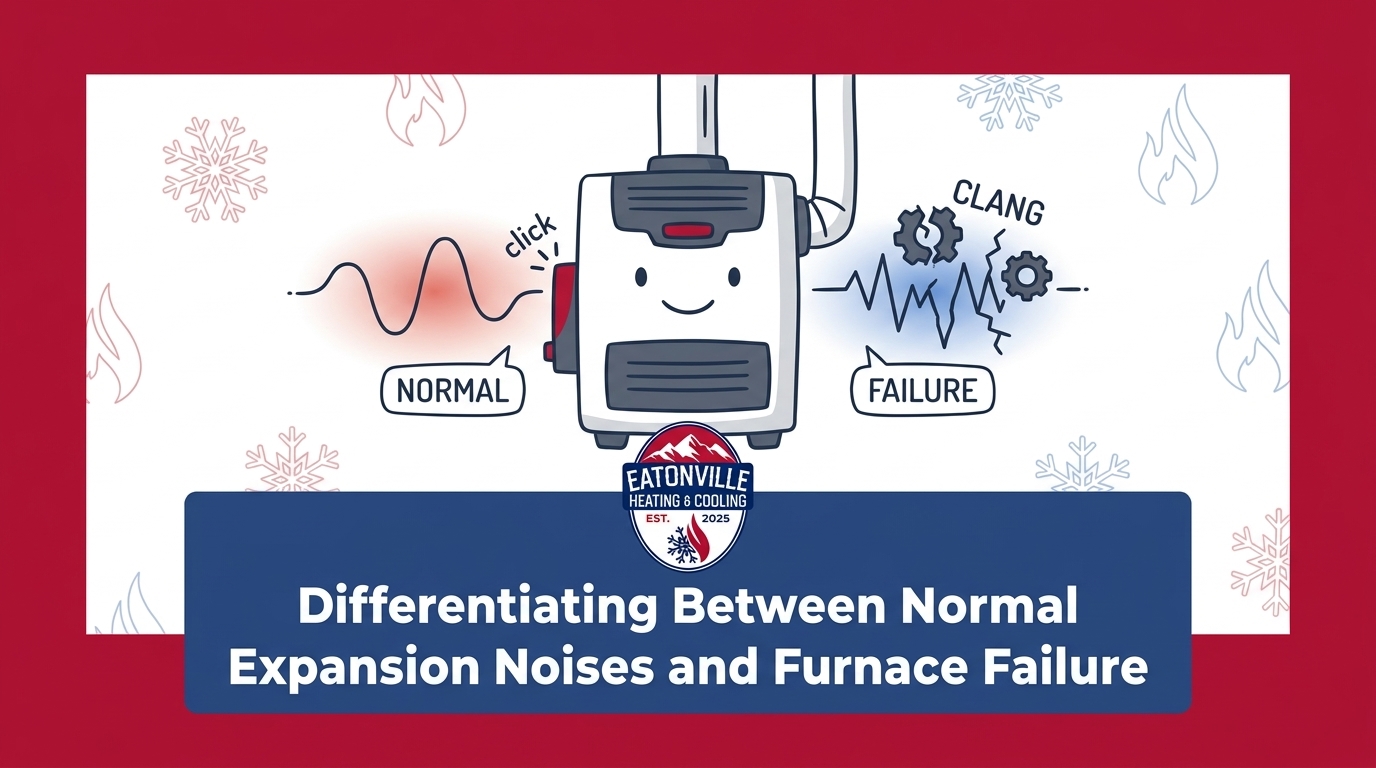
Differentiating Between Normal Expansion Noises and Furnace Failure
Hearing a loud bang on the first chilly fall morning can be terrifying. Decide with confidence whether to let the system run or shut it down for emergency service.
How Federal Way's Fall Humidity Affects Indoor Air Quality
The transition to damp autumn weather creates a tricky shoulder season for your HVAC system. Without the AC running, ambient moisture gets trapped inside. See how to manage ventilation.
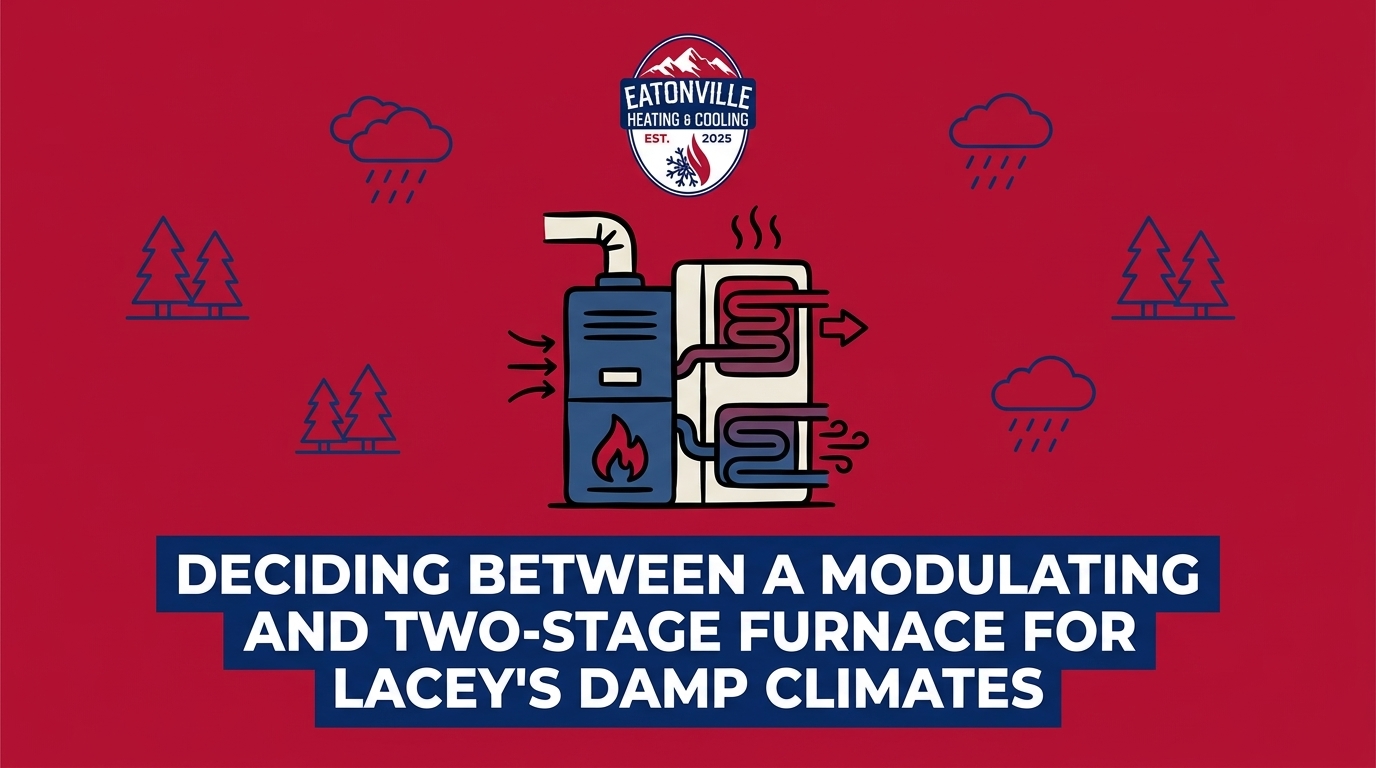
Deciding Between a Modulating and Two-Stage Furnace for Lacey Climates
Upgrading your heating system before the damp winter hits? Find out whether the precise comfort of a modulating unit or the reliability of a two-stage system fits your home.

What a Comprehensive Fall Furnace Inspection Actually Entails
A professional heating tune-up requires much more than a basic filter change. We pull back the curtain on the exact electrical and combustion tests that prevent winter breakdowns.
Repurposing Old AC Pads When Upgrading to a New Heat Pump
Preparing for a fall system upgrade? Reusing a sunken 1990s concrete base can cause poor drainage and oil starvation for modern equipment—see why leveling matters.