


Diagnose Why AC Runs but Doesn’t Cool
Why Your AC Running But Not Cooling Is More Common Than You Think If you're dealing with ac not cooling but running what to check first is probably the most important question you can ask — and the good news is that
Why Your AC Running But Not Cooling Is More Common Than You Think
If you're dealing with ac not cooling but running what to check first is probably the most important question you can ask — and the good news is that most causes are simple enough to diagnose yourself. Here's a quick overview of where to start:
First things to check when your AC runs but won't cool:
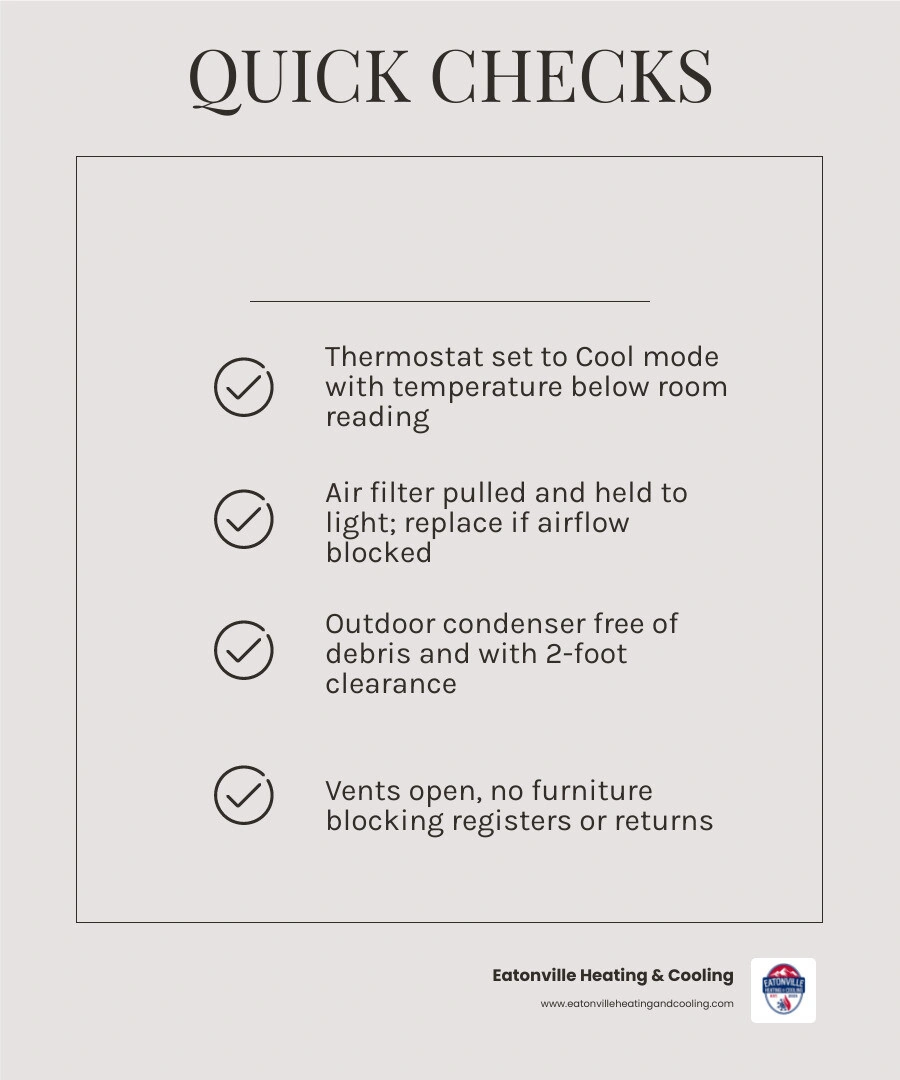
1. Thermostat — Confirm it's set to Cool mode, the fan is on Auto, and the target temperature is below the current room temperature
2. Air filter — Pull it out and hold it up to light; replace it if you can't see through it
3. Outdoor condenser unit — Check for debris, overgrown vegetation, or anything blocking airflow
4. Vents and registers — Make sure none are blocked by furniture, rugs, or closed dampers
5. Frozen coils — Look for ice on the copper refrigerant lines near the indoor unit
6. Circuit breaker — Check if the breaker for the AC has tripped
Most of the time, one of these six checks will point you straight to the problem. If everything looks fine and the air is still warm, that's when it's time to call in a pro.
Running an AC that isn't cooling properly isn't just uncomfortable — it puts real strain on the compressor, which is one of the most expensive parts in the system. Catching the issue early can be the difference between a quick fix and a costly repair.
I'm Matthew Percy, owner of Eatonville Heating & Cooling, and after years of diagnosing HVAC issues across Eatonville, WA, I've seen how often an ac not cooling but running situation comes down to something a homeowner can resolve in under 10 minutes. Keep reading and I'll walk you through each check step by step.
AC Not Cooling But Running What to Check First
When it is May 2026 and the Eatonville sun is beating down on your roof, the last thing you want is a system that makes noise but doesn't lower the temperature. It is incredibly frustrating to hear the hum of the machine and feel air moving through the vents, only to realize your living room is still a sweltering 80 degrees.
The very first thing we always tell our neighbors in Graham and Puyallup to look at is the thermostat. It sounds simple, but you would be surprised how often a setting gets bumped or a battery dies at the exact wrong moment.
The Thermostat Deep-Dive
First, verify that your thermostat is actually in "Cool" mode. Sometimes, after a brief cold snap where you might have switched to "Heat," the system stays there. Next, check the temperature setpoint. For a proper test, set it at least 5 degrees below the current room temperature to ensure the system is being told to work.
Another common culprit is the fan setting. If your fan is set to "On" instead of "Auto," the blower will run 24/7. This means that even when the cooling cycle is off, the system is blowing unconditioned air throughout your house, which can make it feel like the ac not cooling but running what to check first is a mechanical failure when it’s actually just a setting. Furthermore, keeping the fan "On" can actually blow moisture back into your home, increasing humidity.
If your display is blank or flickering, replace the batteries immediately. A weak signal from the thermostat can prevent it from properly engaging the outdoor compressor. For more insights on this, check out The Most Common Reasons Your AC Isn't Keeping Your Home Cool.
Restoring Airflow: Filters and Vents
Airflow is the lifeblood of your HVAC system. Without it, the heat exchange process simply cannot happen. According to the Department of Energy, swapping out a clogged filter for a clean one can reduce your air conditioner's energy consumption by 5% to 15%. In a state like Washington, where we value our energy efficiency, that is a massive saving.
The Impact of a Clogged Filter
A dirty air filter is the number one cause of "running but not cooling" calls. When the filter is packed with dust, pet hair, and debris, the blower motor has to work twice as hard to pull air through. This restriction doesn't just make the air feel weak; it can lead to your indoor evaporator coils getting too cold and freezing into a block of ice.
If you aren't sure if your unit is the right size to handle your home's airflow needs, you can read more about What Size Air Conditioner Do You Really Need for Your Home.
Blocked Registers and Return Vents
Walk through your home in Tacoma or Olympia and check every single vent. Are there rugs covering the floor registers? Is a sofa pushed up against the large return air intake? Blocked vents force the system to recirculate the same stagnant air, preventing it from pulling heat out of the rooms effectively.
AC Not Cooling But Running What to Check First for Airflow Issues
If you’ve replaced the filter and opened the vents but still have issues, consider the following:
• MERV Ratings: For most homes in our area, a MERV 8 to 11 filter is the "sweet spot." Anything higher (like MERV 13+) might be too restrictive for older residential blowers, causing the very cooling issues you're trying to avoid.
• The Light Test: If you hold your filter up to a bright light and cannot see any light passing through the fibers, it is effectively a wall. Change it immediately.
• Duct Leaks: The Department of Energy estimates that typical homes lose 20% to 30% of conditioned air through duct leaks. If your AC is running perfectly but the air isn't reaching the bedrooms in Bonney Lake, your attic ducts might be cooling the squirrels instead of your family.
Inspecting the Outdoor Condenser Unit
The outdoor unit (the condenser) is responsible for releasing the heat collected from inside your home into the outside air. If this unit is "suffocating," your house will never get cool.
Clear the Perimeter
Over the spring, it’s easy for blackberry bushes or tall grass to surround your unit. We recommend maintaining at least a 2-foot clearance around the entire unit. Trim back any shrubs and remove any "treasures" like toys or garden tools that might have leaned against the fins.
Cleaning the Coils
The metal fins on the outside of your unit act like a radiator. If they are coated in dirt, pollen, or "cottonwood fluff" (a common sight in Sumner and Orting), they can't release heat.
How to safely clean your condenser:
1. Turn off the power at the outdoor disconnect switch or the breaker.
2. Use a standard garden hose (never a pressure washer, as it will crush the delicate fins).
3. Gently rinse the unit from the top down, washing the debris out of the fins.
If you notice the fins are bent, you can use a "fin comb" to carefully straighten them. Regular attention to these details is part of why How Regular AC Maintenance Protects Your System and Your Budget is such a vital concept for local homeowners.
Managing Frozen Coils and Refrigerant Issues
One of the most confusing sights for a homeowner is seeing ice on their AC unit when it’s 90 degrees outside. If you see frost on the copper lines leading into your house or on the indoor evaporator coil, your system has "frozen up."
Why Your AC Freezes
When airflow is restricted (due to those dirty filters we mentioned) or when refrigerant levels are low, the temperature of the coil drops below freezing. Humidity in the air then turns to ice on the coil, creating an insulated barrier that prevents the AC from absorbing any more heat. To understand the mechanics behind this, read Why Your AC Freezes Up and What You Can Do About It.
The Thawing Process
If you find ice, turn off the cooling immediately. If you keep running it, you risk "slugging" the compressor with liquid refrigerant, which can destroy the motor. Switch your thermostat to "Fan Only" mode. This will blow warm indoor air over the ice to melt it. This process can take 2 to 4 hours. Do not attempt to scrape the ice off with a tool, as you will likely puncture the delicate copper lines.
Signs of a Refrigerant Leak
Refrigerant does not get "used up" like gasoline in a car. It circulates in a sealed loop. If you are low on refrigerant, you have a leak.
• Hissing or Bubbling: A faint hissing sound near the indoor or outdoor unit often indicates a high-pressure leak.
• Ice Buildup: As mentioned, low pressure causes freezing.
• Warm Air: If the air coming out of the vents is exactly the same temperature as the air going in, the heat transfer medium (refrigerant) is likely gone.
Handling refrigerant requires EPA Section 608 certification. This is not a DIY job. If you suspect a leak, it’s time to weigh your options—sometimes a repair is easy, but on older units, it might be time for a change. See our guide on Repair or Replace Your AC: How to Make the Right Call.
Frequently Asked Questions
Air conditioning isn't just a luxury anymore; it's a vital part of home health. About 88% of U.S. homes now have AC, and it accounts for roughly 12% of household electricity use. American homeowners spend about $29 billion each year just to stay cool. Understanding your system helps keep those costs down.
Why is my AC running but not cooling the house?
The most common reasons include a thermostat set to the wrong mode, a heavily clogged air filter that's choking the system, or an outdoor unit that is too dirty to release heat. More serious issues include a failed capacitor (the "battery" that starts the compressor) or a refrigerant leak.
Should I turn off my AC if it is not blowing cold air?
Yes. If your AC is running but the temperature is rising, turn it off. Continuing to run a malfunctioning system puts immense stress on the compressor. If the system is frozen, running it can cause permanent mechanical failure. It is better to be warm for a few hours while you troubleshoot than to face a total system replacement.
AC Not Cooling But Running What to Check First for a System Reset?
If your system seems "glitched," you can perform a hard reset:
1. Turn the system off at the thermostat.
2. Flip the circuit breaker for both the indoor and outdoor units to "Off."
3. Wait at least 3 to 5 minutes (the "3-minute rule" allows pressures in the system to equalize).
4. Flip the breakers back on.
5. Set the thermostat back to "Cool."
Conclusion
At Eatonville Heating & Cooling, we know that your home is your sanctuary. As a family-owned company based right here in Eatonville, WA, we’ve spent years serving our neighbors in Spanaway, Yelm, and University Place. We believe in transparency and helping our customers understand their systems so they can stay comfortable without unnecessary stress.
If you’ve walked through these steps—checked your thermostat, swapped your filter, and cleaned your outdoor unit—and you’re still sweating, don't wait for the problem to get worse. Our expert technicians are ready to provide reliable, fast service to get your home back to the perfect temperature.
Whether you're in Lakewood, Federal Way, or right here in Eatonville, we’re just a phone call away. Schedule your professional air conditioning service today and let us take the heat off your shoulders!
Recent Posts

Adapting Yelm Wood-Framed Homes for Modern Central Air
Adding central air to an older wood-framed home takes careful planning. See how attic framing, ductwork and wiring shape a safe, effective upgrade.
Differentiating Between Normal Expansion Noises and Furnace Failure
Hearing a loud bang on the first chilly fall morning can be terrifying. Decide with confidence whether to let the system run or shut it down for emergency service.
How Federal Way's Fall Humidity Affects Indoor Air Quality
The transition to damp autumn weather creates a tricky shoulder season for your HVAC system. Without the AC running, ambient moisture gets trapped inside. See how to manage ventilation.
Deciding Between a Modulating and Two-Stage Furnace for Lacey Climates
Upgrading your heating system before the damp winter hits? Find out whether the precise comfort of a modulating unit or the reliability of a two-stage system fits your home.
What a Comprehensive Fall Furnace Inspection Actually Entails
A professional heating tune-up requires much more than a basic filter change. We pull back the curtain on the exact electrical and combustion tests that prevent winter breakdowns.
Repurposing Old AC Pads When Upgrading to a New Heat Pump
Preparing for a fall system upgrade? Reusing a sunken 1990s concrete base can cause poor drainage and oil starvation for modern equipment—see why leveling matters.