



Choosing Between Side-Discharge and Traditional Condensers for Tight Lot Lines
Squeezing a standard AC into a narrow side yard can trap hot exhaust and ruin efficiency. Compare spatial and airflow differences to find what fits your property.
Will Your New AC Actually Fit? The Narrow Yard Dilemma
Are you looking at the narrow strip of grass between your home and your neighbor's fence, wondering how a massive metal cooling system is supposed to operate there safely? Choosing Between Side-Discharge and Traditional Condensers for Tight Lot Lines is one of the most important decisions you will make when upgrading your home comfort, especially if your property lacks a sprawling backyard. In many dense suburban neighborhoods throughout Western Washington, homeowners face the exact same architectural challenge: squeezing modern cooling technology into Federal Way narrow side yards without violating local building codes or suffocating the equipment.
The dilemma usually starts when you realize that installing a cooling system is about much more than just finding a physical footprint that accommodates the metal box. A condenser needs to breathe. If you wedge a standard, cube-shaped unit into a highly restricted space, you risk creating an environment where the machine constantly chokes on its own hot exhaust. This leads to poor performance, skyrocketing utility bills, and premature mechanical failure.
Fortunately, you have options. The HVAC industry has evolved rapidly, offering distinct architectural styles to solve spatial constraints. Upgrading your air conditioning systems now involves choosing between the familiar, top-venting traditional condenser and the modern, slimline side-discharge unit. Making the right choice ensures that your AC installation in Federal Way not only passes municipal inspection but also delivers reliable, efficient cooling for years to come without turning your side yard into an unusable, noisy wind tunnel.
Understanding Airflow Physics: Why Traditional Units Struggle in Tight Spaces
To understand why specific condenser shapes matter, you have to look at the physics of how an air conditioner actually cools your home. Your outdoor unit does not create cold air; it absorbs heat from inside your house and pumps it outside, releasing it into the atmosphere. How that heat disperses determines the efficiency of your entire system.
The Threat of Hot Air Recirculation
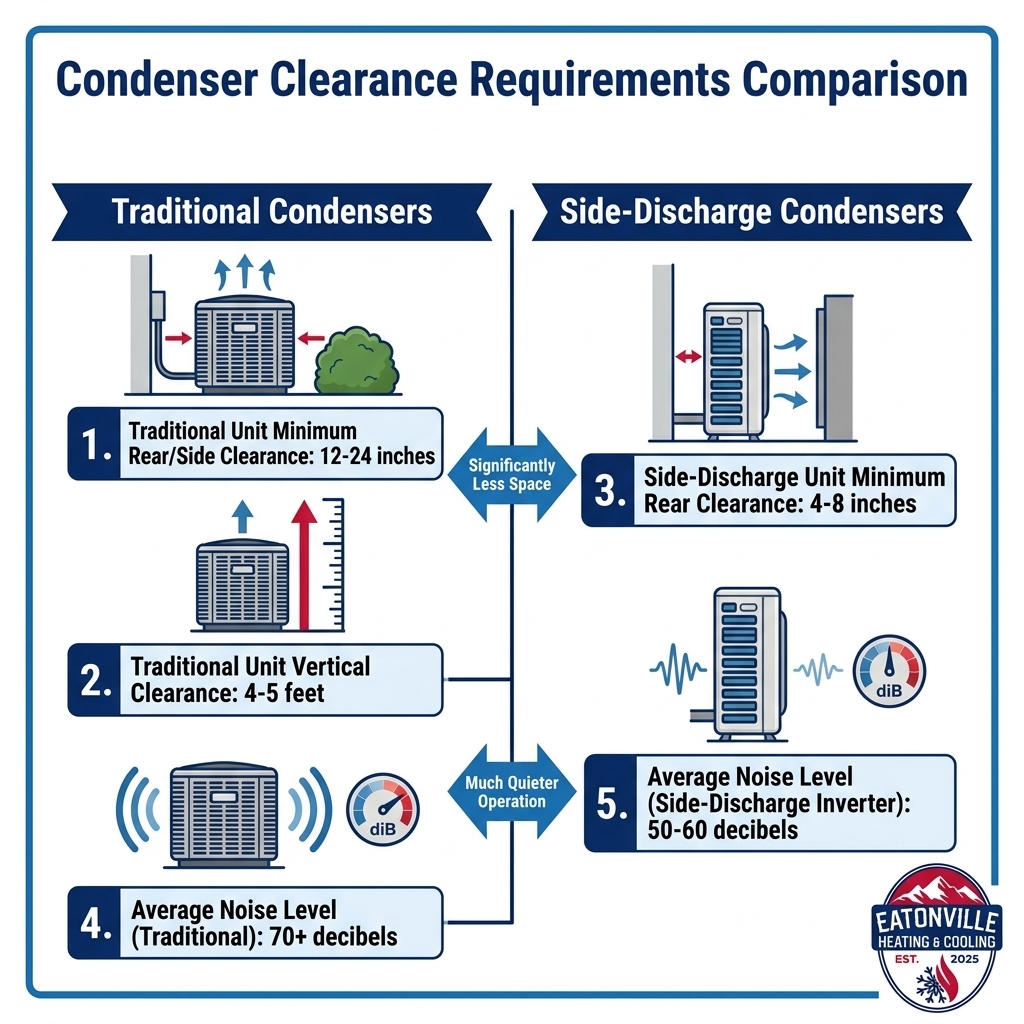
Traditional condensers are designed as large cubes that draw fresh ambient air through the sides and forcefully exhaust hot air straight up through the top. For this process to work properly, a traditional unit typically requires four to five feet of completely unobstructed vertical clearance. When you place one of these units in a tight side yard—especially under an overhanging roof eave or right next to a solid six-foot privacy fence—that upward exhaust hits a barrier.
Instead of dispersing into the atmosphere, the hot air deflects off the eaves or the fence and pools around the unit. The condenser then pulls that same hot, rejected air right back into its intake fins. This phenomenon is known as hot air recirculation, and it forces the compressor to work dramatically harder to achieve the same amount of cooling. During August late-summer cooling demands, when heat domes settle over the region, this recirculation can cause a traditional unit to overheat, short-cycle, or shut down entirely right when you need it most.
The Horizontal Airflow Solution
Side-discharge units, often referred to as slimline condensers, operate on a completely different airflow principle. Instead of pushing air up, they draw air in through the back and forcefully push it horizontally out the front. This design is uniquely suited for tight boundaries.
Because the air is pushed horizontally away from the home, a side-discharge unit can be backed up almost directly against an exterior wall. The hot exhaust is directed outward into the open yard rather than upward into an eave. If you are considering an AC replacement, Eatonville Heating & Cooling specializes in evaluating these specific property layouts to prevent airflow choke points. By analyzing the exact dimensions of your property line, professionals can ensure your new system has the breathing room it needs to operate at peak efficiency, preventing the dreaded late-summer breakdown.
Clearance Codes and Property Line Setbacks Compared
Beyond the physics of airflow, homeowners must also navigate strict legal and manufacturer requirements. There are two sets of rules that govern where a condenser can sit: manufacturer clearance specifications (which keep the machine running) and municipal building codes (which govern property lines and neighborly disputes).
Traditional top-discharge condensers typically demand 12 to 24 inches of open clearance on all four sides. If your side yard is only four feet wide, a standard 30-inch-wide cube unit immediately violates these clearances, leaving insufficient room for airflow or for a technician to perform routine maintenance. In contrast, side-discharge units are built like a suitcase. They are tall and wide but incredibly shallow. Many slimline models can operate safely with as little as 4 to 8 inches of rear clearance against your home's foundation.
Comparing Spatial Requirements
Understanding the hard data helps clarify exactly what is permissible in Federal Way narrow side yards. Local setback requirements also dictate how close any permanent structure or mechanical equipment can sit to the actual property boundary line. If a traditional unit pushes too far into the required setback zone, an inspector can force you to move it.
• Typical Footprint Size — Traditional Top-Discharge Condenser: 29" x 29" to 35" x 35" (Cube) — Side-Discharge (Slimline) Condenser: 12" x 32" to 15" x 37" (Suitcase)
• Minimum Rear Clearance — Traditional Top-Discharge Condenser: 12 to 24 inches — Side-Discharge (Slimline) Condenser: 4 to 8 inches
• Minimum Side Clearance — Traditional Top-Discharge Condenser: 12 to 24 inches — Side-Discharge (Slimline) Condenser: 4 to 8 inches
• Vertical Clearance Needed — Traditional Top-Discharge Condenser: 48 to 60 inches (unobstructed) — Side-Discharge (Slimline) Condenser: Minimal (exhausts horizontally)
• Front Exhaust Clearance — Traditional Top-Discharge Condenser: N/A (exhausts upward) — Side-Discharge (Slimline) Condenser: 20 to 24+ inches (for airflow path)
By drastically reducing the depth of the unit and the required rear clearance, side-discharge models free up valuable walkway space and ensure you remain compliant with strict municipal property line setbacks.
Navigating Noise Decibels and HOA Regulations
Airflow and physical dimensions are not the only constraints when dealing with tight lot lines. Noise pollution is a massive factor that catches many homeowners off guard. Narrow side yards flanked by your home's exterior wall on one side and a solid wooden or vinyl fence on the other act as acoustic echo chambers. When a loud machine turns on in that confined corridor, the sound waves bounce back and forth, amplifying the noise and sending it directly into your—or your neighbor's—windows.
The Echo Chamber Effect
Traditional single-stage air conditioners are powerful, but they operate with a heavy mechanical clunk when they cycle on, and the large fan blades generate significant wind noise. These units frequently operate at 70 decibels or higher. In an open backyard, 70 decibels dissipates quickly. In an echo chamber, it sounds like a lawnmower running constantly outside your living room.
This is where Homeowner Associations (HOAs) step in. Many planned communities enforce strict noise ordinances that limit mechanical sounds crossing property lines. If your new traditional unit violates this decibel limit, the HOA can mandate its removal.
Quiet Operation by Design
Side-discharge units offer a distinct advantage here. Because the vast majority of slimline models utilize variable-speed inverter compressors (rather than traditional single-stage motors), they operate at a fraction of the volume. An inverter-driven side-discharge unit frequently runs between 50 and 60 decibels—roughly the volume of a quiet conversation or a modern refrigerator.
Having localized experience in navigating HOA noise restrictions specifically for Pacific Northwest residential layouts means recognizing these acoustic traps before installation begins. Recommending a side-discharge unit in Federal Way narrow side yards often prevents lengthy disputes with neighbors and ensures total compliance with strict community bylaws.
Inverter Technology: A Perfect Match for Western Washington
When you pivot from a traditional cube to a slimline unit, you are usually doing more than just changing the shape of the metal box—you are upgrading the internal technology. The overwhelming majority of modern side-discharge units are actually highly advanced inverter-driven heat pumps, rather than basic, cooling-only air conditioners.
Understanding how this technology works reveals why these systems are ideal for the regional climate. A traditional single-stage compressor only knows one speed: 100% capacity. It blasts cold air until the thermostat is satisfied, shuts off completely, and then slams back on when the house warms up. This constant on-and-off cycling draws massive amounts of electricity and creates uneven temperature swings.
• Variable-Speed Precision: Inverter technology operates like the accelerator pedal in a car. It ramps up smoothly to reach the desired temperature and then dials back to a low, continuous purr to maintain that comfort perfectly.
• Year-Round Utility: Because many side-discharge models are heat pumps, they can reverse their operation to provide highly efficient heating during the chilly, damp winters, making them a year-round comfort solution.
• Energy Efficiency: By avoiding the massive power spikes of constant hard starts, inverter systems consume significantly less electricity over the course of a season.
This steady, continuous operation is particularly effective during August late-summer cooling periods. Instead of fighting the heat wave with aggressive blasts of air, the system smoothly extracts humidity and heat all day long. Furthermore, upgrading to high-efficiency heat pump options often qualifies homeowners for various generic energy rebates or federal tax credits designed to promote electrification (always verify current programs with a tax professional or your local utility provider). Ultimately, choosing a side-discharge unit is not just a spatial compromise; it is a definitive upgrade in home comfort technology.
Connecting the System: Indoor and Outdoor Synergy
While the focus of a tight lot line dilemma is naturally on the outdoor condenser, it is vital to remember that the outdoor equipment is only half of the equation. The placement of your outdoor unit directly dictates how the refrigerant lines, electrical wiring, and condensation drains route into your home to connect with the indoor air handler or evaporator coil.
Line-Set Routing Flexibility
In a traditional setup, if the outdoor unit is forced to sit in a less-than-ideal location just to meet clearance codes, the installation team must run long, winding line-sets across your home's exterior or through crawlspaces to reach the indoor equipment. The longer the refrigerant lines, the harder the compressor has to work to pump the cooling agent back and forth, which can result in a slight loss of efficiency.
Because side-discharge units are compact and require minimal rear clearance, they offer far more flexibility in placement. They can often be mounted on wall brackets, tucked neatly behind landscaping, or placed much closer to the ideal entry point for the indoor equipment. This synergy between indoor and outdoor placement reduces the length of the refrigerant run, resulting in a cleaner aesthetic on the exterior of your home and better overall system efficiency.
Optimizing this outdoor placement provides a natural transition to evaluating your interior setup. If you are utilizing ductless technology alongside your slimline condenser, understanding where to place the indoor unit of a mini split is the next critical step in achieving perfect, whole-home comfort.
Frequently Asked Questions About Condenser Clearances
What is the minimum clearance for an AC condenser?
Clearance requirements depend entirely on the style of the unit. Traditional top-discharge units generally need 12 to 24 inches of clearance on all four sides and 4 to 5 feet of completely unobstructed vertical space above them. Side-discharge units, however, can often operate safely with just 4 to 8 inches of rear clearance, though they need about two feet of open space in front to exhaust air horizontally.
Can I put my AC unit next to a fence?
Yes, you can place a unit near a fence, but the type of condenser dictates how close it can sit. Traditional top-discharge units struggle near solid fences because the barrier can trap hot exhaust air, leading to recirculation and overheating. Side-discharge units are much better suited for fence-line placement because they draw air from the back and forcefully push it horizontally, avoiding the trapped-air effect.
Are side discharge AC units better for narrow yards?
Yes, side-discharge units are widely considered the superior choice for narrow side yards. Their slim, suitcase-like profile frees up walkway space, and their horizontal airflow prevents the hot air recirculation that plagues traditional units in tight corridors. Additionally, their quieter inverter technology prevents noise from echoing off nearby fences and into windows.
How much space does a slimline AC need?
A slimline (side-discharge) AC requires a remarkably small footprint compared to standard units. It typically requires only a few inches (usually 4 to 8) of rear clearance against a wall or foundation. However, front clearance is required for the horizontal exhaust path, meaning you generally need 20 to 24 inches of open air directly in front of the fan to prevent airflow restriction.
Do side-discharge units meet local HOA noise limits?
In almost all cases, yes. Side-discharge units frequently utilize variable-speed inverter technology, which allows them to run at significantly lower decibel levels—often between 50 and 60 decibels. Because they lack the loud mechanical clunk and high fan noise of traditional single-stage units, they are highly likely to comply with even the strictest neighborhood HOA noise regulations.
Expert Guidance for Your Narrow Lot Line Installation
You do not have to sacrifice cooling power or system efficiency just because your property features a tight lot line. By understanding the differences in airflow physics, clearance codes, and noise decibels, you can select a system that fits your space legally and operates flawlessly. Whether a standard model fits the bill or a slimline unit is required to prevent recirculation, professional guidance removes the guesswork from the equation.
A thorough, on-site assessment can determine the exact footprint, setback requirements, and airflow needs specific to your property's architecture. Do not wait until the late-summer heat exposes the flaws in an aging system. Reach out for a professional evaluation today to ensure your next AC installation in Federal Way delivers reliable, quiet, and efficient comfort tailored perfectly to your home's unique layout.
Recent Posts

Adapting Yelm Wood-Framed Homes for Modern Central Air
Adding central air to an older wood-framed home takes careful planning. See how attic framing, ductwork and wiring shape a safe, effective upgrade.
Differentiating Between Normal Expansion Noises and Furnace Failure
Hearing a loud bang on the first chilly fall morning can be terrifying. Decide with confidence whether to let the system run or shut it down for emergency service.

How Federal Way's Fall Humidity Affects Indoor Air Quality
The transition to damp autumn weather creates a tricky shoulder season for your HVAC system. Without the AC running, ambient moisture gets trapped inside. See how to manage ventilation.
Deciding Between a Modulating and Two-Stage Furnace for Lacey Climates
Upgrading your heating system before the damp winter hits? Find out whether the precise comfort of a modulating unit or the reliability of a two-stage system fits your home.

What a Comprehensive Fall Furnace Inspection Actually Entails
A professional heating tune-up requires much more than a basic filter change. We pull back the curtain on the exact electrical and combustion tests that prevent winter breakdowns.
Repurposing Old AC Pads When Upgrading to a New Heat Pump
Preparing for a fall system upgrade? Reusing a sunken 1990s concrete base can cause poor drainage and oil starvation for modern equipment—see why leveling matters.