

How to Fix AC Circuit Breaker Tripping
What to Do When Your Circuit Breaker Trips Every Time Your AC Turns On If you're dealing with a circuit breaker tripping when AC turns on what to do about it is probably the first thing on your mind — especially on
What to Do When Your Circuit Breaker Trips Every Time Your AC Turns On
If you're dealing with a circuit breaker tripping when AC turns on what to do about it is probably the first thing on your mind — especially on a hot Pacific Northwest summer day. Here's a quick answer before we dive deeper:
Quick steps to take right now:
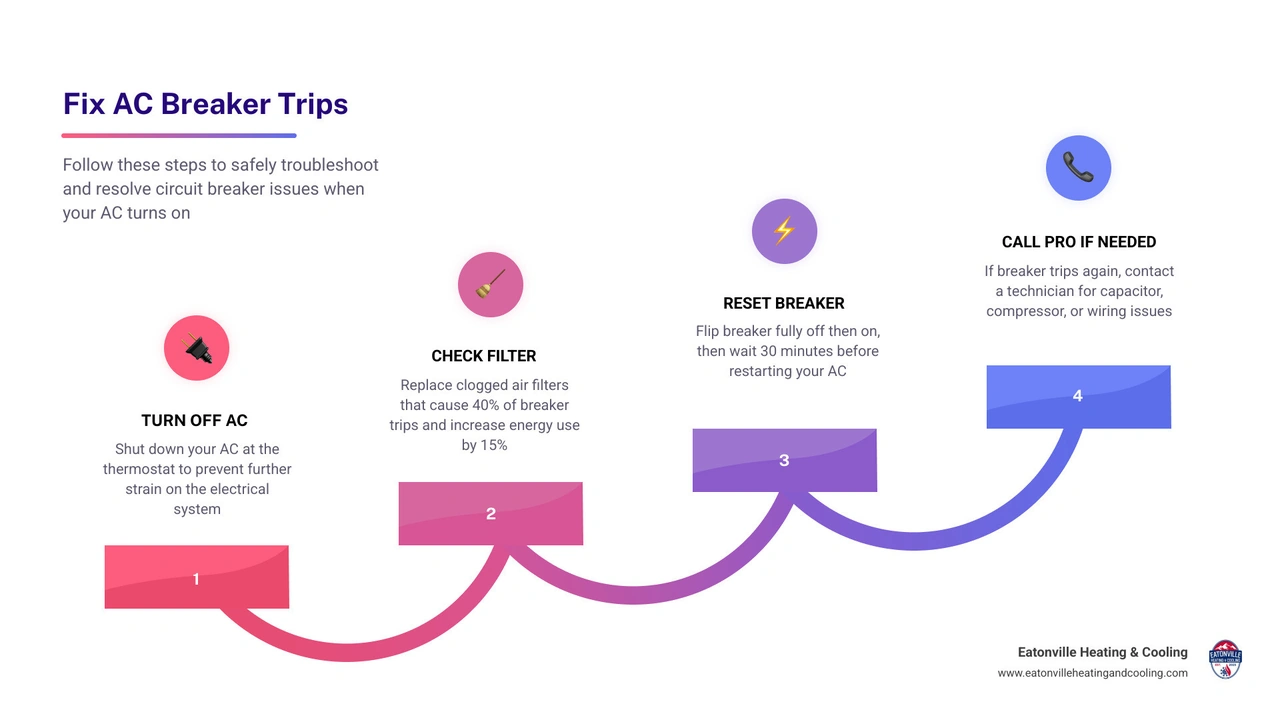
1. Turn off your AC at the thermostat before touching the breaker
2. Check your air filter — replace it if it's clogged
3. Reset the breaker once by flipping it fully off, then back on
4. Wait 30 minutes, then turn the AC back on at the thermostat
5. Stop and call a professional if the breaker trips again immediately
Do not keep resetting a tripping breaker. Repeated resets without fixing the cause can damage your system or create a fire risk.
Your circuit breaker is not the enemy here — it's doing exactly what it's designed to do. When your AC pulls more electricity than the circuit can safely handle, the breaker cuts power to prevent overheating, equipment damage, or worse, an electrical fire. A clogged air filter alone accounts for roughly 40% of AC breaker issues, and dirty condenser coils can push energy consumption up by as much as 30%. So while the tripping is frustrating, it's telling you something important.
The causes range from simple fixes you can handle yourself — like swapping out a dirty filter — to more serious electrical faults that need a licensed technician. Knowing which is which can save you time, money, and stress.
I'm Matthew Percy, owner of Eatonville Heating & Cooling, and over the years I've diagnosed countless cases of a circuit breaker tripping when AC turns on and what to do to fix it safely and permanently. In this guide, I'll walk you through everything from basic homeowner checks to the warning signs that mean it's time to call a pro.
Common Mechanical Causes for a Tripping Breaker
When we think of electrical trips, we often jump straight to wires and fuses. However, in our experience serving homes from Tacoma to Graham, the culprit is frequently a mechanical issue that forces the electrical system to work harder than it should. When your AC struggles to move air or shed heat, it draws more amperage. If that draw exceeds the breaker’s rating, "click"—you’re sitting in the heat. Understanding the most common reasons your AC isn't keeping your home cool often leads us directly to the reason the breaker is tripping.
Clogged Air Filters and System Strain
It might surprise you to learn that a simple piece of pleated fabric can take down your entire cooling system. Statistics show that a clogged air filter is responsible for about 40% of AC breaker issues.
When the filter is packed with dust, pet hair, and debris, the blower motor has to work overtime to pull air through the restriction. This extra effort can increase electrical consumption by up to 15%. Eventually, the motor draws so much current that the circuit becomes overloaded. If you haven't changed your filter in the last few months, this is the very first place you should look.
Dirty Condenser Coils and Overheating
Your outdoor unit contains condenser coils that are responsible for releasing the heat collected from inside your home. In May 2026, as the pollen flies in Federal Way and Puyallup, these coils can quickly become coated in "fuzz" and dirt.
Dirty condenser coils act like a thermal blanket, trapping heat inside the system. This reduces cooling capacity by as much as 40% and forces the compressor to run at higher pressures and temperatures. To keep up, the system can increase energy consumption by up to 30%. This massive spike in power demand is a common reason for the circuit breaker tripping when AC turns on what to do scenarios we see during early summer heatwaves.
Circuit breaker tripping when ac turns on what to do: A Homeowner's Guide
If you find yourself standing in front of your electrical panel in the dark, don't panic. There are safe, logical steps you can take to troubleshoot the issue before you need to pick up the phone. Safety is our number one priority at Eatonville Heating & Cooling, so always remember: if something smells like it's burning or you see sparks, stop immediately and call for AC Repair Eatonville WA.
Immediate Troubleshooting: Circuit breaker tripping when ac turns on what to do
The "Hard Reset" is the most effective first step for any homeowner. Follow this sequence precisely:
1. Thermostat Check: Go to your thermostat and turn the system to "Off." This prevents the AC from trying to start up the moment you flip the breaker, which can cause a secondary surge.
2. The Panel Flip: Find your AC breaker (usually a double-pole breaker labeled "AC" or "HVAC"). Flip it all the way to the "Off" position—you should feel a firm click. Then, flip it back to "On."
3. The Cooling Period: Wait at least 30 minutes. This allows the internal components of the AC, like the compressor, to cool down and the internal pressures to equalize.
4. The Test: Turn the thermostat back to "Cool." If the system starts and stays running, you likely had a temporary "nuisance trip" perhaps caused by a power blip. If it trips again immediately, you have a hard fault that requires professional attention.
Safe Homeowner Inspections in May 2026
While you wait that 30 minutes for the system to cool, perform a quick visual sweep of your property. Ensure all supply and return vents inside the house are open and unobstructed by furniture or curtains. Outside, check the condenser unit. It needs at least two feet of clear space for proper airflow. Trim back any Lacey or Olympia spring growth that might be crowding the unit.
Dirty Air FilterBlocked VentsOutdoor DebrisTrips ImmediatelyBurning SmellHumming but no startElectrical Component Failures and Startup Issues
Sometimes the problem isn't airflow; it's the electrical "guts" of the machine. Air conditioners are complex machines that require a massive amount of "juice" just to get moving. If you're in need of HVAC Repair Puyallup WA, it’s often because one of these internal components has reached the end of its lifespan.
Failing Capacitors and Fan Motors
Think of a capacitor like a high-powered battery that gives your AC motors a "kickstart." It provides the necessary torque to get the fan and compressor spinning. Over time—especially during our fluctuating Washington weather—these capacitors can bulge, leak, or simply lose their ability to hold a charge.
When a capacitor fails, the motor tries to start but can't. It sits there hummning, drawing massive amounts of current (locked rotor amps) until the breaker trips to prevent the motor from melting. Similarly, if the outdoor fan motor windings are shorted, the breaker will trip the moment the thermostat calls for cooling.
Compressor Problems and Inrush Current
The compressor is the heart of your AC, and it's also the most expensive part. Compressor problems account for about 20% of breaker issues. As a compressor ages, it can develop "hard starting" issues where it requires more and more power to begin its cycle.
In some cases, a compressor can become "grounded." This means an electrical winding inside the compressor has broken and is touching the metal side of the tank. This creates a direct short to ground, which will trip the breaker instantly and forcefully. If your unit is over 10 to 12 years old, it might be time to read up on whether to repair or replace your AC: how to make the right call.
When to Call a Professional for AC Breaker Issues
There is a fine line between a DIY filter change and a dangerous electrical repair. Electrical malfunctions cause approximately 30,000 injuries annually in the United States, and we don't want you to be one of them. If you’ve done the basic checks and the "click" of the breaker persists, it’s time for AC Repair Tacoma WA.
Expert Diagnostics: Circuit breaker tripping when ac turns on what to do
When our technicians arrive at your home in Lakewood or University Place, we don't just flip switches. We use precision multimeters to measure "inrush current"—the exact amount of electricity your AC pulls the millisecond it turns on.
We check for:
• Loose Wiring: Over time, the vibrations of the AC can loosen electrical connections. Loose wires create resistance, resistance creates heat, and heat trips breakers.
• Pitted Contactors: The "switch" in your outdoor unit can get charred or stuck, causing electrical arcing.
• Weak Breakers: Believe it or not, circuit breakers themselves can wear out. If a breaker has tripped dozens of times, the internal spring mechanism can become weak, causing it to trip at lower and lower thresholds.
Identifying Dangerous Electrical Faults
If you notice a burning smell, see scorch marks on your electrical panel, or hear a buzzing/sizzling sound, keep the power off. These are signs of arc faults or short circuits. Modern AFCI (Arc Fault Circuit Interrupter) breakers are designed to detect these specific signatures to prevent fires. If your home is older and hasn't had a panel evaluation recently, the AC might be exposing weaknesses in your home's aging electrical infrastructure.
Preventive Maintenance for Long-Term Reliability
The best way to handle a circuit breaker tripping when AC turns on what to do is to ensure it never happens in the first place. At Eatonville Heating & Cooling, we’ve seen that professional maintenance prevents 95% of unexpected breakdowns. Regular service is an investment in your home's safety and your family's comfort.
Seasonal Inspections and Cleaning
Our comprehensive tune-ups go far beyond what a homeowner can do with a garden hose. We use specialized, coil-safe chemicals to strip away deep-seated grime from your condenser, ensuring maximum heat transfer. We also tighten all electrical terminals, test capacitor capacitance levels, and check refrigerant charges. Proper maintenance can reduce energy consumption by 5-40%, which means the service often pays for itself in lower utility bills. You can learn more about how regular AC maintenance protects your system and your budget on our blog.
Improving Home Efficiency in May 2026
In addition to maintenance, consider these efficiency boosters for your Lacey or Tumwater home:
• Smart Thermostats: These can prevent "short cycling," which is when the AC turns on and off too rapidly, putting immense strain on the breaker.
• Hard Start Kits: If you have an older unit, we can install a capacitor-based kit that reduces the "startup" power draw by 40-50%, making it much easier on your electrical panel.
• Ceiling Fans: By running fans counter-clockwise, you can set your thermostat a few degrees higher, reducing the total load on your cooling system.
Frequently Asked Questions
Is it safe to keep resetting my AC breaker?
No, it is not. A circuit breaker is a safety device. If it trips once, it could be a fluke. If it trips twice, it is a warning. Repeatedly forcing a breaker to stay on when there is a fault can lead to wire insulation melting and, eventually, a house fire.
Why does my AC only trip the breaker on very hot days?
On extreme heat days, your AC has to work much harder to move heat out of your house. The refrigerant pressures are higher, the compressor runs longer, and the outdoor fan motor works at its limit. If your system is already marginally dirty or has a weakening component, the extra stress of a 90-degree day is often the "tipping point" for the breaker.
Can a dirty air filter really cause a breaker to trip?
Absolutely. A clogged filter is the most common cause of "delayed" trips—where the AC runs for 10 or 20 minutes and then the breaker pops. The restricted airflow causes the blower motor to pull more current and can eventually cause the evaporator coils to freeze, leading to even more strain on the system.
Conclusion
Dealing with a circuit breaker tripping when AC turns on what to do can be a major headache, but it’s a problem with a clear solution. Whether it’s a simple filter change or a complex compressor issue, the goal is always the same: keeping your home cool and your electrical system safe.
As a family-owned business based right here in Eatonville, we take pride in serving our neighbors across Pierce and Thurston counties. From Auburn to Yelm, we’re here to provide the expert, honest service you deserve. If your AC is giving you trouble and the breaker won't stay put, don't sweat it out.
Contact us today for professional Air Conditioning Services. We’ll get your system back up and running efficiently so you can get back to enjoying your summer in comfort!
Recent Posts

Adapting Yelm Wood-Framed Homes for Modern Central Air
Adding central air to an older wood-framed home takes careful planning. See how attic framing, ductwork and wiring shape a safe, effective upgrade.
Differentiating Between Normal Expansion Noises and Furnace Failure
Hearing a loud bang on the first chilly fall morning can be terrifying. Decide with confidence whether to let the system run or shut it down for emergency service.
How Federal Way's Fall Humidity Affects Indoor Air Quality
The transition to damp autumn weather creates a tricky shoulder season for your HVAC system. Without the AC running, ambient moisture gets trapped inside. See how to manage ventilation.
Deciding Between a Modulating and Two-Stage Furnace for Lacey Climates
Upgrading your heating system before the damp winter hits? Find out whether the precise comfort of a modulating unit or the reliability of a two-stage system fits your home.
What a Comprehensive Fall Furnace Inspection Actually Entails
A professional heating tune-up requires much more than a basic filter change. We pull back the curtain on the exact electrical and combustion tests that prevent winter breakdowns.
Repurposing Old AC Pads When Upgrading to a New Heat Pump
Preparing for a fall system upgrade? Reusing a sunken 1990s concrete base can cause poor drainage and oil starvation for modern equipment—see why leveling matters.