

Is Your Broken AC an Actual Emergency or Can It Wait?
Are you staring at a blank thermostat at midnight, wondering exactly when to call for emergency AC repair vs waiting until morning? At Eatonville Heating & Cooling, our dispatchers hear the panic in our customers' voices when this happens. It is incredibly frustrating to wake up sweating because your cooling system decided to quit in the middle of the night. You are suddenly forced to make a fast decision while you are tired and uncomfortable. Do you endure the heat of a stuffy house until the sun comes up, or do you pick up the phone right now and agree to pay a premium emergency dispatch fee?
This is a dilemma almost every homeowner faces eventually. When your system breaks down after standard business hours, the financial stakes change. After-hours service calls inherently cost more because technicians are pulled away from their families or woken up from sleep to travel to your home. You need a clear, no-nonsense way to decide if your current situation warrants that extra expense.
Here is the reality our technicians share with homeowners every summer: many late-night cooling failures do not actually require an immediate response. While a hot house is miserable, a system that simply stops blowing cold air can often sit safely until standard business hours resume. However, there is a distinct line between mild physical discomfort and a genuine threat to your property or your family's safety. Understanding that line is the key to protecting your wallet.
If you decide your situation can wait, you can always schedule standard Air Conditioning Services for the next day. But before you make that call, you need to evaluate the exact symptoms your system is displaying right now. Let's walk through a straightforward decision matrix to help you make the smartest, safest choice for your home.
Safety First: Situations That Require Immediate After-Hours AC Repair
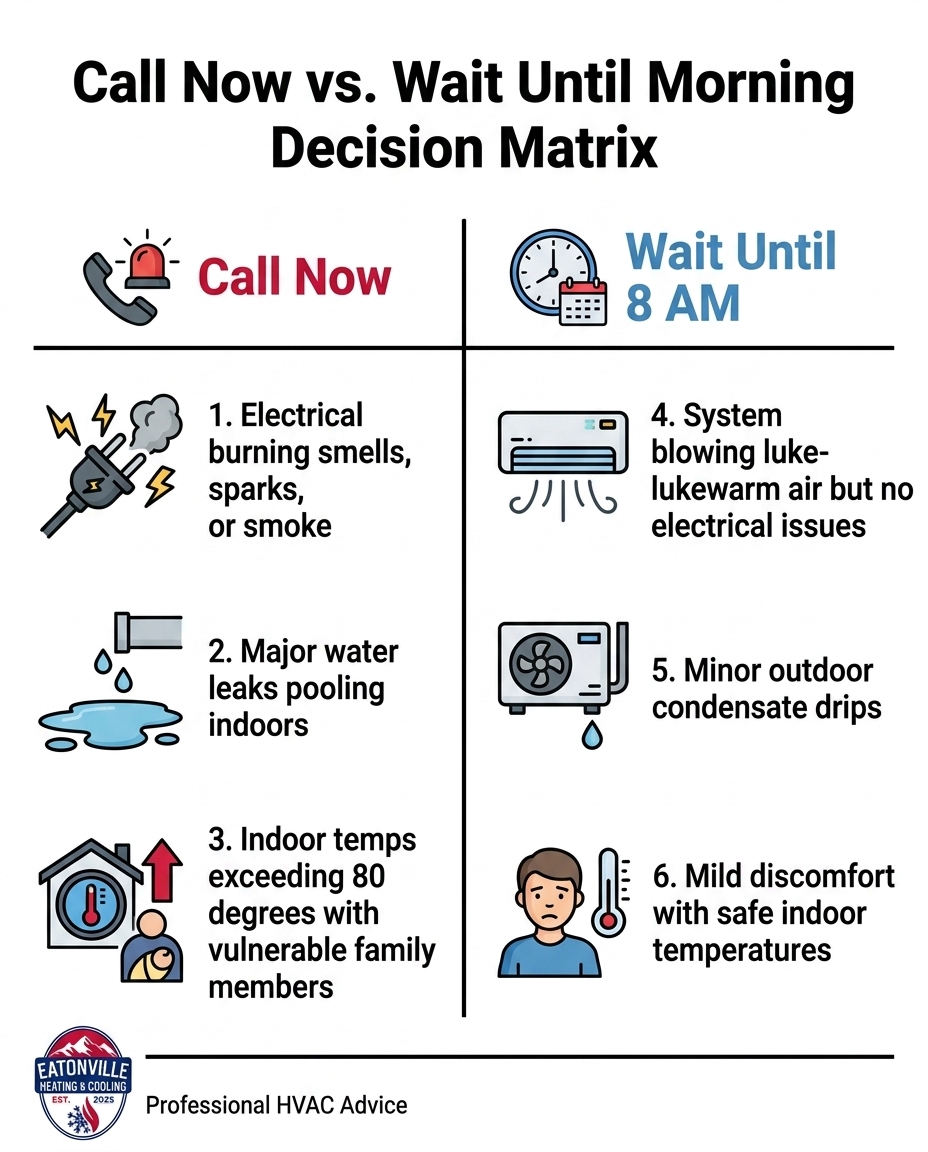
In our years of servicing HVAC systems across the region, we have found there are specific scenarios where delaying a repair is genuinely dangerous. In these cases, paying the premium emergency dispatch fee is no longer a luxury; it is a necessary investment in your family's safety. If you observe any of the following signs, you should not wait for the sun to come up to call for emergency AC repair in Bonney Lake.
What if my AC smells like it's burning?
If you detect an acrid, electrical burning smell coming from your vents or the indoor unit, you have an immediate safety hazard on your hands. This odor usually indicates that wire insulation is melting, a motor is severely overheating, or electrical components are actively failing.
Electrical failures inside HVAC equipment are a major fire risk. If you smell burning plastic or ozone, immediately turn off the system at your thermostat. Then, walk to your main electrical panel and flip the breaker for the air conditioner to the "off" position. Do not turn the system back on under any circumstances. Call for an after-hours technician right away to inspect the wiring and components.
What if the unit is sparking or smoking?
Visible smoke or sparks near your outdoor compressor or indoor air handler represent an active, critical emergency. This goes beyond a strange smell; it means a component is actively short-circuiting. Just like with a burning smell, cut the power at the breaker panel immediately. Do not attempt to inspect the electrical panels yourself. Secure the area, keep pets and children away from the equipment, and contact a professional immediately.
Are high indoor temperatures dangerous at night?
Sometimes the emergency is not the equipment itself, but the environment it leaves behind. According to the EPA, extreme indoor temperatures can lead to severe heat stress. If your indoor temperature is climbing rapidly and remains trapped above 80 degrees, you need to evaluate who is inside the house.
Healthy adults can typically endure a warm night with the help of a fan and some water. However, vulnerable individuals face serious health risks in high heat. If you have infants, elderly family members, or individuals with respiratory and cardiovascular medical conditions in the home, a broken air conditioner during a heatwave is a medical emergency. High indoor temperatures prevent the body from cooling down overnight, which can lead to heat exhaustion. If you cannot safely relocate these vulnerable family members to a cooler location, you must call for immediate repair.
Property Protection: When Leaks Become Late-Night Emergencies
Mechanical failures are not the only reason a cooling system stops working. Our team frequently sees situations where the way the system handles moisture becomes the primary threat. Your air conditioner removes gallons of humidity from your home's air every single day. When the drainage system fails, that water has to go somewhere, and it usually ends up damaging your house.
A minor drip outside near your compressor is completely normal. However, pooling water indoors is a severe issue that can destroy your property overnight. Here is how to handle a late-night water leak in your Bonney Lake home:
1. Identify the source of the water: Check around your indoor air handler (often located in a closet, basement, or attic). If you see water actively overflowing from the drain pan or pooling on the floor, you have a clogged condensate line.
2. Turn off the cooling system immediately: The air conditioner will continue pulling moisture from the air as long as it runs. Turning the thermostat to "off" stops the condensation process and halts the flow of water.
3. Assess the location: If your air handler is in an attic, a leaking drain pan can send gallons of water through your ceiling drywall, destroying insulation, paint, and flooring below. This secondary property damage is incredibly expensive to fix.
4. Clean up the standing water: Use towels or a wet/dry vacuum to remove the water that has already spilled. This prevents mold growth and further water damage to your floorboards.
If you catch the leak early, turn the system off, and successfully clean up the water, you can often wait until morning for a technician to clear the drain line. However, if the leak is severe, actively damaging your ceiling, or if you cannot stop the flow of water, this qualifies as a property-threatening emergency that justifies an after-hours call.
The Climate Factor: Surviving a Pacific Northwest Heat Dome
The rules for handling a broken air conditioner change depending on where you live and what the weather is doing outside. Historically, Western Washington residents had a simple solution for a late-night cooling failure: just open a window. The natural nighttime temperature drop in the Pacific Northwest usually provided enough relief to sleep comfortably until a technician could arrive the next day.
However, increasing "heat dome" events have completely changed this dynamic. During a severe summer heatwave, a high-pressure system traps hot air over the region. When this happens, the nighttime temperatures do not drop. The air outside remains stagnant and warm, meaning opening a window at 11 PM might actually let more heat into your house.
Your home acts like a thermal battery. Throughout a 95-degree day, your roof, walls, and attic absorb massive amounts of solar radiation. When the sun goes down, that trapped heat radiates down into your living spaces. If your AC fails during a heat dome, the indoor temperature will continue to climb even after dark.
Actionable indoor temperature thresholds:
• Under 78 degrees: Uncomfortable, but generally safe for healthy adults to wait until morning using ceiling fans.
• 79 to 82 degrees: Borderline. Open windows if the outside air is cooler than inside. Use portable fans to create a cross-breeze.
• Above 82 degrees indoors (with no outside cooling): This crosses from mild discomfort into a potential health risk, especially if the heatwave is expected to continue the next day. If your house cannot shed heat overnight, you will start the next morning at a dangerous temperature disadvantage.
During a historic summer heatwave, waiting until morning might mean waiting in an 85-degree bedroom. In these specific climate conditions, prioritizing a fast repair is often the smartest choice for your physical well-being.
When It Is Safe (and Smart) to Wait Until 8 AM
If there is no electrical fire risk, no massive water leak, and no immediate threat to a vulnerable family member's health, you are generally safe to wait for standard business hours. As a locally-owned company, Eatonville Heating & Cooling believes in an honest approach: we actively prefer our customers save their money on premium emergency dispatch fees unless there is a genuine safety risk.
You can confidently wait to schedule standard AC repair in Eatonville if you are experiencing these non-emergency symptoms:
• The system is blowing lukewarm air: If the fan is running but the air isn't cold, you likely have a failing capacitor or a low refrigerant charge. Turn the system off to prevent damage to the compressor and wait for morning.
• Poor or weak airflow from the vents: This usually points to a severely clogged air filter or a frozen evaporator coil. Neither of these requires a midnight dispatch.
• A noisy but functioning outdoor fan: If the outdoor unit is rattling or buzzing louder than usual but still cooling the house safely, you can often let it run (or turn it off if the noise is disruptive) until standard hours.
• The thermostat screen is blank: While annoying, this is often just dead batteries or a tripped float switch in the drain pan. It is not a safety hazard.
When you encounter these symptoms, the most financially sound choice is to power down the equipment. Running a struggling system overnight can turn a minor component failure into a complete compressor replacement. Turn it off, set up some fans, and call a reliable local contractor right at 8 AM.
Safe Steps to Take While You Wait for Business Hours
If you have determined that your situation does not require a premium emergency dispatch fee, your next goal is to manage the environment safely until morning. In our years of serving local homes, we have found that attempting DIY repairs on high-voltage HVAC equipment in the dark is incredibly dangerous. Instead, take these safe, practical steps to protect your home and your Bonney Lake family.
1. Turn the thermostat to "Off": This is the single most important step. If your system is low on refrigerant or has a restricted airway, leaving it running will cause the indoor evaporator coil to turn into a solid block of ice. This can permanently damage the compressor. Turn the system completely off.
2. Check the electrical breaker panel: Go to your main electrical panel and look for the breaker labeled "AC" or "HVAC." If it has tripped to the middle position, you can safely flip it completely off, then back on once. If it trips a second time, stop immediately. A repeatedly tripping breaker indicates a serious electrical short. Do not force it to stay on.
3. Maximize indoor airflow: Turn on all ceiling fans in the bedrooms. If you have portable box fans or oscillating fans, position them to keep air moving across your skin. Moving air evaporates sweat faster, making a warm room feel several degrees cooler.
4. Monitor the system's symptoms: Take a few notes on exactly what happened before the system failed. Did you hear a loud grinding noise? Did the air slowly get warmer, or did it stop suddenly? Knowing the signs your AC compressor is failing helps you give accurate information to the dispatcher when you call in the morning, which speeds up the diagnostic process.
How to Avoid the Midnight AC Breakdown Altogether
The absolute best way to handle an after-hours cooling emergency is to prevent it from happening in the first place. A pattern we see often during peak summer heatwaves is that most late-night failures are not random acts of bad luck; they are the direct result of neglected maintenance. Mechanical parts wear down predictably over time, and a trained technician can spot a failure weeks before it actually stops your system from working.
For example, the capacitor inside your outdoor unit acts like a massive battery that jump-starts the compressor. Capacitors degrade slowly. During a routine check, a technician can measure the electrical output of the capacitor. If it is weak, they replace it on the spot for a standard fee during standard business hours. If you skip that check, that same weak capacitor will likely fail completely during the hottest part of a summer heatwave, leaving you sweating in the dark.
Similarly, routine care prevents the severe water leaks we discussed earlier. Technicians actively flush the condensate drain lines and treat the drain pan to prevent algae growth, ensuring water flows freely outside your home instead of through your ceiling drywall.
Investing in preventative AC maintenance is the most reliable way to avoid emergency dispatch fees. By scheduling a seasonal check-up in the spring, before the peak heat arrives, you ensure your equipment is clean, calibrated, and ready to handle the heavy workload of a Pacific Northwest summer.
Frequently Asked Questions About Late-Night AC Failures
What qualifies as an AC emergency?
An AC emergency is any situation that poses an immediate threat to your safety, health, or property. This includes electrical burning smells, visible sparks, major indoor water leaks, or indoor temperatures rising to dangerous levels when vulnerable individuals (infants, elderly, or medically fragile people) are in the home. If none of these factors are present, the situation is usually a non-emergency that can wait until standard business hours.
Can a broken AC wait until tomorrow?
Yes, in most cases, a broken AC can safely wait until tomorrow. If the system is simply blowing warm air, making a strange noise without sparking, or has poor airflow, there is no immediate safety risk. The smartest move is to turn the thermostat to the "off" position to prevent further mechanical damage, use fans to stay comfortable, and call a local HVAC contractor right at 8 AM to avoid paying a premium emergency dispatch fee.
Should I turn off my AC if it's leaking water?
Yes, you must turn off your AC immediately if you notice water pooling indoors. Your air conditioner generates condensation as it cools the air. If the drain line is clogged, that water will overflow the drain pan and spill into your home, causing severe damage to your drywall, ceilings, and flooring. Turning the system off at the thermostat stops the condensation process and halts the leak until a technician can clear the blockage.
Why did my AC stop working at night?
Air conditioners often fail late at night because they have been working at maximum capacity all day. During a hot afternoon, the system runs continuously to fight the heat. This heavy workload puts immense strain on aging parts like capacitors, fan motors, and contactors. When the sun goes down, those stressed components finally give out. Additionally, frozen evaporator coils (caused by dirty filters) often take hours to freeze completely, finally blocking airflow late in the evening.
How do I survive a night without AC in a heatwave?
To survive a night without AC during a heatwave, focus on moving air and blocking heat. Turn on all ceiling fans and use portable fans to create a cross-breeze. If the outside air is cooler than the inside air, open your windows. If the outside air is warmer (common during a severe heat dome), keep windows closed and blinds drawn. Stay hydrated, sleep with lightweight cotton sheets, and avoid using heat-generating appliances like ovens or dryers.
Does resetting the breaker fix a frozen AC?
No, resetting the breaker will not fix a frozen AC. A frozen evaporator coil is caused by a lack of airflow (such as a severely clogged air filter) or a low refrigerant charge, not an electrical glitch. If your system is frozen, you must turn the thermostat to "off" and leave the indoor fan turned "on" to help melt the ice. This process can take several hours. Resetting the breaker does not address the root cause and will only cause the system to freeze again.
Make the Right Call for Your Comfort and Wallet
Deciding when to call for emergency AC repair vs waiting until morning ultimately comes down to a simple rule of thumb: prioritize safety and property protection first. If you smell burning wire, see sparks, have a massive water leak pooling in your hallway, or have vulnerable family members trapped in a dangerously hot house, do not hesitate. Make the call.
However, if you are simply dealing with a system that is blowing warm air or making a strange noise, the most financially sound choice is to turn the system off at the thermostat, set up a few fans, and wait for the sun to come up. You will save money by avoiding a premium emergency dispatch fee without putting your family at risk. Whether you need immediate help tonight or a standard appointment tomorrow morning, expert help is available. Reach out for emergency AC repair in Bonney Lake to get your home back to a safe, comfortable temperature without any unnecessary pressure.
Recent Posts
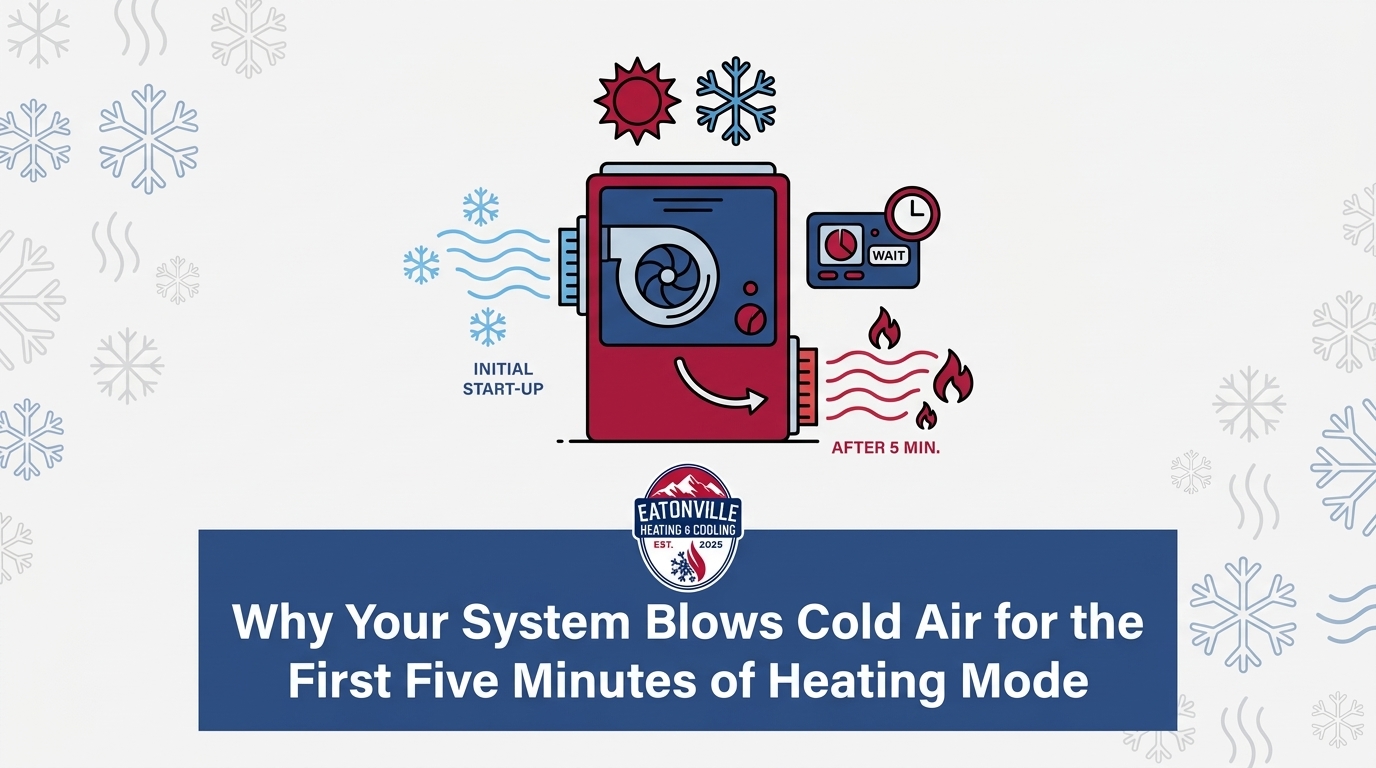
Why Your System Blows Cold Air for the First Five Minutes of Heating Mode
Turning on your furnace on a chilly fall morning only to feel a freezing breeze is stressful. Find out if that initial blast of cold air is normal or a sign of trouble.
Evaluating Dual-Fuel Systems vs Standard Heat Pumps for Auburn Winters
Sub-freezing overnight temperatures force electric heat pumps to work harder. Explore the efficiency tipping point between standard electric and dual-fuel gas backups to choose the right system.
Upgrading Crawlspace Insulation in Lacey Before Heating Season Begins
Don't let your furnace work overtime just to heat the damp air beneath your floorboards. Upgrading your crawlspace insulation stops hidden heat loss and keeps your living room warm all winter long.
Planning Your Pre-Winter HVAC Tune-Up Schedule in Eatonville
The first fall freeze always triggers a scheduling panic for heating repairs. Booking your maintenance in September guarantees priority service when temperatures drop.
Planning Your Pre-Winter HVAC Tune-Up Schedule in Eatonville
The first fall freeze always triggers a scheduling panic for heating repairs. Booking your maintenance in September guarantees priority service when temperatures drop.
Securing Your AC Condenser Against Falling Leaves and Autumn Debris
Wet September leaves can trap moisture inside your outdoor base pan, causing rust and restricted airflow. See how clearing this debris protects your winter heating cycle.