


Step-by-Step Guide to Signs Your AC Compressor is Going Bad
Why Spotting Signs Your AC Compressor Is Going Bad in a Pacific Northwest Climate Can Save You Thousands The signs your AC compressor is going bad in a pacific northwest climate are easy to miss — until your system stops
Why Spotting Signs Your AC Compressor Is Going Bad in a Pacific Northwest Climate Can Save You Thousands
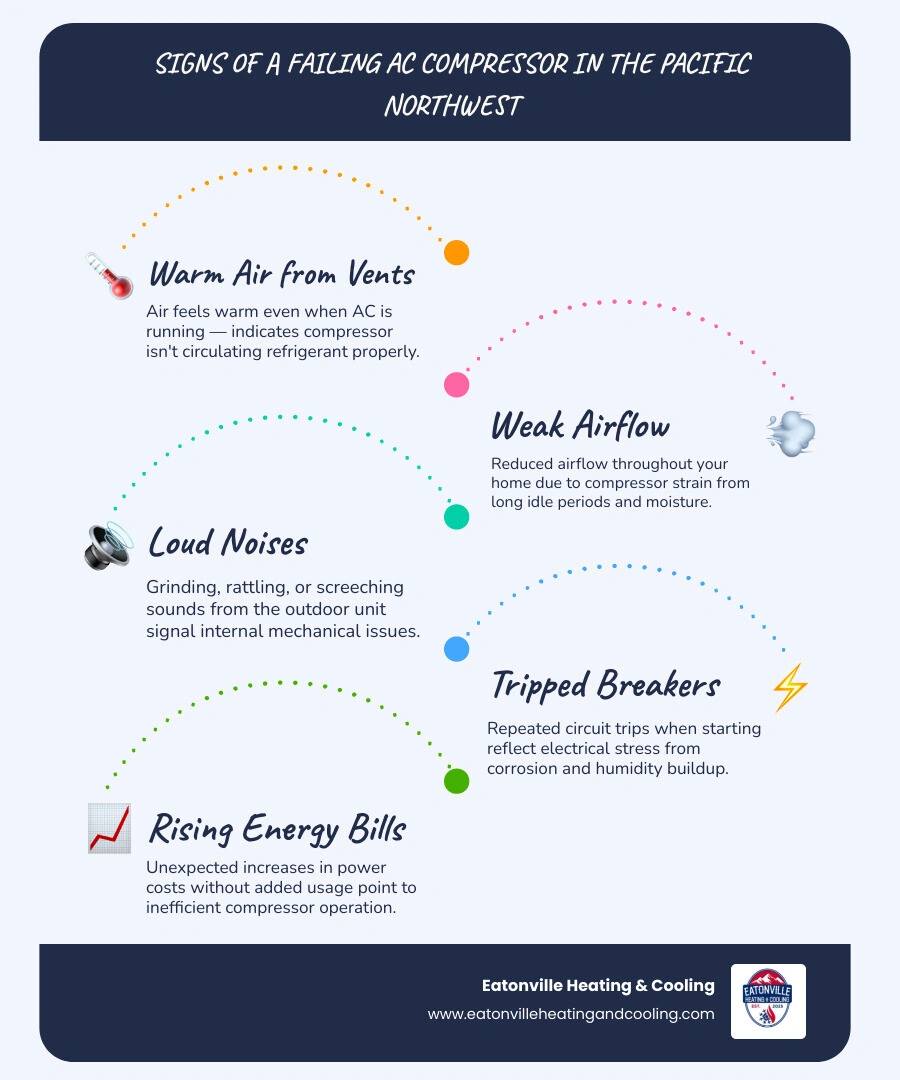
The signs your AC compressor is going bad in a pacific northwest climate are easy to miss — until your system stops working entirely on the one hot week of the year you actually need it. Here is a quick summary of what to watch for:
• Warm air blowing from vents even when the AC is running
• Weak or reduced airflow throughout your home
• Loud grinding, rattling, or screeching from the outdoor unit
• Circuit breaker tripping repeatedly when the AC turns on
• Compressor not starting or taking a long time to kick on
• Visible oily residue around the outdoor unit (sign of a refrigerant leak)
• Rising energy bills without a change in usage
• Short cycling — the system turns on and off more frequently than normal
Most Pacific Northwest homeowners do not run their AC for months at a time. That long idle period, combined with the region's moisture, pollen, and occasional wildfire smoke, puts unique stress on compressors that simply does not show up in warmer, drier climates. Catching these warning signs early is the difference between a manageable repair and a full system replacement.
I'm Matthew Percy, owner of Eatonville Heating & Cooling, and after years of servicing AC systems across Western Washington, I've seen how the PNW's mild-but-demanding climate creates specific and often overlooked signs your AC compressor is going bad in a pacific northwest climate. In this guide, I'll walk you through exactly what to look for so you can act before a small problem becomes a costly one.
How the PNW Environment Impacts Your AC Compressor
When people think of the Pacific Northwest, they think of evergreen trees, misty mornings, and incredibly mild summers. What they often do not realize is that this exact environment creates a unique set of challenges for air conditioning hardware.
The compressor is the heart of your cooling system. Its job is to compress cool, low-pressure refrigerant gas into a hot, high-pressure gas, forcing it through the condenser coils to dump heat outside before looping back to cool your home. Because our summers are relatively short, your AC unit spends most of the year sitting completely idle. This long hibernation, combined with high humidity and coastal or mountain moisture, is actually harder on a compressor than continuous, steady use.
According to regional data, the average lifespan of a central air conditioner in Western Washington typically ranges from 12 to 18 years. However, a system that is neglected can easily fail in just 10 to 12 years, while a well-maintained system frequently lasts 15 to 20 years. In our damp climate, preventative maintenance is the single most important factor determining whether your compressor makes it to its golden years or dies a premature death.
The Toll of Long Winter Hibernation on HVAC Systems
From October to May, your outdoor AC unit sits in the damp, cool Washington air. During these long months of disuse, moisture naturally accumulates inside the outdoor cabinet. Without the heat generated by regular operation to dry things out, this persistent moisture can lead to electrical corrosion on vital terminals, contactors, and control boards.
Furthermore, the oil inside the compressor that keeps the mechanical parts lubricated can settle and become cold and viscous. When the first sudden 85°F heat wave hits places like Puyallup or Olympia in late spring, and you flip your thermostat to "cool," the compressor is forced to start under immense mechanical strain without immediate, proper lubrication. This initial startup strain is a primary cause of premature capacitor failure and mechanical lockups.
Pollen, Dust, and Wildfire Smoke Accumulation
Spring in Western Washington brings heavy pollen loads from our beloved Douglas firs, alders, and maples. In late summer, we frequently contend with seasonal wildfire smoke settling into the Puget Sound basin.
As your outdoor condenser unit pulls in air to release heat, it acts like a giant vacuum cleaner, trapping pollen, dust, and microscopic smoke particles directly against the condenser coils. This buildup forms a thick, insulating blanket over the coils. When the coils cannot release heat, the compressor is forced to work twice as hard and run much longer cycles to cool your home. This extra strain is one of the most common reasons your AC isn't keeping your home cool and will rapidly accelerate internal compressor wear.
Critical Signs Your AC Compressor Is Going Bad in a Pacific Northwest Climate
Because a failing compressor will struggle to move refrigerant efficiently, the warning signs often start small before escalating into a total system breakdown. If you notice your AC not cooling but running: what to check first is the outdoor unit to see if the compressor is actually engaging or if it is struggling to stay on.
To help you understand what is happening inside your system, here is a comparison of how a healthy compressor behaves versus one that is on its way out:
Startup SoundAir TemperatureSystem Cycle LengthElectrical DrawOutdoor Unit ExteriorSubtle Signs Your AC Compressor Is Going Bad in a Pacific Northwest Climate
In our mild climate, you might not notice a failing compressor immediately because the outdoor temperatures rarely push the system to its absolute limits. However, there are subtle clues that point to impending trouble.
One major warning sign is a slow startup. If you stand near your outdoor unit and hear it struggle, stutter, or hum loudly for several seconds before the fan and compressor finally kick in, the system is "hard starting." This is often a sign of failing electrical components or high internal friction.
Another subtle sign is short cycling. If your AC turns on, runs for three minutes, shuts off, and then repeats this cycle ten minutes later, it is placing massive electrical and mechanical stress on the compressor motor. Over time, this constant starting and stopping will destroy the unit.
Lastly, pay close attention to your utility bills. A compressor with worn-out internal valves has to work much harder and run longer to achieve the same cooling effect. If you want to learn how to tell if your air conditioner is costing you more than it should, comparing your year-over-year summer energy bills is a great place to start. A sudden 15% to 20% spike in power usage is a classic red flag.
Obvious Mechanical and Electrical Warning Signs
As the compressor deterioration progresses, the symptoms will become impossible to ignore. You may start hearing loud grinding, metal-on-metal clanking, or severe vibration coming from the outdoor cabinet. These sounds typically indicate that the internal piston or scroll mechanisms are failing, or that the motor bearings have completely worn out.
If the compressor motor begins to short-circuit internally or draw excessive electrical current, it will repeatedly trip the circuit breaker in your home's main panel. If your AC trips the breaker once, you can try resetting it. If it trips a second time, do not reset it again. Doing so can cause permanent damage to your home’s electrical system or even spark an electrical fire.
Finally, look for oily residue around the base of the outdoor unit or along the refrigerant lines. The compressor contains specialized lubricating oil mixed with the refrigerant. If there is a crack in the compressor housing or a leak at the connection valves, this oil will seep out, leaving a dark, sticky residue that collects dirt and pollen. If you also notice water pooling around your indoor system, you may have a secondary issue, such as the AC leaking water inside the house: causes and fixes in a Western Washington home.
Distinguishing Compressor Failure from Other Common AC Issues
Before you assume your compressor is completely dead, it is important to rule out simpler, less expensive problems. Many common AC issues present symptoms that mimic compressor failure, but they can be resolved with basic troubleshooting or minor repairs.
If your system is acting up, start with the basics:
1. Check the thermostat: Ensure it is set to "Cool" and the fan is set to "Auto" or "On." If the batteries are dead, replace them.
2. Inspect the air filter: A heavily clogged air filter restricts airflow so severely that the indoor evaporator coil will freeze over. If you want to know why your AC freezes up and what you can do about it, a dirty air filter is almost always the prime suspect. Replace your filter every 1 to 3 months, especially during high-pollen spring months and late-summer wildfire seasons.
3. Clear the outdoor unit: Ensure there is at least 2 feet of clear space around your outdoor condenser. Cut back any ferns, blackberries, or landscaping that might be choking off its airflow.
Compressor Failure vs. Bad Start Capacitor
One of the most common misdiagnoses in the HVAC world is mistaking a bad capacitor for a failed compressor. The capacitor is a small, cylindrical device that acts like a temporary battery, providing the high-voltage electrical boost needed to start the compressor and fan motors.
Because of our seasonal temperature swings and damp winters, capacitors in Western Washington have a high failure rate, typically lasting only 5 to 7 years. When a capacitor fails, the compressor will want to start but won't have the electrical power to do so. You will hear a distinct, loud humming sound coming from the outdoor unit every few minutes, followed by a click as the system's thermal overload switch shuts it down to prevent overheating.
Replacing a capacitor is a quick, straightforward repair for a professional technician. If you ignore the humming and keep letting the system try to start with a bad capacitor, however, you will eventually burn out the compressor motor itself.
Compressor Failure vs. Low Refrigerant Levels
If your AC is running but blowing lukewarm air, you might have a low refrigerant charge rather than a bad compressor. Because modern air conditioners are closed systems, they should never "lose" refrigerant. If the level is low, it means you have a leak.
A system with low refrigerant will exhibit low pressure levels, causing the evaporator coil to freeze and ice to form on the copper lines. The compressor will continue to run, but because it cannot build up enough pressure, it will run continuously without cooling your home. Only an EPA-certified technician can legally handle, test, and recharge refrigerant systems under strict environmental regulations. If your system is older and still uses the phased-out R-22 refrigerant, repairing a leak can be incredibly costly, often making a system upgrade the smarter choice.
Repair vs. Replace: Making the Right Call for Your Home
Because the compressor is the single most expensive mechanical component in your air conditioning system, finding out it has failed presents a major decision: should you repair it or replace the entire system?
When making this choice, we recommend using the $5,000 Rule. Multiply the age of your air conditioning system by the cost of the repair. If the total exceeds $5,000, it is almost always more cost-effective to replace the unit.
For example:
• A 5-year-old system needing a minor electrical repair is a clear candidate for repair.
• A 13-year-old system needing a brand-new compressor is a clear candidate for replacement. At that age, the remaining components (like the fan motor, condenser coils, and indoor evaporator coil) are also nearing the end of their lifespans. Spending money on a new compressor for an old system is often "throwing good money after bad."
Additionally, modern systems installed in June 2026 feature incredibly high SEER2 efficiency ratings. Upgrading an old, inefficient system to a modern, right-sized AC or heat pump can reduce your cooling energy consumption by 30% to 40%. To help you weigh your options, take a look at our guide on how to repair or replace your AC: how to make the right call.
Why You Shouldn't Ignore Signs Your AC Compressor Is Going Bad in a Pacific Northwest Climate
If you suspect your compressor is failing, the worst thing you can do is continue running the system. When a compressor motor burns out internally, it can cause an "acid burnout." This occurs when the extreme heat of the motor failure causes the refrigerant and oil mixture to break down, creating highly corrosive acid that contaminates the entire copper line-set and indoor coil.
If an acid burnout occurs, you cannot simply swap out the compressor. The acid will destroy the new compressor within days. The entire system must be chemically flushed, and in many cases, every single component must be replaced. If you live in the South Sound and notice your system struggling, contact us immediately for professional AC repair Tacoma WA to catch the problem before catastrophic damage occurs.
Frequently Asked Questions About Failing AC Compressors
Is it safe to run my AC if the compressor is failing?
No, it is not safe. Running an air conditioner with a failing compressor can cause a chain reaction of expensive damage. It places extreme stress on your home's electrical panel, increases the risk of an electrical fire, and can lead to a system-wide acid burnout. If your AC is tripping breakers, making grinding noises, or blowing warm air, shut the system down at the thermostat and leave it off until a professional can inspect it.
How long do AC compressors typically last in Western Washington?
In our mild Western Washington climate, a compressor typically lasts between 12 and 18 years. However, this lifespan is heavily dependent on regular maintenance. Because our systems sit idle for long periods, they are highly susceptible to moisture damage and sudden startup strain. To see how simple, annual preventative care can keep your system running smoothly for up to 20 years, read about how regular AC maintenance protects your system and your budget.
Can a homeowner troubleshoot a bad compressor safely?
Homeowners can safely perform basic visual and auditory checks, such as checking the air filter, ensuring the outdoor unit is clear of debris, inspecting the electrical panel for a tripped breaker, and listening for unusual noises. However, you should never attempt to open the compressor housing or test electrical contacts with a multimeter unless you are a trained professional. Compressors operate on high-voltage electricity and contain pressurized refrigerants under extreme pressure. For safe, accurate diagnostics, it is always best to schedule professional AC service Tacoma WA.
Conclusion
Your AC compressor is a rugged piece of machinery, but the unique climate of the Pacific Northwest — with its damp winters, heavy spring pollen, and sudden summer heat spikes — demands proactive attention. By recognizing the early warning signs of a failing compressor, you can avoid stressful summer breakdowns and protect your budget from emergency replacement costs.
At Eatonville Heating & Cooling, we are a family-owned HVAC company dedicated to keeping our neighbors comfortable across Eatonville, Tacoma, Puyallup, Olympia, Auburn, and the surrounding Western Washington communities. We pride ourselves on honest advice, transparent service, and quality craftsmanship.
If your air conditioner is making strange noises, blowing warm air, or costing you too much on your monthly energy bills, don't wait for the hottest day of the year to take action. Contact us today to schedule our expert Air Conditioning Services and ensure your home stays cool and comfortable all summer long!
Recent Posts

Adapting Yelm Wood-Framed Homes for Modern Central Air
Adding central air to an older wood-framed home takes careful planning. See how attic framing, ductwork and wiring shape a safe, effective upgrade.
Differentiating Between Normal Expansion Noises and Furnace Failure
Hearing a loud bang on the first chilly fall morning can be terrifying. Decide with confidence whether to let the system run or shut it down for emergency service.
How Federal Way's Fall Humidity Affects Indoor Air Quality
The transition to damp autumn weather creates a tricky shoulder season for your HVAC system. Without the AC running, ambient moisture gets trapped inside. See how to manage ventilation.
Deciding Between a Modulating and Two-Stage Furnace for Lacey Climates
Upgrading your heating system before the damp winter hits? Find out whether the precise comfort of a modulating unit or the reliability of a two-stage system fits your home.
What a Comprehensive Fall Furnace Inspection Actually Entails
A professional heating tune-up requires much more than a basic filter change. We pull back the curtain on the exact electrical and combustion tests that prevent winter breakdowns.
Repurposing Old AC Pads When Upgrading to a New Heat Pump
Preparing for a fall system upgrade? Reusing a sunken 1990s concrete base can cause poor drainage and oil starvation for modern equipment—see why leveling matters.