



Identifying the Source of Burning Smells When You First Turn on the Heater
Turning on your heater for the first time this fall shouldn't cause panic. We explain how to tell harmless burning dust from melting wires, and when to shut off the breaker.
Is It Normal to Smell Burning When Turning on the Heater for the First Time?
Are you staring at your vents right now, trying to figure out the safety of your home by identifying the source of burning smells when you first turn on the heater? Every September during the early fall transition, our dispatchers at Eatonville Heating & Cooling field frantic calls from homeowners experiencing this exact scenario. The first truly chilly morning has finally arrived. You flip your thermostat from cooling to heating for the first time in months, expecting a wave of cozy warmth. Instead, within minutes, a distinct, alarming burning odor fills the hallway. The immediate panic sets in: is your HVAC system on fire, or is this just a normal part of the seasonal shift?
Whether you need comprehensive Heating Services or just a little peace of mind, our team believes that knowing how to interpret these sudden odors is your first line of defense as a homeowner. Identifying the root cause comes down to distinguishing between two very different scenarios: harmless summer dust burning off the heat exchanger, or dangerous electrical components melting down under pressure.
The Crucial Decision: Wait or Shut Down?
The next 15 minutes are absolutely critical for assessing the situation safely. When you first notice a burning smell coming from your ductwork, your initial instinct might be to panic and call 911, or conversely, to ignore it and hope it goes away. Both extremes can be problematic.
The baseline rule is simple: safety always comes first. If you are ever in doubt, or if you see visible smoke accompanying the smell, turn the system off immediately at the thermostat and the breaker. However, if there is no smoke and the smell is relatively mild, you are likely facing a harmless, temporary issue. This guide will walk you through exactly how our technicians use sensory clues—specifically, the distinct olfactory profiles of different burning materials—to diagnose the issue safely and make a fast, confident decision about whether to wait it out or shut it down.
Why Heaters Collect So Much Dust Over the Summer
To understand why your furnace or heat pump is suddenly emitting strange odors, you have to look at what happens to the equipment during the off-season. During the cooling months, the heating components of your HVAC system sit completely dormant. In our years of servicing homes across the region, we've noticed that because of Eatonville WA's mild, sometimes damp summer climate, heating systems are often turned off entirely for long stretches of time.
While the system sits quietly in your basement, garage, or utility closet, it acts as a magnet for airborne particulate matter. Even in the cleanest homes, the indoor air contains microscopic debris. Over the course of three to four months, a layer of household dust, pet dander, dead skin cells, and microscopic lint settles directly onto the heat exchanger and the surrounding burner elements.
The Ignition Phase:
When the first cold snap hits and you finally call for heat, those burners ignite, and the heat exchanger rapidly rises to hundreds of degrees within seconds. That accumulated blanket of summer dust does not just blow away—it is instantly incinerated by the intense heat. This flash-burning of organic material is exactly what creates that sudden, alarming odor that pushes through your vents.
If you are experiencing the smell of burning dust from your heat pump or furnace, it is helpful to remember that this is a mechanical inevitability, not necessarily a failure. The system is simply clearing its throat, so to speak, after a long summer slumber. However, knowing why it happens is only half the battle; knowing exactly what it should smell like is how you keep your home safe.
Sensory Clues: What Does Harmless Burning Dust Smell Like?
Because you cannot always see inside your ductwork or furnace cabinet, our technicians always remind customers that your nose becomes your best diagnostic tool during the September early fall transition. Harmless burning dust has a very specific olfactory profile that is easy to recognize once you know what to look for.
Key characteristics of harmless burning dust:
• The Scent Profile: It smells remarkably similar to singed lint, a hot hair dryer that has just been turned on, or an old-fashioned space heater warming up. It has a dry, slightly earthy, and distinctly "dusty" quality to it.
• The Intensity Curve: The smell will usually start quite strong—often strong enough to make you stop in your tracks—but it should begin to fade rapidly after the first few minutes of operation.
• The Visual Cue: This is crucial. The odor should be entirely isolated to the scent coming from the vents. There should be absolutely no visible smoke, no haze in the air, and no soot forming around the registers.
• The Sound: The system should sound normal. You should hear the click of the thermostat, the gentle whoosh of the blower motor, and the steady flow of air, without any popping, sparking, or grinding noises accompanying the smell.
If the smell matches this description perfectly, you are almost certainly dealing with standard seasonal dust burn-off. It is an annoyance, but it is not a threat to your property.
Warning Signs: Recognizing Dangerous Electrical Smells
While dust is harmless, an electrical failure is a severe emergency. According to the National Fire Protection Association (NFPA), heating equipment is a leading cause of home fires in the United States. Accurate identification of electrical smells is critical to preventing a catastrophic event.
When wiring, capacitors, or blower motors begin to fail, they emit odors that are entirely distinct from burning dust. When our team responds to emergency calls for heater repair in Eatonville WA, we often find it is because a component has overheated to the point of melting its protective casing.
How to distinguish the danger:
• The Scent — Harmless Dust Burn-Off: Singed lint, hot hair dryer, dry earth. — Dangerous Electrical Failure: Acrid, melting plastic, sharp metallic, or a distinct "fishy" odor.
• The Duration — Harmless Dust Burn-Off: Fades steadily over 10 to 15 minutes. — Dangerous Electrical Failure: Persists, grows stronger, or comes in harsh waves.
• Visuals — Harmless Dust Burn-Off: Invisible; purely an odor. — Dangerous Electrical Failure: May be accompanied by a light haze, faint smoke, or sparking sounds.
• Physical Reaction — Harmless Dust Burn-Off: Mildly annoying to the nose. — Dangerous Electrical Failure: Harsh on the throat, causes immediate watering of the eyes, smells toxic.
Immediate Actions for Electrical Odors
If you detect the sharp, toxic smell of melting plastic or burning wires, you must act immediately. Never attempt to open the furnace cabinet or perform DIY electrical checks. High-voltage HVAC equipment can hold a lethal charge even when powered down at the thermostat.
• Step 1: Shut off the system at the thermostat immediately to stop the call for heat.
• Step 2: Walk to your home's main electrical panel and flip the breaker to the HVAC system to cut all power to the unit.
• Step 3: If there is visible smoke, if the smell intensifies after the power is cut, or if you see flames, evacuate the area immediately and call 911.
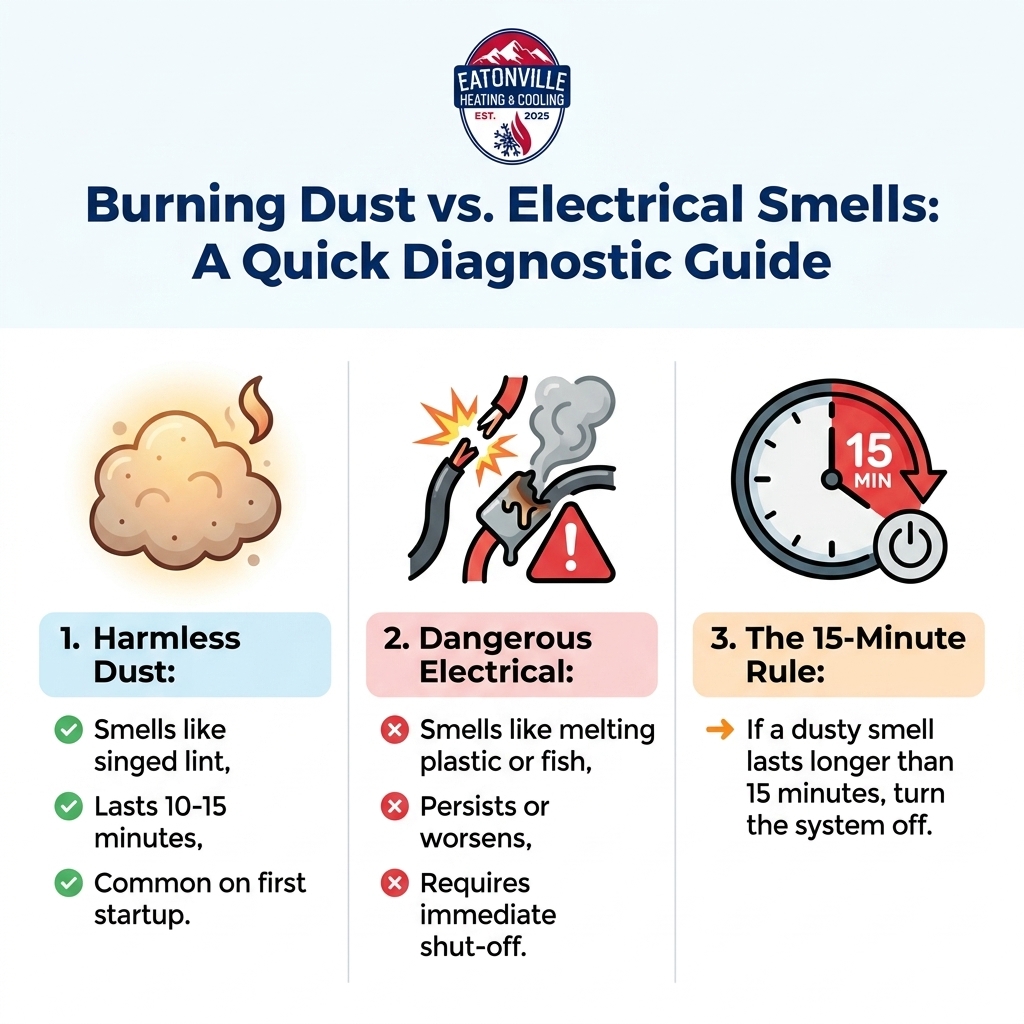
The 15-Minute Rule: When to Wait and When to Act
Homeowners often struggle with the "wait and see" approach because they lack a concrete timeline. Leaving a system running indefinitely while hoping a smell goes away is dangerous, but shutting it down after thirty seconds of dust burn-off leaves your house freezing. To navigate the September early fall transition safely, we highly recommend employing what our technicians call the strict 15-Minute Rule.
1. Confirm the Scent Profile: Take a moment to actively smell the air coming from the vent. If it smells like acrid plastic or fish, abort this process and shut the system down immediately. If it smells like dry, singed lint (dust), proceed to step two.
2. Set a Hard Timer: Look at your watch or use your smartphone to set a timer for exactly 15 minutes. Do not guess how much time has passed, as anxiety can make one minute feel like ten.
3. Monitor Continuously: Stay near a primary vent and monitor the odor. Over the course of the 15 minutes, the smell should steadily decrease in intensity. It should peak in the first two minutes and trail off significantly thereafter.
4. Make the Final Call: When the timer goes off, evaluate the air. If the smell is completely gone or barely noticeable, your system has successfully burned off the summer dust and is safe to operate. If the smell persists beyond 15 to 20 minutes, or if it has gotten worse at any point during the countdown, shut the system down completely at the thermostat and call our professional team.
This rule removes the guesswork from the equation, giving you a safe, structured way to evaluate your system's health without ignoring potential warning signs.
Could a Clogged Air Filter Be Causing the Burning Odor?
While dust on the heat exchanger and melting electrical wires are the two extremes, there is a middle ground that frequently causes burning odors: a severely clogged air filter. This issue bridges the gap between a harmless nuisance and a mechanical failure, and it is entirely preventable.
The Mechanics of a Clogged Filter:
Your HVAC system requires a specific volume of airflow to operate correctly. When an air filter is neglected and becomes caked with dirt, pet hair, and debris, it acts like a wall, severely restricting the amount of air that can pass through the system.
Because the system is starved for air, the blower motor has to work twice as hard to pull oxygen through the return vents. This excessive strain causes the motor to overheat. When a blower motor overheats, its internal lubricants and coil windings get dangerously hot, producing a hot, dusty, or slightly mechanical burning smell that is often pushed into the living space.
Furthermore, restricted airflow means the heat exchanger itself cannot dissipate its heat properly. The furnace gets hotter than it was designed to, triggering the high-limit switch to shut the system down—but not before a distinct hot-metal smell permeates the house.
As local HVAC professionals, we always stress that checking and replacing the air filter is the only safe DIY troubleshooting step a homeowner in Eatonville WA should take. If you pull the filter out and it looks like a thick gray blanket, replace it immediately. Maintaining good indoor air quality through regular filter changes not only prevents these alarming smells but also extends the life of your blower motor and keeps your energy bills in check.
Why Professional Diagnostics Matter for Persistent Smells
If you have ruled out a dirty air filter and the 15-minute rule has expired with the smell still lingering, it is time to transition from monitoring to taking decisive action. Persistent burning smells are a legitimate fire hazard, not a mere nuisance. Guessing at the cause is a dangerous game that puts your property and family at risk.
At Eatonville Heating & Cooling, our decades of local experience and commitment to safety mean we never want homeowners guessing about potential fire hazards. A professional diagnostic goes far beyond simply sniffing the air. When a licensed technician evaluates a system for burning odors, they perform a comprehensive safety audit.
What a professional diagnostic entails:
• Electrical Testing: Technicians use multimeters to check the amp draws on the blower motor and inducer motor to ensure they are not over-amping and overheating.
• Wiring Inspection: A thorough visual and physical inspection of all internal wiring to look for melted insulation, loose connections, or scorched terminals.
• Heat Exchanger Integrity: Inspecting the heat exchanger for dangerous cracks that could be leaking carbon monoxide or causing irregular burn patterns.
Sometimes, a persistent burning smell or continuous system strain reveals that the current equipment is fundamentally inadequate for the home. For example, our team recently helped a customer in the Eatonville WA area who struggled with severe home heating inadequacy from a previously recommended system that was constantly overworking. After performing a detailed diagnostic, we provided our expertise on modern mini-splits and recommended a larger capacity system. Once installed, the new system adequately heated the home without the dangerous overheating and strain that leads to burning odors.
Relying on professional heater maintenance and diagnostics ensures that you have total peace of mind, knowing your system is verified safe to operate through the long, cold winter ahead.
Frequently Asked Questions About Heater Odors
How long should a heater smell like burning?
Our technicians generally advise that a heater should only smell like burning for typically 10 to 15 minutes during the very first cycle of the September early fall transition. This brief window allows the accumulated summer dust to burn off the heat exchanger safely. If the dusty, singed-lint smell lasts longer than 20 minutes, you should shut the system off at the thermostat and contact a professional to investigate further.
What does an electrical fire smell like in a house?
An electrical fire produces a very distinct, harsh odor that smells like acrid, melting plastic, burning rubber, or sometimes a sharp, "fishy" scent. Unlike the mild smell of dusty lint, this odor is highly irritating to the nose and throat and will often grow stronger the longer the system runs. If you detect this smell, it requires immediate breaker shut-off and professional intervention, as it indicates melting wire insulation or failing components.
Is it safe to run my heater if it smells like burning?
Yes, it is generally safe to let the heater run if it is the first time you have turned it on for the season and the odor smells strictly like dusty lint for under 15 minutes. However, it is absolutely not safe to run the heater if the smell is electrical, smells like melting plastic, is accompanied by visible smoke, or persists beyond the 20-minute mark.
Why does my new furnace smell like it is burning?
New furnaces often have a thin layer of factory oils, protective coatings, and sealants applied to the heat exchanger during the manufacturing process to prevent rust during shipping. These industrial oils burn off during the first few heating cycles, creating a temporary odor that can smell slightly more chemical or metallic than standard household dust. This is a normal part of the break-in process and should dissipate after a few hours of total run time.
Should I call the fire department or an HVAC technician?
If you see visible smoke coming from the vents, see flames inside the cabinet, or if the smell of burning wires intensifies even after you have shut off the power at the breaker, evacuate the home immediately and call 911. If the system is turned off, there is no smoke, and the smell begins to dissipate safely, you should call our licensed HVAC technicians for emergency repairs.
Secure Your Peace of Mind This Fall Heating Season
Dealing with strange odors from your vents can be incredibly stressful, especially when the temperature outside is dropping and you just want to keep your home comfortable. While a brief smell of singed dust is a completely normal part of firing up your system in Eatonville WA, guessing about persistent or acrid smells is never worth the risk.
Your safety and comfort should never be left to chance. If you have applied the 15-minute rule and the odor hasn't cleared, or if you immediately detect the harsh scent of melting plastic, it is time to bring in the experts. Let our expert team at Eatonville Heating & Cooling help. Schedule a thorough, professional inspection with us today to secure your peace of mind, ensuring your heating system is running safely, efficiently, and reliably for the entire winter season.
Recent Posts

Adapting Yelm Wood-Framed Homes for Modern Central Air
Adding central air to an older wood-framed home takes careful planning. See how attic framing, ductwork and wiring shape a safe, effective upgrade.
Differentiating Between Normal Expansion Noises and Furnace Failure
Hearing a loud bang on the first chilly fall morning can be terrifying. Decide with confidence whether to let the system run or shut it down for emergency service.
How Federal Way's Fall Humidity Affects Indoor Air Quality
The transition to damp autumn weather creates a tricky shoulder season for your HVAC system. Without the AC running, ambient moisture gets trapped inside. See how to manage ventilation.
Deciding Between a Modulating and Two-Stage Furnace for Lacey Climates
Upgrading your heating system before the damp winter hits? Find out whether the precise comfort of a modulating unit or the reliability of a two-stage system fits your home.
What a Comprehensive Fall Furnace Inspection Actually Entails
A professional heating tune-up requires much more than a basic filter change. We pull back the curtain on the exact electrical and combustion tests that prevent winter breakdowns.
Repurposing Old AC Pads When Upgrading to a New Heat Pump
Preparing for a fall system upgrade? Reusing a sunken 1990s concrete base can cause poor drainage and oil starvation for modern equipment—see why leveling matters.