


Upgrading to Inverter-Driven ACs for Two-Story Federal Way Homes
If your upstairs is always hot while the downstairs freezes, standard air conditioning might be to blame. See why variable-speed cooling solves this multi-level house problem.
Why Is Your Upstairs So Hot While the Downstairs Freezes?
Why is it that your downstairs thermostat reads a comfortable 70 degrees, but you are still sweating through your sheets in the master bedroom upstairs? If you are researching upgrading to Inverter-Driven ACs for Two-Story Federal Way Homes, you are likely trying to solve this exact, stubbornly persistent frustration. It is a daily battle during the peak of summer: you turn the thermostat down to cool the upper levels, only to turn the ground floor into an absolute icebox.
If you are looking for permanent air conditioning solutions, understanding the root cause of this temperature imbalance is the first step. A typical pattern we see in Federal Way two-story homes is a heavy reliance on portable fans, closed vents, or window units just to make the second floor bearable. The concrete problem is stubborn heat stratification, an issue that standard cooling systems simply were not built to handle.
The core decision point: You are likely weighing whether the higher upfront investment in an inverter-driven (variable-speed) AC system is the right choice to finally achieve even cooling. To make an informed choice, you need a clear breakdown of why standard units fail in multi-level architecture and how variable-speed technology completely changes the game.
The Physics of Heat Stratification in Multi-Level Architecture
To understand why cooling a two-story home is inherently difficult, we have to look at the basic physics of air movement. Thermodynamics dictates that hot air is less dense than cold air. Because it is lighter, hot air naturally rises to the highest point in a structure, while the heavier, denser cold air sinks to the bottom. In a multi-level home, the second story effectively acts as a collection zone for all the heat generated inside the house.
The Impact of Solar Heat Gain
Beyond internal heat rising, the upper level of your home faces a massive external heat load. The prolonged solar heat gain during peak July heat in the Pacific Northwest makes this architectural challenge even more pronounced. The sun beats down on your roof for up to 15 hours a day during a Pacific Northwest summer. Roofing materials absorb this thermal energy, radiating it straight into your attic. Even with good insulation, that trapped heat presses down on your second-story ceilings.
Simultaneously, second-story windows catch direct sunlight, creating a greenhouse effect in your upper bedrooms. Without continuous, active air circulation to break up these thermal layers, the hot air stagnates. It creates an uncomfortable heat trap that sits heavily over the upper floor. Traditional HVAC setups interact very poorly with this physical reality, often making the temperature divide worse instead of better.
Why Standard Single-Stage AC Systems Fail to Cool the Second Floor
The Problem: You set your thermostat to 68 degrees hoping to cool down the upstairs bedrooms. Thirty minutes later, you need a sweater in the living room, but the upstairs is still uncomfortably warm. Many homeowners assume the system is broken and start looking for Federal Way AC repair, when in reality, it is a mechanical limitation of single-stage technology in multi-story layouts.
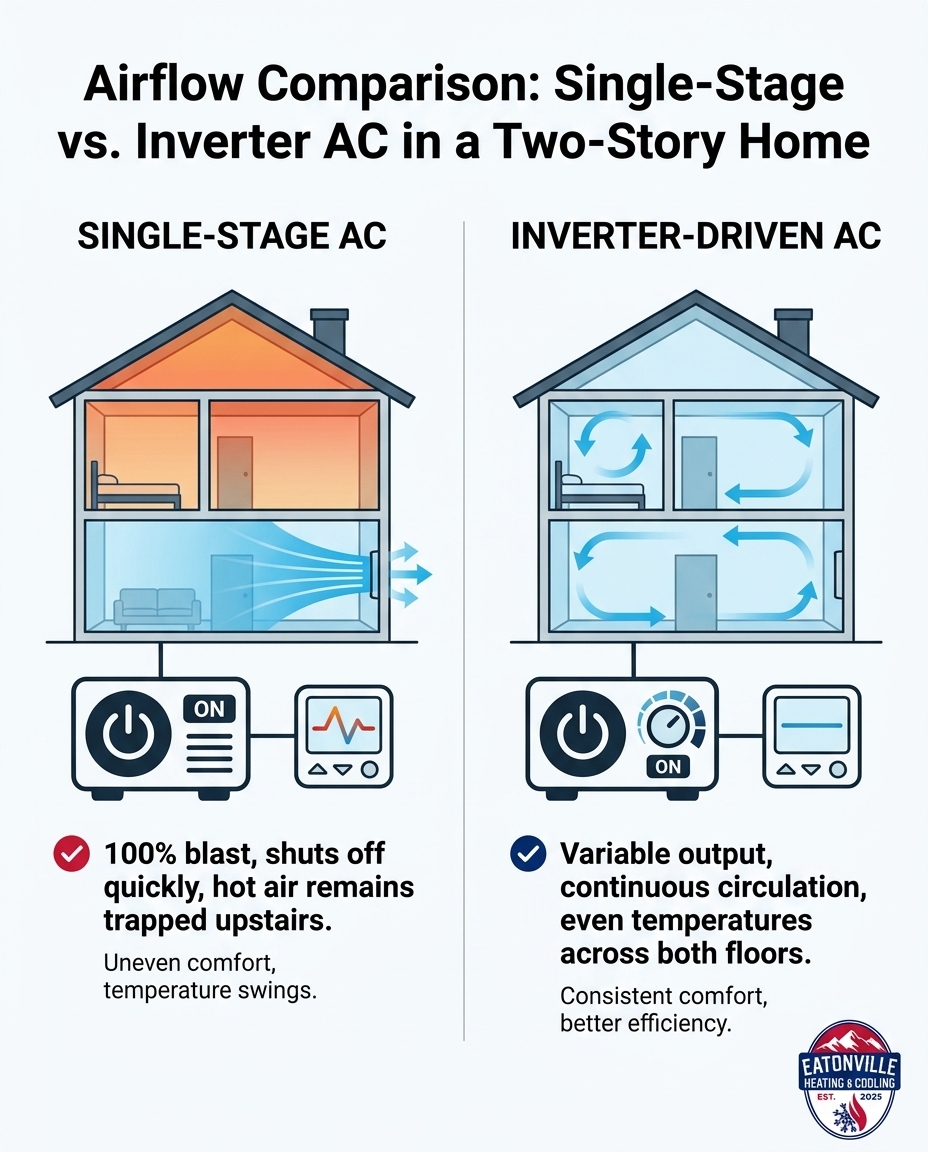
The Cause: A traditional single-stage air conditioner operates on a very simple mechanism: it is either 100% ON or 100% OFF. There is no middle ground. When the system turns on, it blasts maximum capacity cold air into the house. Because the thermostat is almost always located on the ground floor—which is naturally cooler and closer to the indoor unit—that thermostat reaches its target temperature very quickly.
The Short-Cycling Illusion
Once the downstairs thermostat senses the target temperature, it shuts the entire system off. This happens long before sufficient conditioned air is pushed up the stairs and into the furthest bedrooms. We see this constantly in Federal Way two-story homes. The system "short-cycles" relative to the needs of the whole house. The heavy, cold air pools on the first floor, while the hot air remains trapped upstairs.
The Solution: Lowering the downstairs thermostat even further does not solve the root issue; it only results in a freezing ground floor, higher energy bills, and unnecessary wear and tear on your compressor. Solving the problem requires a fundamental change in how the air is delivered and circulated throughout the home.
How Inverter-Driven Air Conditioners Solve the Upstairs Heat Trap
Inverter technology is the direct, mechanical solution to the short-cycling and heat stratification problems that plague multi-level homes. Unlike a standard system that blasts air and shuts off, an inverter-driven (or variable-speed) compressor operates continuously. It modulates its output—running at 30%, 50%, or 70% capacity—to match the exact cooling load required at any given moment.
Because the system runs almost continuously at a lower, quieter speed, it provides constant air mixing. This steady airflow prevents the hot air from stagnating on the second floor and keeps the heavy cold air from pooling downstairs. During a hot Pacific Northwest summer, this continuous circulation is the key to breaking up thermal boundaries.
Why Inverter ACs Solve Two-Story Cooling Issues
• Continuous air circulation: A steady flow of air physically prevents heat from rising and settling in upstairs bedrooms.
• Longer cooling cycles: Because the system doesn't shut off abruptly, conditioned air has the time it needs to reach the furthest rooms in the house.
• Variable output matching: The compressor adjusts to the exact temperature needs of the home without shutting off prematurely when the downstairs cools down.
• Enhanced dehumidification: Longer run times pull significantly more moisture out of the air, creating a more comfortable, less sticky environment on all floors.
Comparing the Systems: Single-Stage vs. Variable-Speed Inverters
To truly understand the value of upgrading, it helps to look at a clear, side-by-side comparison of how these two distinct technologies perform in a multi-level environment. For Federal Way two-story homes, the performance gap between these two systems is highly noticeable the moment you walk up the stairs.
• Airflow Consistency — Single-Stage AC: Stop-and-go blasts of air; fails to reach upper levels effectively. — Variable-Speed Inverter AC: Continuous, steady airflow; actively mixes air across all floors.
• Temperature Control — Single-Stage AC: Noticeable temperature swings (hot and cold spots). — Variable-Speed Inverter AC: Precise temperature matching within a fraction of a degree.
• Energy Efficiency — Single-Stage AC: Draws massive power spikes every time it starts up. — Variable-Speed Inverter AC: Uses minimal power to maintain temperature, highly efficient.
• Noise Levels — Single-Stage AC: Loud, abrupt clanking when the compressor kicks on. — Variable-Speed Inverter AC: Whisper-quiet operation, often undetectable from inside.
The Highway Driving Analogy
Think of an inverter system like cruising down the highway at a steady 60 miles per hour. You use far less gas because your momentum is constant. A single-stage system is like stop-and-go city driving—slamming on the gas, hitting the brakes, and burning excess fuel in the process. The continuous operation of an inverter is actually far more energy-efficient despite running for longer periods.
Note that regardless of the system you choose, keeping it running at peak efficiency requires consistent upkeep. Scheduling routine AC maintenance ensures that filters remain clean and coils stay clear, which is especially important for maintaining the precise airflow required to cool a second story.
Handling Extreme Heat: Performance During Peak Summer Events
The reality of our regional climate is shifting. Federal Way's increasing summer temperature spikes require systems capable of variable output to maintain consistent comfort across multiple floors. We are no longer dealing with just a few warm weeks; we are facing extended periods of severe heat.
With the increasing frequency of heat dome events in the Pacific Northwest, traditional cooling systems are being pushed beyond their design limits. During these extreme high-load conditions, a single-stage unit will often run non-stop, struggling to keep up with the heat gain, and still fail to push enough air to the second floor to make a difference.
Ramping Up When It Counts
Inverter systems excel under these exact conditions. Because they are variable, they can ramp up to maximum capacity—sometimes even slightly beyond their nominal rating—during the hottest part of the afternoon to combat severe solar heat gain. Then, as the sun sets and the outdoor temperature drops, the system seamlessly scales back its output. This dynamic response provides incredible peace of mind, knowing your home is equipped to handle a Pacific Northwest summer without leaving the upstairs bedrooms sweltering.
Is the Investment in an Inverter AC Worth It for Your Home?
The short answer is yes, provided you are dealing with the specific challenges of a multi-level layout. It is true that inverter-driven systems come with a higher initial investment compared to standard, single-stage units. However, evaluating that cost requires looking beyond generic "energy savings" and recognizing the technology as a targeted solution to a physical architectural problem.
At Eatonville Heating & Cooling, our deep understanding of Pacific Northwest climate challenges and localized expertise in custom airflow solutions for multi-story homes allows us to design systems that actually work. We know that installing a standard unit in a tall house often results in buyer's remorse when July rolls around and the upstairs is still unlivable.
The True Return on Investment
The true ROI of upgrading is found in your quality of life. It is the ability to finally sleep comfortably in your upstairs bedrooms during the summer. It is the elimination of noisy window units, hazardous extension cords, and box fans cluttering your hallways. For Federal Way two-story homes, the value is in achieving genuine whole-home comfort.
Furthermore, proper installation and custom airflow design are strictly required to get the most out of this advanced technology. An inverter AC is a highly sophisticated piece of equipment; if the ductwork is not evaluated or the system is improperly sized, you will not experience the full benefits. Professional assessment is non-negotiable.
Frequently Asked Questions About Two-Story Cooling
Why is my upstairs so hot even with the AC on?
Your upstairs remains hot because hot air naturally rises, and your standard AC likely shuts off before pushing enough cold air to the second floor. The downstairs thermostat reaches its target temperature quickly and turns the system off. This leaves the rising heat trapped in your upper bedrooms with no active airflow to clear it out.
Are inverter ACs worth the money for a two-story house?
Yes, they are highly recommended for multi-level homes because they solve the specific problem of heat stratification. By running continuously at a lower speed, an inverter AC constantly mixes the air in your home. This eliminates the hot spots upstairs and prevents the downstairs from becoming uncomfortably cold, making the investment highly worthwhile for Federal Way two-story homes.
What is the best air conditioning system for a two-story house?
A variable-speed (inverter-driven) air conditioning system paired with a properly designed duct network is generally the best centralized solution. The variable capacity allows for long, steady cooling cycles that reach the furthest rooms. In homes where ductwork modifications aren't possible, a multi-zone ductless mini-split system is another excellent option for targeted upstairs cooling.
Will a variable-speed AC run constantly?
Yes, a variable-speed AC is designed to run almost continuously, but at a very low, energy-efficient speed. Instead of blasting on and shutting off, it gently circulates air to maintain a perfectly even temperature. This continuous operation uses far less electricity than the constant starting and stopping of a traditional unit.
Can I cool my second floor without a second AC unit?
Absolutely, provided your primary centralized unit is capable of variable-speed operation and your ductwork is properly balanced. An inverter-driven system provides the extended airflow necessary to reach the second floor. However, if your ductwork is drastically undersized, you may need zoning dampers or a supplemental ductless unit for optimal comfort.
Achieve Whole-Home Comfort with Expert AC Upgrades
A hot, uncomfortable upstairs is a highly solvable problem when you apply the right technology and expert installation. You do not have to spend another summer avoiding your second floor or freezing out your living room just to cool down your bedrooms. An inverter system provides the continuous, variable cooling needed to eliminate hot spots and bring balance back to your home.
If you are tired of the temperature tug-of-war, it is time to have a professional assess your two-story home's specific cooling needs. Upgrading to Inverter-Driven ACs for Two-Story Federal Way Homes is the most effective way to guarantee lasting comfort. Reach out today to discuss your options and schedule your AC installation in Federal Way.
Recent Posts
Why Your System Blows Cold Air for the First Five Minutes of Heating Mode
Turning on your furnace on a chilly fall morning only to feel a freezing breeze is stressful. Find out if that initial blast of cold air is normal or a sign of trouble.
Evaluating Dual-Fuel Systems vs Standard Heat Pumps for Auburn Winters
Sub-freezing overnight temperatures force electric heat pumps to work harder. Explore the efficiency tipping point between standard electric and dual-fuel gas backups to choose the right system.
Upgrading Crawlspace Insulation in Lacey Before Heating Season Begins
Don't let your furnace work overtime just to heat the damp air beneath your floorboards. Upgrading your crawlspace insulation stops hidden heat loss and keeps your living room warm all winter long.
Planning Your Pre-Winter HVAC Tune-Up Schedule in Eatonville
The first fall freeze always triggers a scheduling panic for heating repairs. Booking your maintenance in September guarantees priority service when temperatures drop.
Planning Your Pre-Winter HVAC Tune-Up Schedule in Eatonville
The first fall freeze always triggers a scheduling panic for heating repairs. Booking your maintenance in September guarantees priority service when temperatures drop.
Securing Your AC Condenser Against Falling Leaves and Autumn Debris
Wet September leaves can trap moisture inside your outdoor base pan, causing rust and restricted airflow. See how clearing this debris protects your winter heating cycle.