

The Hidden Costs of Upsizing Your AC Unit in a Lacey Tract Home
Assuming a larger air conditioner will fix those hot upstairs bedrooms during the July heat? An oversized system actually causes higher humidity, short-cycling, and premature wear in standard homes.
The "Bigger is Better" Myth: Why Oversizing Fails in Standard Subdivisions
Bigger isn't always better, and if you are currently researching the hidden costs of upsizing your AC unit in a Lacey tract home, you are likely trying to solve a frustrating comfort issue. When your air conditioner runs constantly during the July peak summer heat, yet the upstairs bedrooms remain uncomfortably warm, the natural assumption is that your current system is simply too weak. In our years serving the local community, our team at Eatonville Heating & Cooling frequently hears homeowners assume that upgrading to a larger, higher-tonnage unit will blast enough cold air to finally cool the entire house.
If you are ready to explore your options right away, you can schedule professional AC installation in Lacey.
In standard neighborhood builds, however, raw cooling power is rarely the actual problem. These houses are designed around a delicate balance of airflow, duct sizing, and thermal dynamics. When you disrupt that balance by installing a massive air conditioner into a system designed for a smaller one, you create a cascade of mechanical and comfort issues.
As we often explain to our customers, an oversized unit does not solve your hot spots; it actually degrades your overall comfort and introduces hidden long-term expenses that you will pay for years to come. The assumption that more tonnage equals more comfort is a costly misconception. Let's break down exactly why this approach fails, the physics behind proper air conditioning, and what our technicians look for instead to achieve true indoor comfort.
Why a Larger AC Leaves Your Home Cold and Clammy
To understand why an oversized air conditioner fails to make your home comfortable, we have to look at the two distinct jobs your cooling system performs. An air conditioner does not just lower the temperature; it also removes moisture from the air. When these two functions fall out of sync, your indoor environment quickly becomes unpleasant.
Sensible Cooling vs. Latent Cooling
Sensible cooling is the process of dropping the actual temperature of the air in your home. This is the number you see on your thermostat. Latent cooling, on the other hand, is the process of removing moisture (humidity) from the air. Both are required for you to feel comfortable.
Because the South Puget Sound region experiences noticeable summer humidity, our Eatonville Heating & Cooling experts always emphasize that latent cooling is just as critical as temperature control. If your home is 72 degrees but the air is saturated with moisture, you will feel sticky, sweaty, and uncomfortable.
The Mechanics of Short-Cycling
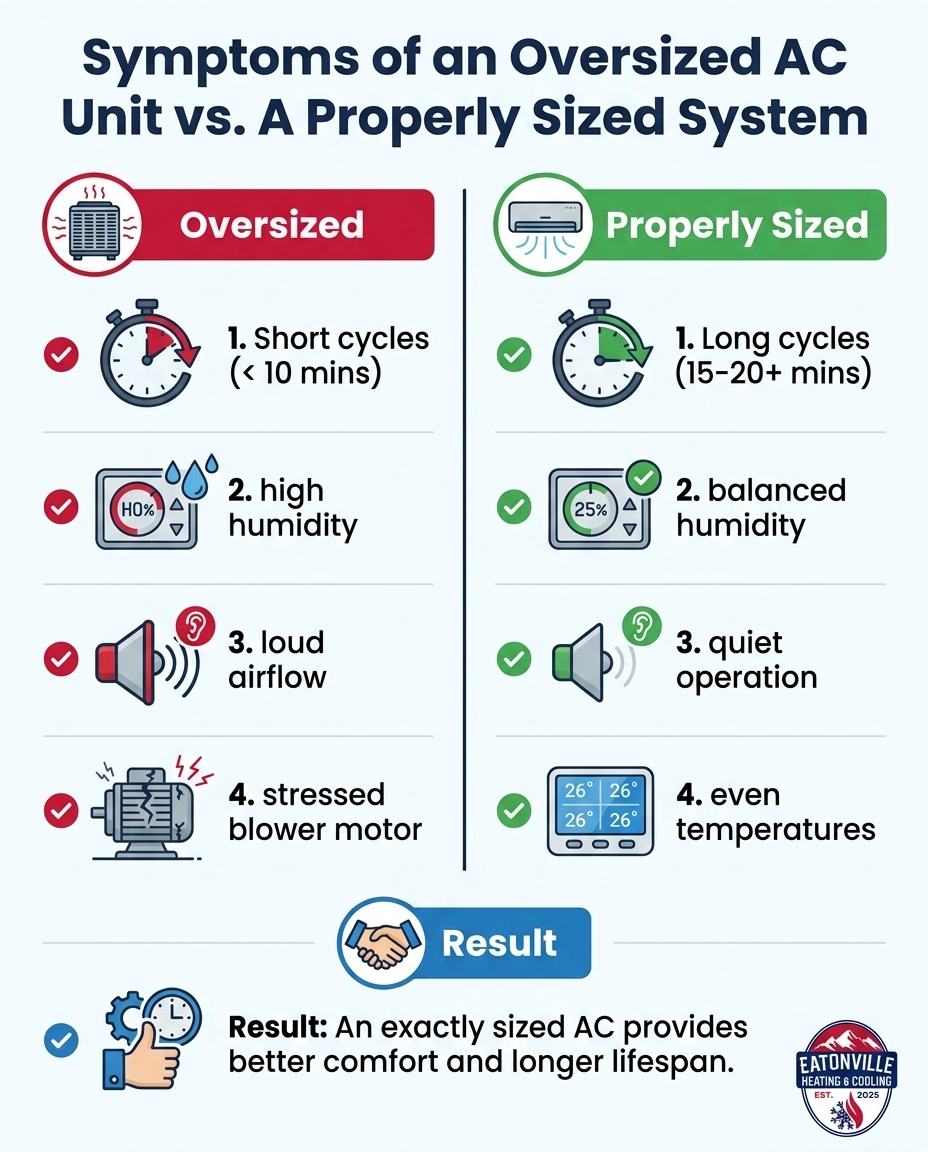
When you install an oversized air conditioner, it has an immense amount of sensible cooling power. It blasts cold air into the house and satisfies the thermostat's temperature setting very quickly—often in under ten minutes. Once the thermostat registers the target temperature, it shuts the system down. This rapid on-and-off process is known as short-cycling.
The problem is that an air conditioner needs to run continuously for at least 15 to 20 minutes just to begin effective moisture extraction. The indoor evaporator coil must get cold and stay cold long enough for the humidity in your air to condense into water droplets and drain away. When the system shuts off after only eight minutes, that moisture stays inside your home.
The result is a "cold and clammy" indoor environment. The air is chilled, but because the system never ran long enough to extract the moisture, you are left dealing with high indoor humidity levels during short-cycling. You might find yourself constantly lowering the thermostat to try and feel comfortable, which only forces the oversized unit to short-cycle even more frequently.
How Standard Ductwork Chokes an Oversized Air Conditioner
The mismatch between a large air conditioner and standard subdivision architecture goes far beyond temperature control. It fundamentally disrupts the mechanical airflow of your house. When we inspect standard Lacey tract homes, our technicians consistently find ductwork sized for a very specific airflow capacity, measured in Cubic Feet per Minute (CFM).
The Airflow Bottleneck: Think of your ductwork as the lungs of your home. If a house was originally designed for a 3-ton air conditioner, the sheet metal and flexible ducts in the walls and attic were sized to handle roughly 1,200 CFM of air. If you upgrade to a 4-ton unit, that new system is trying to push 1,600 CFM of air through the exact same pipes.
Rising Static Pressure: When a larger AC attempts to force excess air through undersized ducts, it creates severe static pressure. This is identical to trying to breathe heavily through a small cocktail straw. The air has nowhere to go, so it backs up against the equipment.
Mechanical Strain: This increased pressure puts immense strain on the blower motor. The motor has to work twice as hard to push the air through the restrictive ducts. You will notice this immediately as excessive noise—the vents will sound like a jet engine is taking off every time the system cycles on. Furthermore, the air will rush past the registers so quickly that it fails to mix properly with the room air, leaving you with poor circulation.
This continuous, daily strain is a primary driver for premature system breakdowns that our repair teams see all summer long. The blower motor overheats, the compressor takes on excess wear, and homeowners end up paying for frequent AC repairs long before the system should technically reach the end of its lifespan.
Comparing the True Costs: Oversized vs. Properly Sized Systems
Homeowners often justify the expense of a larger unit by assuming it will cool the house faster and run less often, thereby saving money. The reality is the exact opposite. Our installation crews have seen firsthand how an oversized system drains your wallet in multiple hidden ways over its shortened lifespan.
To fully understand the financial impact, let's look at a direct comparison between an oversized unit and a system that is engineered to match the home's exact footprint.
• Upfront Equipment Costs — Oversized Air Conditioner: Higher initial purchase price for the larger tonnage unit. — Properly Sized Air Conditioner: Lower base cost, allowing you to invest in a higher-efficiency model instead.
• Electrical Consumption — Oversized Air Conditioner: High energy usage due to constant starting and stopping (startup spikes draw the most power). — Properly Sized Air Conditioner: Lower energy usage through long, steady, low-power cooling cycles.
• System Lifespan — Oversized Air Conditioner: Accelerated wear and tear on the compressor significantly reduces overall lifespan. — Properly Sized Air Conditioner: Normal wear and tear allows the system to reach its full expected lifespan.
• Indoor Air Quality — Oversized Air Conditioner: Poor moisture control leading to potential mold growth in dark, damp ductwork. — Properly Sized Air Conditioner: Excellent moisture extraction, keeping the home dry and inhospitable to mold.
Understanding the Financial Drain of Short-Cycling
The most significant hidden cost comes from electrical consumption. Air conditioners consume massive amounts of electricity during startup—often three to five times more power than they use while running steadily. Because an oversized unit short-cycles, it goes through this high-draw startup phase dozens of times a day. A properly sized unit turns on, stays on, and efficiently maintains the temperature using far less electricity.
Furthermore, the high indoor humidity levels during short-cycling force your system to work in a damp environment. Over time, this unmanaged moisture can lead to biological growth inside your vents, creating indoor air quality issues that are expensive to remediate. Conversely, choosing a properly sized, high-efficiency unit often opens the door to financial benefits; for instance, federal tax credits or local utility incentive programs may apply to qualifying AC installations. We always advise our customers to verify current programs with their utility or a tax professional. If you are unsure about your home's requirements, learning what size air conditioner you really need is the best way to avoid these hidden traps.
Solving Uneven Cooling Without Adding More Tonnage
If upsizing is not the answer, how do you fix the hot spots in your home? The truth is that uneven temperatures across different rooms are usually the real reason homeowners assume they need a bigger AC. The upstairs is sweltering, the basement is freezing, and the living room is just okay. In our experience, this is almost always an airflow and distribution problem, not a capacity problem.
Recently, our team was contacted by a local homeowner because their home comfort level was not maintained across different areas of the house. Rather than simply dropping in a larger, oversized central unit that would short-cycle, we designed and installed a 6-zone dual system. This setup precisely controlled the temperature in each specific area. The outcome was a completely transformed home where every single room stayed perfectly controlled, without wasting energy over-cooling unoccupied spaces.
Targeted solutions address the root cause of the discomfort in Lacey tract homes. Here are a few ways we solve hot spots without upsizing:
• Zoning Systems: Motorized dampers are installed in your ductwork, allowing a central thermostat system to direct cold air only to the rooms that actually need it.
• Duct Modifications: Sometimes, simply enlarging a return air vent or adjusting the supply trunks can balance the airflow and eliminate hot spots.
• Multi-Zone Mini-Splits: Adding a ductless unit to a stubborn upstairs master bedroom provides targeted cooling without disrupting the main central system.
Properly designed systems run longer, gentler cycles. This strategy is vastly superior for both the mechanical health of the equipment and the overall comfort of the home. Keeping up with routine AC service ensures these targeted systems continue to operate at peak performance.
Why Professional Load Calculations Protect Your Investment
The only accurate way to determine the correct size for a new air conditioner is through an ACCA Manual J residential load calculation. This is a precise engineering formula that measures exactly how much heat your home gains during the day and how much cooling power is required to remove it.
Contractors who guess based on "rules of thumb" or who automatically upsize your unit based on square footage alone are doing you a disservice. A proper load calculation takes the guesswork out of the equation. At Eatonville Heating & Cooling, we rely on precise load calculations to match the specific floor plan of your home, prioritizing your actual daily comfort over simply selling you the highest-tonnage unit available.
A professional Manual J load calculation measures several critical factors to ensure your system can handle the July peak summer heat:
• Exact Square Footage and Volume: Measuring not just the floor space, but the cubic volume of air in rooms with vaulted ceilings.
• Window Orientation and Type: Accounting for south-facing and west-facing windows that let in massive amounts of solar heat during the late afternoon.
• Insulation Levels: Evaluating the R-value of your attic, walls, and crawlspace to see how well the home retains its conditioned air.
• Duct Sizing and Layout: Ensuring the existing ductwork can handle the precise CFM output of the proposed equipment without increasing static pressure.
• Occupancy and Heat Generating Appliances: Factoring in the number of people living in the home and the heat generated by kitchens and electronics.
By matching the system to the home's exact thermal footprint, you guarantee optimal dehumidification, lower energy bills, and a long, healthy lifespan for your equipment.
Frequently Asked Questions About AC Sizing and Indoor Humidity
Why does my house feel humid with the AC on?
As we frequently explain to our customers, the system is likely short-cycling. When an air conditioner is too large for the space, it cools the air too quickly and shuts off before it can extract moisture. Because the system does not run long enough to condense the water vapor on the evaporator coil, the humidity remains trapped inside your home, leaving you feeling cold and clammy.
What are the signs of an oversized air conditioner?
Frequent on/off cycles (running for less than 10 minutes at a time) are the most obvious warning sign. You may also experience high indoor humidity, uneven temperatures between different rooms, and unusually loud airflow rushing from your vents. Over time, you might also notice your utility bills creeping up due to the constant electrical spikes from the system starting and stopping.
Is it better to oversize an air conditioner?
No. Oversizing leads to poor moisture control, higher energy bills, and premature system failure. A properly sized unit that runs continuously during the hottest parts of the day is vastly superior for your comfort and your wallet. In our experience, the "bigger is better" mindset is a myth that only results in expensive mechanical strain.
What happens if my AC is too big for my house?
It will force too much air through standard ductwork, stressing the blower motor and failing to dehumidify the space. The increased static pressure causes the system to overheat and wear out years before it should. Additionally, the short cooling cycles will leave some rooms freezing while others remain uncomfortably warm.
How long should an AC run to remove humidity?
A properly sized system should run in continuous cycles of 15 to 20 minutes or more during peak heat to effectively manage moisture. The indoor coil needs this sustained time to get cold enough to pull water vapor out of the air. If your system runs for less than 15 minutes on a hot afternoon, it is not effectively dehumidifying your home.
Secure the Right Fit for Your Home's Cooling Needs
True comfort comes from a system engineered for your specific home, not just raw power. As our team has seen time and time again, the hidden costs of upsizing your AC unit in a Lacey tract home range from high indoor humidity to premature compressor failure. Standard subdivision ductwork simply cannot handle the excessive airflow of an oversized unit, and the resulting short-cycling will leave you cold, clammy, and frustrated.
Before you replace your struggling unit, insist on a proper load calculation rather than guessing or upgrading the tonnage by default. A system matched exactly to your home's thermal footprint will run quieter, last longer, and finally eliminate those stubborn hot spots. We invite you to consult with our Eatonville Heating & Cooling experts to evaluate your current system's performance and explore air conditioning solutions that prioritize your long-term comfort and peace of mind.
Recent Posts
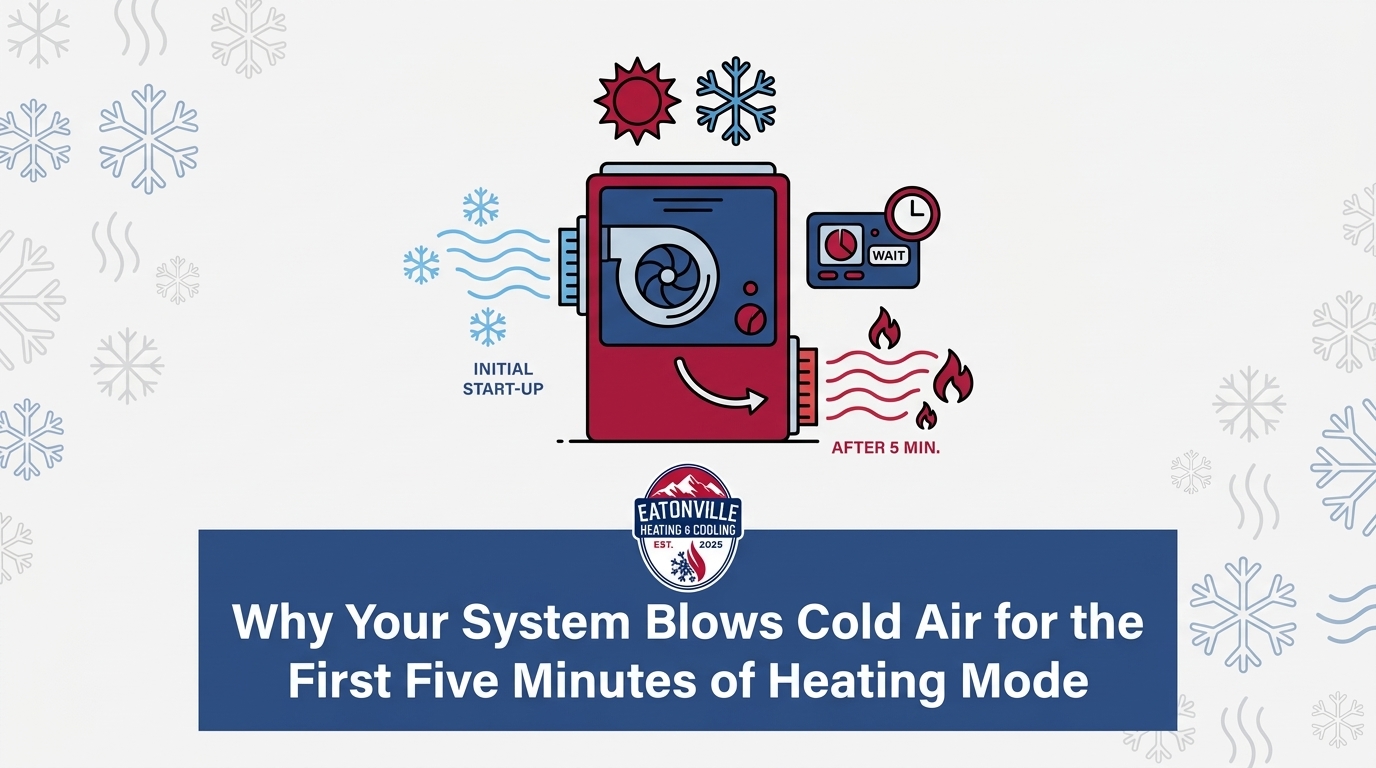
Why Your System Blows Cold Air for the First Five Minutes of Heating Mode
Turning on your furnace on a chilly fall morning only to feel a freezing breeze is stressful. Find out if that initial blast of cold air is normal or a sign of trouble.
Evaluating Dual-Fuel Systems vs Standard Heat Pumps for Auburn Winters
Sub-freezing overnight temperatures force electric heat pumps to work harder. Explore the efficiency tipping point between standard electric and dual-fuel gas backups to choose the right system.
Upgrading Crawlspace Insulation in Lacey Before Heating Season Begins
Don't let your furnace work overtime just to heat the damp air beneath your floorboards. Upgrading your crawlspace insulation stops hidden heat loss and keeps your living room warm all winter long.
Planning Your Pre-Winter HVAC Tune-Up Schedule in Eatonville
The first fall freeze always triggers a scheduling panic for heating repairs. Booking your maintenance in September guarantees priority service when temperatures drop.
Planning Your Pre-Winter HVAC Tune-Up Schedule in Eatonville
The first fall freeze always triggers a scheduling panic for heating repairs. Booking your maintenance in September guarantees priority service when temperatures drop.
Securing Your AC Condenser Against Falling Leaves and Autumn Debris
Wet September leaves can trap moisture inside your outdoor base pan, causing rust and restricted airflow. See how clearing this debris protects your winter heating cycle.