


How Ductless Mini Splits Handle Pacific Northwest Heat Dome Events
When the Heat Dome Hits: What Eatonville Homeowners Need to Know About Ductless Cooling Understanding how ductless mini splits handle pacific northwest heat dome events starts with one hard fact: the region is no longer
When the Heat Dome Hits: What Eatonville Homeowners Need to Know About Ductless Cooling
Understanding how ductless mini splits handle pacific northwest heat dome events starts with one hard fact: the region is no longer the mild-summer paradise it once was. In June 2021, Portland hit a record-breaking 116°F, Seattle reached 108°F, and Bellingham topped out at 99°F — temperatures that exposed just how unprepared most Pacific Northwest homes were. Many of those homes had no cooling at all. Others had systems that simply couldn't keep up. For Eatonville homeowners and families across the South Sound, that event was a wake-up call.
Here's a quick summary of how ductless mini-splits perform during extreme heat events:
Cooling capacityEfficiency ratingEnergy lossInstallation speedZone controlAir qualityNoise levelUnlike window units or portable coolers — which cool only a small slice of your home — ductless mini-splits deliver whole-room, zoned comfort without tearing apart your walls or running expensive ductwork. And because they operate as heat pumps year-round, they handle PNW winters just as effectively as summer heat waves.
I'm Matthew Percy, owner of Eatonville Heating & Cooling, and after years of installing and servicing ductless systems across Western Washington, I've seen how the right mini-split setup makes the difference between a safe, cool home and a dangerous one when the next heat dome arrives. In this guide, I'll walk you through everything you need to know about how ductless mini splits handle pacific northwest heat dome events — from the technology behind them to installation, air quality, and long-term performance.
The Science of Extreme Heat: How Ductless Mini Splits Handle Pacific Northwest Heat Dome Events
When outdoor temperatures soar past 100°F during a heat dome, traditional air conditioners face a brutal battle. Standard central AC systems operate on a simple binary: they are either 100% on or 100% off. When your thermostat calls for cooling, the compressor roars to life at maximum capacity, runs until the target temperature is met, and then shuts down. During a heat wave, this constant on-and-off cycling creates massive energy spikes, strains your electrical panel, and wears down key components.
Ductless mini-splits handle extreme heat completely differently. At the heart of a modern mini-split is inverter-driven compressor technology. Think of an inverter compressor like a modern vehicle on cruise control. Instead of stopping and starting at every intersection, it gently modulates its speed up or down to match the exact cooling load of the room. When a heat dome event begins, the mini-split ramps up to bring the room to your desired temperature, then drops down to a low-speed, continuous purr to maintain that temperature.
This continuous operation offers several massive advantages in extreme weather:
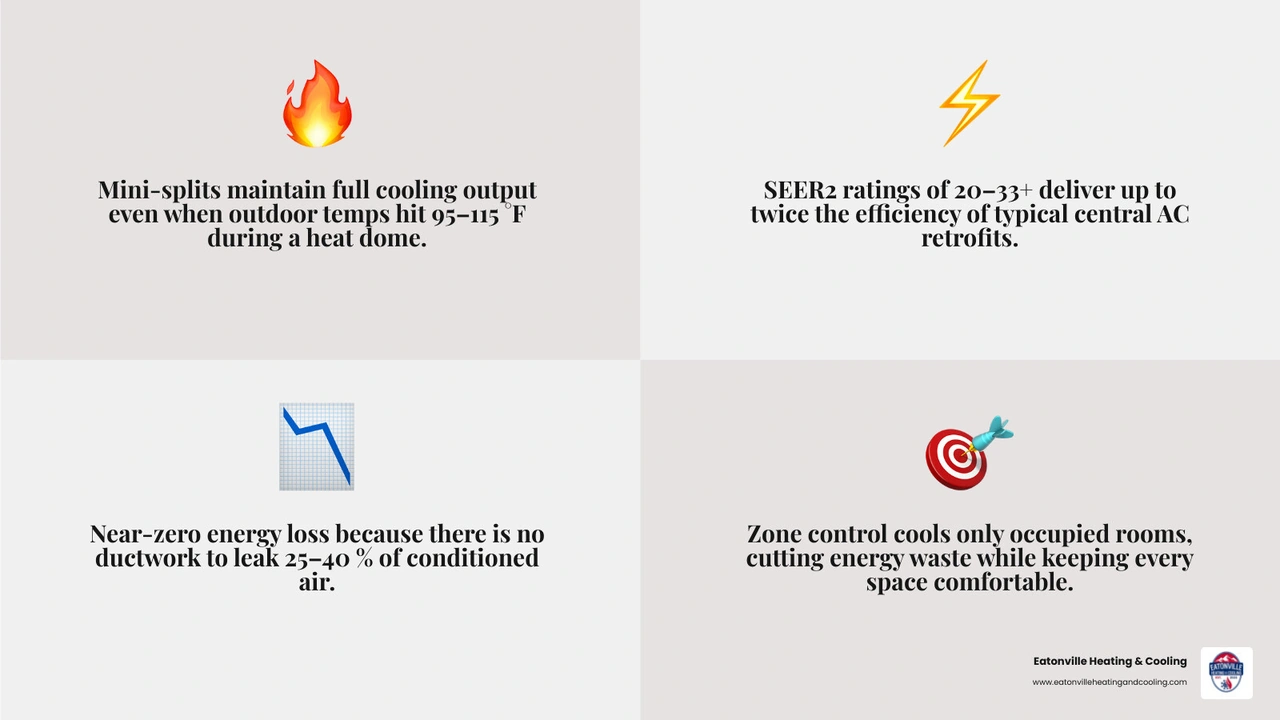
• Unparalleled Efficiency: Because they don't have to constantly restart, mini-splits achieve incredible Seasonal Energy Efficiency Ratio 2 (SEER2) ratings, often ranging from 20 to 33+. Traditional central AC retrofits typically hover between 13 and 16 SEER2.
• Zero Distribution Loss: According to the Department of Energy, traditional ducted systems lose 25% to 40% of their conditioned air through duct leakage, especially when those ducts run through blistering hot attics or crawlspaces. Ductless systems deliver 100% of the cold air directly into your living space because there are no ducts to leak.
• Extended Operational Thresholds: While cheap portable units and older AC systems begin to fail or "derate" once temperatures pass 95°F, high-efficiency mini-splits are designed to maintain full cooling capacity at outdoor temperatures up to 115°F or higher.
As Western Washington summers transition from historically mild to increasingly extreme, selecting a system that won't buckle under pressure is essential. You can read more about this shift in our detailed guide on How the Transition from Mild to Heat Dome Summers Affects Which HVAC System is Right for Your Home.
Retrofitting Older Eatonville Homes Without Invasive Ductwork
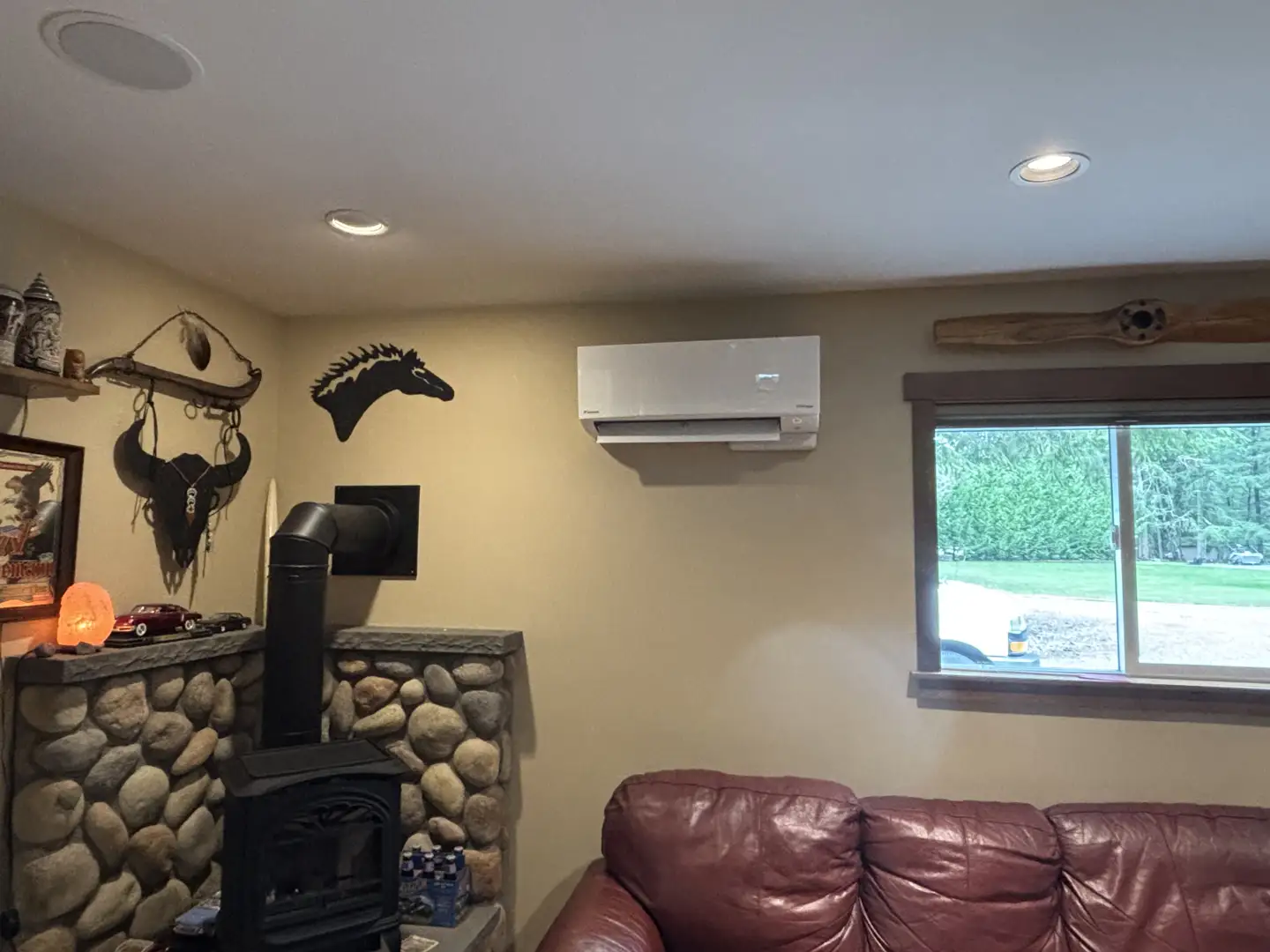
Many of the most beautiful homes in our local service areas — whether it's a 1920s Craftsman in Tacoma, a mid-century ranch in Puyallup, or a classic farmhouse in Eatonville — share a common challenge: they were built long before central air conditioning was standard. These homes typically rely on baseboard heaters, wall heaters, or radiant hydronic systems, meaning they completely lack existing ductwork.
Trying to retrofit a traditional central HVAC system into a vintage home is often an invasive, destructive, and costly nightmare. It requires sacrificing precious closet space, building unsightly drywall soffits to hide bulky duct runs, and cutting through historic lath and plaster walls.
Ductless mini-splits completely bypass these structural challenges. Instead of massive metal ducts, a mini-split relies on a small refrigerant line set, a condensate drain, and power cables to connect the outdoor condenser to the indoor air handlers.
Here is why they are the perfect fit for older South Sound homes:
1. The 3-Inch Solution: All of the necessary connections between the indoor and outdoor units pass through a single, small 3-inch hole drilled in an exterior wall. This preserves the architectural integrity of your home, with zero need for major drywall demolition or reconstruction.
2. Flexible Mounting Options: Indoor air handlers aren't limited to high wall mounts. We can install floor-mounted consoles (which look great replacing old baseboard heaters), ceiling cassettes that sit flush with the ceiling, or slim-duct units hidden in small attic spaces.
3. Rapid Installation Timeline: While retrofitting central ductwork can keep your home under construction for one to two weeks, a multi-zone ductless system can typically be installed in just one to three days. A single-zone system often takes our technicians only four to eight hours to fully commission.
If you are weighing your options for an older home, you'll want to read our article, Are Mini Splits More Efficient Than Adding Ductwork to an Older PNW Home.
When you're ready to move forward, it's also helpful to understand the step-by-step process of how we handle these projects locally. Check out our breakdown on How is a Ductless Mini Split Installed Step by Step in Western Washington. And if you are wondering about the legalities and building codes in Pierce or Thurston County, we've got you covered with our guide: Do You Need a Permit to Install a Mini Split in Washington State.
Year-Round Performance: From Summer Heat Waves to Freezing Winters
While we talk a lot about heat domes, Western Washington is famous for its unpredictable weather swings. We can experience a 90°F heat wave in August, followed by a damp, freezing cold snap in January. A ductless mini-split is not a single-season appliance; it is a highly advanced, year-round heat pump.
During the summer, the system works by absorbing heat from your indoor air and releasing it outside. In the winter, the process reverses. The outdoor unit extracts ambient heat energy from the cold outdoor air — yes, even when it feels freezing outside, there is still heat energy present — compresses it to raise its temperature, and transfers it indoors.
Modern cold-climate ductless heat pumps are incredibly resilient. High-performance models can maintain 80% to 100% of their heating capacity at temperatures as low as -15°F, which is well below the typical winter lows we experience in Eatonville, Graham, or Spanaway.
Multi-Zone Control: Comfort Only Where You Need It
One of the greatest features of a ductless layout is zone control. In a traditional ducted home, a single thermostat in the hallway dictates the temperature for the entire house. If your upstairs bedrooms are sweltering but your basement is freezing, a central system will keep running, wasting energy to cool spaces that don't need it.
With a multi-zone ductless system, each indoor air handler operates on its own independent thermostat. During a heat dome event, you can set your active living spaces to a comfortable 72°F during the day while keeping unoccupied guest rooms or your home office turned off. At night, you can shift the cooling focus entirely to the bedrooms. This targeted zoning can reduce your cooling energy consumption by 25% to 40% compared to cooling an entire house with central air.
To help you visualize how these systems stack up against traditional options, here is a direct comparison:
Primary DistributionEnergy Waste (Duct Loss)Zoning CapabilitiesAverage Sound LevelsWinter Heating EfficiencyAesthetic PreservationIf you are planning an upgrade in our home base of Eatonville, make sure to read our comprehensive Heat Pump Installation Eatonville WA Guide and our local expert resource, the Best Heat Pump Installation Eatonville Guide.
Managing Wildfire Smoke and Indoor Air Quality in the South Sound
In the Pacific Northwest, heat dome events and summer heat waves are increasingly accompanied by another environmental challenge: wildfire smoke. When dry, hot east winds push smoke from the Cascades into the Puget Sound basin, indoor air quality (IAQ) becomes a critical health concern.
During a wildfire smoke event, opening your windows for a "cool breeze" is not an option. You must keep your home sealed tight. However, sealing your home without proper filtration can trap indoor pollutants, pet dander, and cooking fumes, creating a stagnant, unhealthy environment.
Ductless mini-splits are equipped with robust, multi-stage filtration systems built directly into each indoor unit. Most quality mini-splits feature:
• Catechin/Anti-Allergen Filters: These pre-filters trap larger particles like dust, pet hair, and pollen.
• Enzyme Filters: Advanced secondary filters designed to capture and neutralize microscopic allergens, mold spores, and bacteria.
• Active Carbon Filters: These help absorb the chemical odors and VOCs associated with wildfire smoke.
Because mini-splits recirculate and continuously filter the air within each specific zone, they capture fine particulate matter (PM2.5) down to 0.3 microns. This localized filtration prevents smoke particles from migrating throughout your home.
Maintaining Your Filters in Our Unique Climate
While these filters are highly effective, they require regular attention — especially in our damp Western Washington climate. The South Sound's high humidity means that moisture can settle on dirty filters if they aren't maintained, potentially leading to musty odors. During a heavy wildfire smoke event, filters can load up with ash and fine particulates in a matter of days.
To keep your air clean and your system running efficiently, we recommend checking and washing your mini-split filters every two to four weeks during high-use summer months.
For a deeper dive into protecting your home's air during smoke season, read our guide on How High MERV Media Filters Reduce Wildfire Smoke Particles in a Pacific Northwest Home. To establish a perfect maintenance routine for our maritime climate, refer to our localized article: How Often to Clean Mini Split Filters in a Damp South Sound Environment.
Troubleshooting and Maintaining Your Mini-Split During Peak Summer
When a heat dome is forecast to bring triple-digit weather to Western Washington, you want to make sure your cooling system is fully prepared. The middle of a 105°F heat wave is the worst possible time to discover a system issue.
Here is a quick checklist to prepare your ductless system for peak summer:
• Clear the Outdoor Condenser: Ensure there are at least two feet of clear space around your outdoor unit. Clear away grass clippings, weeds, fallen leaves, and blackberry vines. The outdoor unit needs unrestricted airflow to dump the heat it extracts from your home.
• Wash the Indoor Filters: Dirty filters restrict airflow, forcing the system to work harder and reducing its cooling capacity. Wash them in warm water, let them air dry completely, and reinstall them.
• Inspect the Condensate Drain: Ensure the outdoor drain line is dripping water when the system is cooling. A clogged drain line can cause water to back up and drip from your indoor unit.
Warning Signs of Trouble
If your system is struggling, pay attention to the warning signs. A grinding, rattling, or squealing noise from either the indoor or outdoor unit is a clear indicator of mechanical stress or a failing fan motor. Similarly, if your system is running constantly but only blowing lukewarm air, you could be dealing with a refrigerant leak or a failing compressor.
If your system isn't keeping you cool, don't panic. Start by checking the basics using our guide: Heat Pump Not Cooling in Summer What to Check First in Western Washington. If your system is making strange noises, you can diagnose the issue with our troubleshooting resource: Heat Pump Making Grinding or Rattling Noise What it Means.
Frequently Asked Questions About PNW Mini-Splits
How do ductless mini splits handle pacific northwest heat dome events compared to central AC?
Ductless mini-splits handle extreme heat dome events far more efficiently than traditional central AC. Because they use inverter-driven compressors, they continuously modulate their cooling output to match the room's needs rather than cycling on and off. Additionally, they eliminate the 25% to 40% energy loss associated with leaky ductwork, delivering 100% of the cold air directly into your living spaces. With SEER2 ratings up to 33+, they consume significantly less electricity during extreme weather.
Do I need a backup heating system for extreme Washington winters?
For most homes in Western Washington, a modern cold-climate ductless mini-split is fully capable of serving as the sole heating source. High-performance models maintain excellent heating capacity down to -15°F, which is far colder than our typical South Sound winter lows. However, if you have existing baseboard heaters or a wood stove, keeping them as a secondary backup for extreme historical cold snaps or power outages is a smart, practical strategy.
Why is professional installation crucial for how ductless mini splits handle pacific northwest heat dome events?
Proper sizing and precision commissioning are critical to extreme weather performance. If a mini-split is undersized, it will run constantly without ever cooling your home during a heat dome. If it is oversized, it will short-cycle, failing to properly dehumidify your air. A professional installation ensures correct refrigerant charge, proper line set routing, dedicated electrical circuits, and full protection of your manufacturer's warranty.
Conclusion
As our summers continue to bring unpredictable heat waves and wildfire smoke, investing in a reliable cooling solution is no longer a luxury — it is a matter of safety and home comfort. Ductless mini-splits have proven to be the most efficient, non-invasive, and high-performing systems for handling the unique climate challenges of the Pacific Northwest.
At Eatonville Heating & Cooling, we are a family-owned, community-focused team. We live and work right here in the South Sound, serving our neighbors in Eatonville, Puyallup, Tacoma, Gig Harbor, Olympia, and the surrounding areas. We take pride in delivering honest advice, high-quality craftsmanship, and personalized comfort solutions that keep your family safe through every season.
If you are ready to explore how a ductless system can transform your home's comfort, contact us today to learn more about our professional Heat Pump Services. Let's make sure your home is ready for whatever weather the Pacific Northwest throws our way next!
Recent Posts

Adapting Yelm Wood-Framed Homes for Modern Central Air
Adding central air to an older wood-framed home takes careful planning. See how attic framing, ductwork and wiring shape a safe, effective upgrade.
Differentiating Between Normal Expansion Noises and Furnace Failure
Hearing a loud bang on the first chilly fall morning can be terrifying. Decide with confidence whether to let the system run or shut it down for emergency service.
How Federal Way's Fall Humidity Affects Indoor Air Quality
The transition to damp autumn weather creates a tricky shoulder season for your HVAC system. Without the AC running, ambient moisture gets trapped inside. See how to manage ventilation.
Deciding Between a Modulating and Two-Stage Furnace for Lacey Climates
Upgrading your heating system before the damp winter hits? Find out whether the precise comfort of a modulating unit or the reliability of a two-stage system fits your home.

What a Comprehensive Fall Furnace Inspection Actually Entails
A professional heating tune-up requires much more than a basic filter change. We pull back the curtain on the exact electrical and combustion tests that prevent winter breakdowns.
Repurposing Old AC Pads When Upgrading to a New Heat Pump
Preparing for a fall system upgrade? Reusing a sunken 1990s concrete base can cause poor drainage and oil starvation for modern equipment—see why leveling matters.