


How to Assess Repair vs Replace for Your 15 Year Old AC
Is a 15 Year Old AC Worth Fixing in a South Sound Home? Here's What to Know First Is a 15 year old ac worth fixing in a south sound home? In most cases, the honest answer is: it depends — but the odds are not in you
Is a 15 Year Old AC Worth Fixing in a South Sound Home? Here's What to Know First
Is a 15 year old ac worth fixing in a south sound home? In most cases, the honest answer is: it depends — but the odds are not in your favor.
Here's a quick breakdown to help you decide:
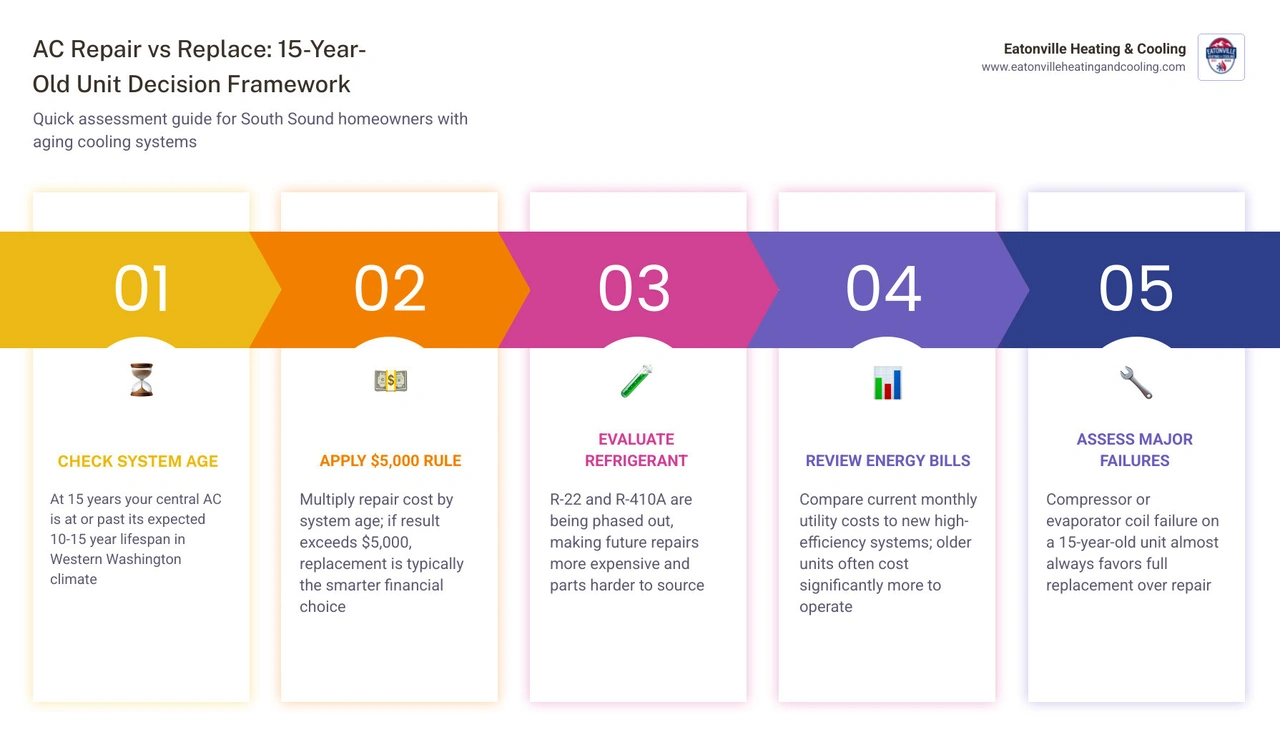
• Age alone is a red flag. The average central AC lasts 10–15 years. At 15, your system is at or past its expected lifespan.
• Apply the $5,000 Rule. Multiply the repair cost by your system's age in years. If the result exceeds $5,000, replacement is usually the smarter move.
• Refrigerant matters. If your unit uses R-22 (Freon) or even R-410A, repairs are becoming more expensive as both refrigerants are being phased out.
• Check your energy bills. A 15-year-old system may be running at significantly lower efficiency than when it was new, costing you more every month.
• One major breakdown is often the tipping point. A compressor or evaporator coil failure on a 15-year-old unit almost always favors replacement over repair.
The South Sound region — including communities like Eatonville, Graham, and Orting — has milder summers than much of the country. That can actually work against you, because aging systems often limp along unnoticed until the first real heat wave hits and they quit entirely.
I'm Matthew Percy, owner of Eatonville Heating & Cooling, and after years of helping South Sound homeowners navigate exactly this question — is a 15 year old ac worth fixing in a south sound home — I can tell you there's a clear, honest way to think through it. The sections below walk you through every factor you need to make a confident decision.
Understanding the Lifespan of PNW Cooling Systems
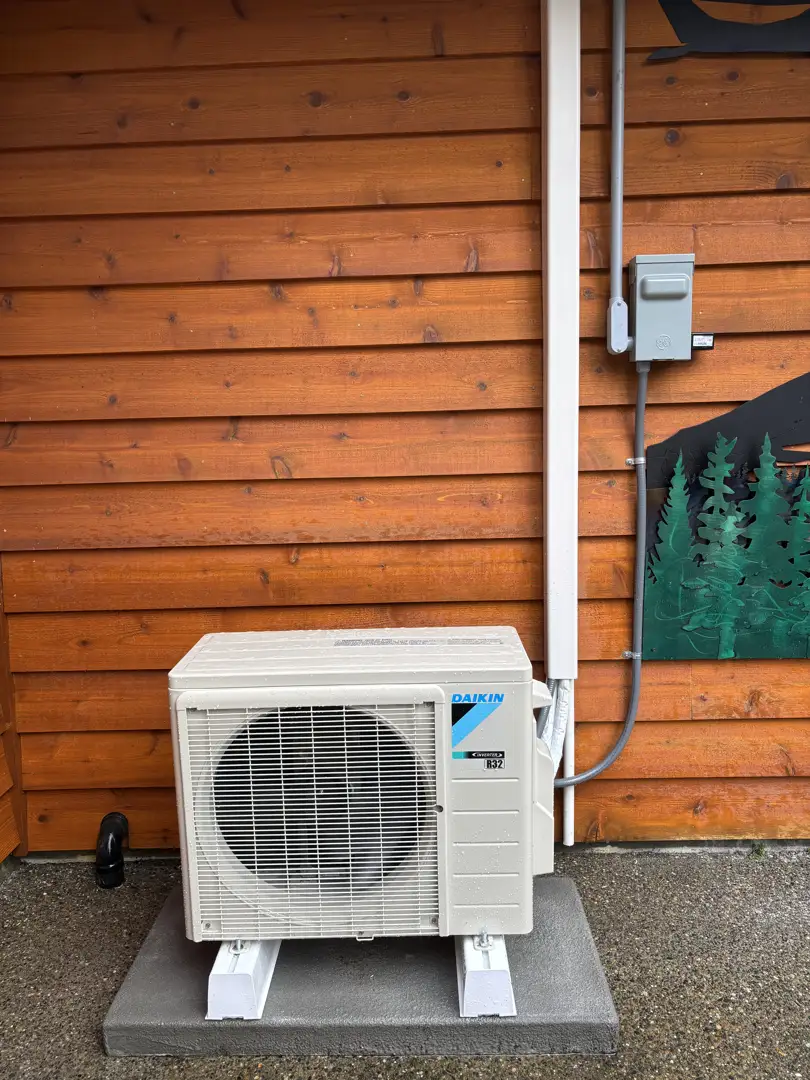
When evaluating whether your air conditioner has reached the end of its road, it helps to understand how long these systems typically last. Across the country, the average central air conditioner has a functional lifespan of 10 to 15 years. Under absolutely perfect conditions—with flawless annual maintenance and a mild climate—some modern systems can reach 15 to 20 years. However, older units often hit a functional wall much sooner, with major components beginning to degrade rapidly after the decade mark.
In our experience, a 15-year-old system is firmly in its "retirement years." While it may still turn on and blow cool air, the internal components have suffered a decade and a half of physical wear. Over time, electrical connections loosen, motors lose their lubrication, and coils experience microscopic corrosion.
To get a better idea of how age affects systems locally, you can read more about the Average Lifespan of a Central Air Conditioner in Western Washington.
How the Western Washington Climate Affects Longevity
Here in the South Sound, our weather patterns create a unique environment for outdoor HVAC equipment. Unlike the desert Southwest or the humid Southeast, where air conditioners run almost continuously for six months of the year, our cooling season is relatively short. Typically, we only experience heavy cooling loads for a few hundred hours a year, mostly between late June and early September.
While this lighter workload can prevent mechanical parts from wearing out as quickly as they would in hotter climates, our damp Pacific Northwest winters introduce a different set of challenges:
• Rust and Corrosion: Our persistent winter rain and high humidity levels mean outdoor condenser units sit in damp conditions for months on end. This moisture can lead to rust on the cabinet and corrosion of the delicate aluminum fins and copper coils.
• The "Idle" Factor: When an air conditioner sits completely idle from October through May, moisture can collect inside the electrical compartments. Pests like mice or spiders may also build nests inside the quiet cabinet, chewing through wiring or blocking airflow.
• Sudden Thermal Shock: When summer finally arrives and we hit a sudden heatwave, homeowners switch their long-dormant systems directly to "high." Running a cold, damp, unprimed system at maximum capacity after months of sitting idle puts immense strain on the compressor.
Without consistent upkeep, these environmental factors can quietly degrade your system from the inside out. For tips on how to combat these local climate effects, explore How Regular AC Maintenance Protects Your System and Your Budget.
Is a 15 Year Old AC Worth Fixing in a South Sound Home?
Deciding whether to sink money into a 15-year-old air conditioner or invest in a new system is one of the most common dilemmas we see in homes from Tacoma to Olympia. To help put this decision into perspective, we have put together a comparison table highlighting the key differences between keeping your old unit alive and upgrading to a modern system:
Expected LifespanWarranty CoverageEnergy EfficiencyRefrigerant TypeRepair FrequencyHome ComfortIf you are trying to weigh these factors for your own household, our detailed guide on how to Repair or Replace Your AC: How to Make the Right Call offers a step-by-step decision-making path.
Applying the $5,000 Rule: Is a 15 Year Old AC Worth Fixing in a South Sound Home?
In the HVAC industry, we use a simple, time-tested mathematical formula called the $5,000 Rule to help homeowners remove the emotion from this decision.
The rule is straightforward: Multiply the age of your air conditioning unit by the estimated repair cost. If the total exceeds $5,000, replacement is almost always the more cost-effective long-term choice.
Let's look at how this math works out for a 15-year-old system:
• Scenario A (Minor Repair): Your 15-year-old AC needs a new capacitor. If the repair is relatively inexpensive, you multiply 15 (years) by the minor repair cost. If the result is well under $5,000, it may make sense to complete the repair to buy yourself another season or two.
• Scenario B (Major Repair): Your 15-year-old AC has a failed compressor or a leaking evaporator coil. Because these are major, labor-intensive components, the repair estimate will be significant. When you multiply 15 (years) by a major repair estimate, the total will easily skyrocket past the $5,000 threshold.
When you cross that $5,000 mark, you are essentially throwing good money after bad. Sinking a significant sum into a system with expired warranties and aged components doesn't guarantee that another part won't fail next month. If you are currently facing a breakdown and want an honest diagnostic assessment, our team is ready to help with dependable AC Repair Eatonville WA.
Efficiency and Utility Bills: Is a 15 Year Old AC Worth Fixing in a South Sound Home?
Even if your 15-year-old air conditioner is still running without needing immediate repairs, it is likely costing you far more to operate than it should.
Air conditioning efficiency is measured by the Seasonal Energy Efficiency Ratio (SEER). Fifteen years ago, the standard minimum SEER rating for a new air conditioner was 13. Today, federal regional standards require a minimum of 14.3 SEER2 (which is roughly equivalent to 15 SEER), and high-efficiency systems can reach 20 SEER or higher.
Furthermore, as an air conditioner ages, its efficiency naturally degrades due to motor wear, coil buildup, and minor refrigerant loss. A system that started at 13 SEER fifteen years ago may only be operating at an effective 9 or 10 SEER today. This efficiency drop directly translates to higher monthly utility bills. Modern high-efficiency systems can reduce cooling energy consumption by 30% to 50% compared to older legacy units.
If you suspect your system is draining your wallet, check out our guide on How to Tell If Your Air Conditioner Is Costing You More Than It Should.
Warning Signs Your Aging Air Conditioner is Nearing Failure
An air conditioner rarely fails completely without giving off a few warning signs first. Recognizing these symptoms early allows you to plan for a replacement on your own terms, rather than waiting for an emergency breakdown during a sweltering July weekend in Puyallup or Lakewood.
If your system is running but failing to keep your home comfortable, start by reviewing AC Not Cooling But Running: What to Check First.
Performance Issues and Uneven Cooling
As an air conditioner approaches the end of its life, its ability to distribute cool air evenly throughout your home begins to diminish. You might notice:
• Weak Airflow: The blower motor may struggle to push air through your ductwork, leaving rooms furthest from the indoor unit warm and stuffy.
• Short Cycling: This occurs when the AC turns on and off every few minutes without ever completing a full cooling cycle. This constant starting and stopping puts extreme stress on the compressor and prevents the system from properly dehumidifying your home.
• Warm Air Blows from the Vents: If the compressor is failing or the refrigerant level is low, the air coming out of your registers may feel lukewarm instead of crisp and cold.
To dive deeper into these performance issues, check out The Most Common Reasons Your AC Isn't Keeping Your Home Cool.
Frequent Breakdowns and Mechanical Wear
If you find yourself calling an HVAC technician every summer for a new part, your system is trying to tell you it is ready to retire. Beyond electrical failures, physical signs of mechanical wear include:
• Frozen Coils: If you see ice forming on the outdoor refrigerant lines or the indoor evaporator coil, it is usually a sign of restricted airflow or a refrigerant leak. Learn more about this issue in Why Your AC Freezes Up and What You Can Do About It.
• Water Leaks: An aging system can develop cracked drain pans or clogged condensate lines, leading to water pooling around your indoor furnace or air handler. For step-by-step troubleshooting, read AC Leaking Water Inside the House: Causes and Fixes in a Western Washington Home.
• Strange Noises: Squealing, grinding, clanking, or banging sounds coming from your outdoor unit indicate that bearings are failing, the fan blade is unbalanced, or the internal valves of the compressor are damaged.
The Impact of Refrigerant Phase-Outs on Older Units
One of the most critical factors making a 15-year-old AC difficult and expensive to repair is the ongoing transition in the types of refrigerants used by the HVAC industry. Federal environmental regulations have fundamentally changed how older cooling systems must be serviced.
If you suspect your system has a refrigerant leak, it is essential to have a licensed professional inspect it. You can schedule a diagnostic visit through our AC Service Eatonville WA page.
The Transition from R-22 and R-410A Refrigerants
If your air conditioner was installed fifteen years ago, there is a very high probability that it operates on R-22 refrigerant (commonly known as Freon).
The Environmental Protection Agency (EPA) completely banned the production and import of R-22. Today, the only R-22 available to service older systems is reclaimed or recycled stock. Because the supply is extremely limited and continues to dwindle, the cost of R-22 has skyrocketed. Sinking money into recharging an R-22 system is rarely a wise investment, as a future leak will simply wash that expensive refrigerant away.
Even if your 15-year-old system is a slightly newer model that uses R-410A (Puron), you are still facing upcoming regulatory hurdles. Under the AIM Act, the EPA is actively phasing down the production of R-410A to make way for next-generation, lower-global-warming-potential (GWP) refrigerants like R-454B. As R-410A production decreases, its service costs will steadily rise over the coming years, making repairs on these units increasingly expensive as well.
Frequently Asked Questions About Aging AC Units
Should I replace my furnace and AC at the same time?
Yes, in most cases, we highly recommend replacing both units together if they are of a similar age. Your heating and cooling systems share the same indoor blower motor and ductwork. By installing a matched system, you ensure that both components are engineered to work together seamlessly, which maximizes energy efficiency, preserves manufacturer warranties, and saves you money on labor costs compared to splitting the installations apart.
How can I avoid a sudden AC breakdown during a summer heatwave?
The single best step you can take is to schedule a professional preventative maintenance tune-up in the spring before the hot weather arrives. During a tune-up, our technicians clean the coils, check refrigerant levels, test electrical components, and identify minor wear-and-tear issues before they escalate into major mid-summer failures. Additionally, remember to change your indoor air filter every 1 to 3 months to maintain proper system airflow.
What are the benefits of upgrading to a modern heat pump?
Upgrading to a modern heat pump is an exceptionally smart choice for South Sound homeowners. Unlike a traditional air conditioner, a heat pump provides both high-efficiency cooling in the summer and incredibly efficient heating during our long, cool winters. Heat pumps can heat your home for a fraction of the cost of electric zonal heat or older gas furnaces. Plus, upgrading to a heat pump often qualifies you for significant local utility rebates and federal tax credits.
Conclusion
At Eatonville Heating & Cooling, we believe in providing our neighbors throughout Pierce, Thurston, and South King counties with honest, pressure-free advice. We are a family-owned company, and our primary goal is to ensure your family stays safe and comfortable throughout every season.
If you are still staring at your outdoor unit wondering if it is time to say goodbye, let us help you run the math. We will perform a complete diagnostic check, give you a transparent assessment of your system's health, and walk you through your options with zero commission-driven sales tactics.
Ready to make the right call for your home's comfort? Read our comprehensive guide on how to Repair or Replace Your AC: How to Make the Right Call, or contact us today to schedule your professional system evaluation!
Recent Posts

Adapting Yelm Wood-Framed Homes for Modern Central Air
Adding central air to an older wood-framed home takes careful planning. See how attic framing, ductwork and wiring shape a safe, effective upgrade.
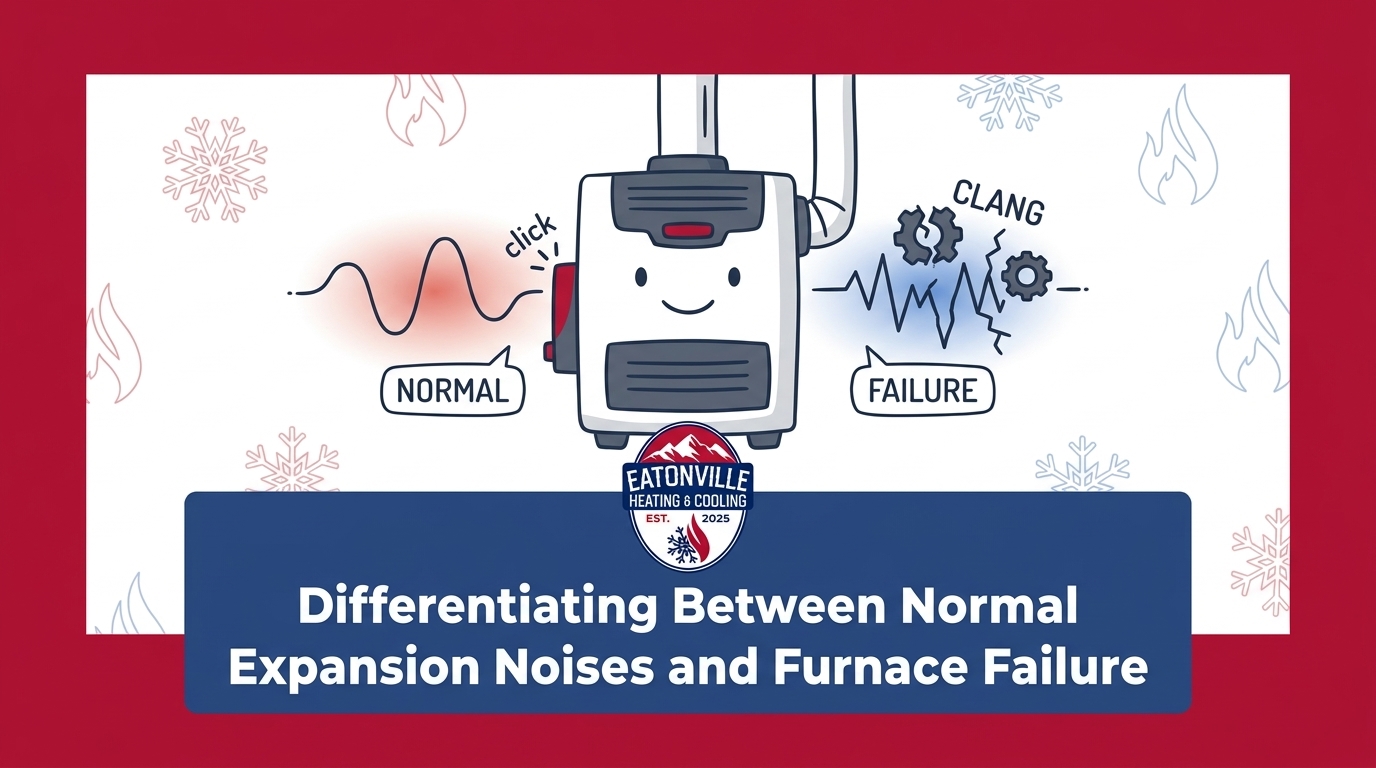
Differentiating Between Normal Expansion Noises and Furnace Failure
Hearing a loud bang on the first chilly fall morning can be terrifying. Decide with confidence whether to let the system run or shut it down for emergency service.
How Federal Way's Fall Humidity Affects Indoor Air Quality
The transition to damp autumn weather creates a tricky shoulder season for your HVAC system. Without the AC running, ambient moisture gets trapped inside. See how to manage ventilation.
Deciding Between a Modulating and Two-Stage Furnace for Lacey Climates
Upgrading your heating system before the damp winter hits? Find out whether the precise comfort of a modulating unit or the reliability of a two-stage system fits your home.
What a Comprehensive Fall Furnace Inspection Actually Entails
A professional heating tune-up requires much more than a basic filter change. We pull back the curtain on the exact electrical and combustion tests that prevent winter breakdowns.
Repurposing Old AC Pads When Upgrading to a New Heat Pump
Preparing for a fall system upgrade? Reusing a sunken 1990s concrete base can cause poor drainage and oil starvation for modern equipment—see why leveling matters.